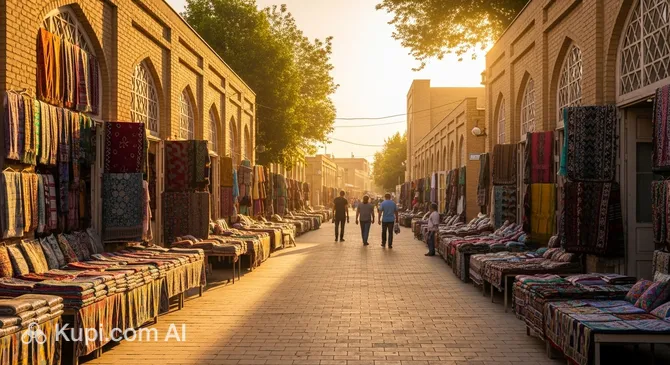
Margilan is one of the most amazing and ancient places in Uzbekistan, located in the heart of the fertile Fergana Valley. This city, which is over 2,000 years old, is rightfully considered the "silk heart" of Central Asia. Through the centuries, it has carried the fame of being a major production center for unique fabrics that once adorned the caravans of the Great Silk Road and were highly valued in Byzantium and Baghdad.
The city possesses its own unique, authentic atmosphere, where the modern pace of life harmoniously intertwines with centuries-old craftsmanship traditions. Exploring Margilan's rich history, you will find that the city still maintains its status as an industrial and cultural hub of the region today, attracting travelers not with the glitter of modern skyscrapers, but with the warmth of living traditions and the skill of its residents.
Margilan. Illustration.
Source: Kupi.com AI
With a population of over 240,000 people, Margilan remains a vibrant and energetic center where life bustles around noisy markets and family workshops. The city's main treasure is hand-weaving: it is here that the famous khan-atlas and adras fabrics are born. We invite you to plunge into the world of Oriental colors and crafts to see firsthand how the legendary Uzbek silk is created.
Weather Overview
Margilan is characterized by a pronounced continental climate, typical of the Fergana Valley. Summer here is long and hot: in July and August, the thermometer often rises above +35°C to 38°C. There is practically no precipitation during this time of year, and the air remains dry, which helps to tolerate the heat more easily if you stay in the shade or near water.
Winters in the region are moderately cold, with average temperatures around 0°C, although nighttime frosts down to -3°C are possible. The wettest period is spring, especially March and April, when the nature of the oasis comes to life and blooms. If you are planning a trip, be sure to check the current weather in Margilan to choose the right wardrobe.
The most favorable time to visit is considered to be the spring (April–May) and autumn (September–October) months. During these periods, mild, comfortable temperatures are established, ideal for visiting silk factories and long walks through colorful Oriental bazaars without the exhausting heat or winter chill.
Average monthly temperature
Average monthly precipitation
Interesting Facts
In 2007, the city officially celebrated its 2000th anniversary, a date confirmed by archaeological finds indicating developed irrigated agriculture in the region since ancient times.
According to one legend, the city's name comes from the phrase "Mo ar gilon", meaning "we are from Gilan"—it is believed that the city was founded by settlers from the Iranian province of the same name, famous for its silk farming.
The famous Yodgorlik factory is capable of producing up to 1,000 meters of fabric per day, while a significant part of the processes is still performed by hand on traditional looms.
As early as the 10th century, Margilan silk was known far beyond the region: it was exported to Greece, Baghdad, and Kashgaria, making the city an important link in world trade at that time.
Margilan is recognized as the main center for making khan-atlas—a fabric with a unique pattern created through complex multi-stage dyeing of threads even before weaving begins.
How to Get There
Margilan is characterized by good transport accessibility due to its proximity to the administrative center of the region. The neighboring Fergana serves as the main hub for travelers, from where you can reach Margilan by taxi or minibus in just 20–30 minutes. When choosing how best to get to Margilan, it's worth considering that during peak hours the journey may take a little longer due to heavy traffic between the cities.
For those arriving from afar, the most convenient option is a flight to Fergana International Airport. This aviation hub accepts regular flights from Tashkent and some international cities. After arrival, you can easily use transfer services or local taxi services to reach the center of Margilan.
While road transport carries the main load within Margilan itself, you can also reach this region from the capital on comfortable trains going to stations in Fergana or neighboring cities. This is a great way to enjoy the views of the Kamchik mountain pass. To move between the cities of the Fergana Valley, tourists most often choose private taxis or regular bus services.
Station
Passenger traffic
Distance
Margilan Railway Station
750 000
4 km
Фергана 1
1
10 km
Altyaryk Station
—
19 km
Quva Railway Station
—
31 km
Namangan Railway Station
900 000
58 km
Main Attractions
The main pride and key point of attraction for tourists is the Yodgorlik Silk Factory. This is a unique place where ancient technologies of manual silk production are carefully preserved. Visitors can not only see the entire process—from unwinding silkworm cocoons to dyeing threads with natural dyes—but also participate in master classes, watching how the shimmering khan-atlas is born on wooden looms.
The spiritual and architectural side of the city is represented by the Khonakoh Mosque. This historical building attracts attention with its traditional architecture and calm atmosphere, allowing visitors to feel the religious heritage of the Fergana Valley. The interior decoration and skillful wood carving bear witness to the high craftsmanship of local architects of past centuries.
No less interesting to visit are the central bazaars of Margilan. Although they are not museums in the conventional sense, it is here that you can find the best examples of silk products, chat with hereditary traders, and experience the authentic atmosphere of an Oriental market. The city squares and craft quarters surrounding the markets turn a walk into a fascinating immersion into the life of a modern artisanal center.
Local Cuisine
The gastronomic scene in Margilan is the quintessence of the Uzbek cuisine of the Fergana Valley. The first thing every guest should try is Fergana plov, which is prepared from a special variety of "devzira" rice that has a characteristic reddish tint. Local cuisine is famous for its abundance of fresh vegetables, fruits, and herbs grown in the fertile oasis of the valley.
It is impossible to imagine a visit to the city without tasting Margilan flatbreads (lepeshka) and aromatic samsa cooked in a tandoor. A traditional lunch often includes juicy shashlik, manti, or hearty lagman. Tea drinking holds a special place in the food culture: green tea is drunk everywhere—in workshops while working, in tea houses near markets, and when receiving guests.
For an authentic experience, we recommend visiting local tea houses located near the markets. A simple and friendly atmosphere prevails here, and the dishes are always fresh and prepared according to home recipes. For dessert, be sure to try the local honey and sweets, as well as the seasonal fruits that this region is so rich in.
Travel Tips
A trip to Margilan promises to be rich and colorful, and to make your journey as comfortable as possible, we have prepared a few practical tips.
Clothing and Dress Code: Choose clothing made from natural fabrics (ideally local cotton) to handle the heat more easily. Since the city is traditional, it is recommended to wear clothes that cover shoulders and knees when visiting mosques and residential neighborhoods.
Best Time to Visit: The ideal months are April, May, September, and October. During this time, the weather is most comfortable for walking and visiting open markets.
Getting Around Town: Use the Yandex Go app to call a taxi—it is reliable and eliminates the need to haggle with the driver.
Finance and Payment: Always carry cash in Sum. Cards are accepted very rarely, mainly only in large hotels in Fergana. Currency exchange is best done at banks.
Communication: The main language is Uzbek, but many residents understand Russian. English is not widely spoken, so a few phrases in the local language ("Assalomu alaykum" — hello, "Rakhmat" — thank you) will help you win people over.
Etiquette: Always ask for permission before taking photos of local residents or their workspaces in factories. Respect for the work of artisans is valued above all here.
Safety: The city is safe for tourists, but in the evening, it is better to stick to central lit streets and avoid unlit outskirts.
Health: During the summer period, be sure to drink bottled water and use sunscreen, as the sun in the valley is very active.
Margilan is a city that opens up to those who show a sincere interest in its traditions. By following these simple rules, you will make your visit pleasant and unforgettable!
Entertainment & Nightlife
Margilan is a city of strict traditions and hardworking craftsmen, so classic nightlife with clubs and noisy bars is practically non-existent here. Evening leisure for locals and guests usually centers around traditional tea houses (chaikhanas) and family gatherings. In these cozy establishments, you can slowly sip green tea, discuss the news, and enjoy watching football matches, which are very popular here.
For those looking for more active entertainment, such as cinemas or modern amusement parks, it is best to head to neighboring Fergana, located just a 15-minute drive away. Most of the region's entertainment infrastructure is concentrated there, including cafes with European cuisine and walking areas.
Daytime entertainment in Margilan itself is educational in nature and involves visiting workshops and markets. Safety in the city is high, and evening walks along the central lit streets are quite comfortable. For moving around late at night, it is recommended to use taxi apps, as public transport finishes work quite early.
Parks & Museums
Although Margilan is not rich in classic art galleries, the city itself can be called an open-air museum. The role of the main cultural institutions here is played by active silk-weaving centers. The Yodgorlik factory hosts exhibitions telling the story of the evolution of weaving art, where historical tools sit alongside modern product samples.
The Khonakoh complex is an architectural monument and cultural site. Visiting such ancient mosques and madrasas replaces a visit to a historical museum, as it is here that you can see traditional carvings and paintings and learn about the spiritual life of the city through the centuries.
As for green zones, Margilan is an oasis city. Despite the dense urban development, the abundance of private gardens and proximity to agricultural land create a feeling of nature's constant presence. For leisurely walks in the classic sense, residents often travel to the central parks of neighboring Fergana, but the charm of the shady courtyards and lively squares of Margilan itself offers equally pleasant impressions.
Getting Around
The public transport system in Margilan is focused on the practicality and compactness of the city. The main means of transport for locals and tourists are fixed-route taxis (Damas minivans) and buses. They connect the city center with the outskirts, industrial zones, and neighboring settlements. The fare is inexpensive, and payment is made in cash to the driver.
Within the city, many key sites are within walking distance of each other; however, to save time, tourists often use taxis. The Yandex Go service works reliably in Margilan, allowing you to see the trip's cost in advance and call a car to the desired location. A ride between the main attractions usually takes no more than 5–10 minutes.
It's worth considering that during the morning and evening peak hours, when workers from silk factories and enterprises go to their shifts, transport can be overcrowded. There is no metro or trams in the city, but for those who prefer active movement, bicycles remain a popular local transport. For trips to remote areas of the valley, it is most convenient to hire a private driver or use intercity taxi stands near the markets.
Accommodation
Accommodation options in Margilan are mainly represented by cozy family guest houses and small private hotels. Most of them are concentrated near craft centers and markets, which is very convenient for tourists who come to learn about silk production. Staying here allows you to immerse yourself in local life and enjoy home hospitality.
The price range in the city is quite affordable: the cost of a room in the budget segment or a guest house usually varies from $20 to $50 per night. During the peak tourist season (spring and autumn), it is recommended to book accommodation in advance, as the number of high-quality options directly in the city is limited.
Many travelers prefer to stay in larger hotels in Fergana, where the choice of hotels is wider and the service meets international standards. In this case, one-day trips are made to Margilan, which is convenient due to the short distance and cheap taxis between the cities.
Nearby Cities
Due to its location in the center of the Fergana Valley, Margilan serves as an excellent starting point for exploring neighboring cities and craft settlements. The region is permeated by a network of roads that allow for quick and budget-friendly travel between interesting locations, each having its own unique character.
Just 13 kilometers away is Fergana—a modern administrative center with wide shaded boulevards and developed infrastructure. It is also worth paying attention to the small town of Tashlak and Yangi Margilan, which practically merge with the main city. For those ready to drive a bit further, Oltiarik, famous for its vineyards and orchards, will be of interest.
Exploring the surroundings of Margilan will allow you to see the diversity of the Fergana Valley: from industrial landscapes to quiet agricultural oases. The most convenient way to make such trips is by minibuses that depart from central markets, or by private cars.
Shopping & Souvenirs
Shopping in Margilan is primarily a hunt for unique textiles. The city is the best place in Uzbekistan to buy natural silk and cotton. The main spot for quality connoisseurs remains the shop at the Yodgorlik factory, where you can purchase fabric cuts, headscarves, scarves, and ready-made clothes directly from the hands of the masters.
For more local flavor and affordable prices, you should head to the local markets (bazaars). Here, in the textile rows, hundreds of types of adras and atlas with the most incredible patterns are presented. Trading at the bazaar is a mandatory ritual, and with the right skill, you can significantly reduce the price while getting a lot of positive emotions from interacting with the sellers.
In addition to fabrics, it is worth bringing back Oriental spices, dried fruits, and the famous Fergana rice from Margilan. Shops and stalls usually work from early morning until evening, and payment is most often made in cash in local currency (sum). There are no large Western-style shopping centers in the city, but that is precisely the charm of traditional Oriental shopping.