Support

Santiago Marino International Airport

About the Airport

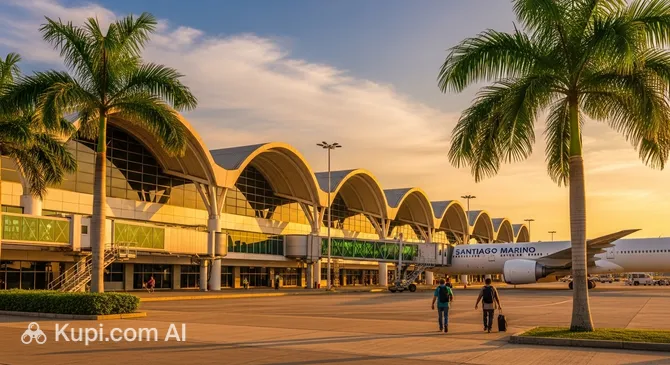
Santiago Marino International Airport. Source: Kupi.com Binoculars

Santiago Marino International Airport (PMV) is not merely a transit hub, but a true gateway to the tropical paradise of Margarita Island. Even during descent, passengers can admire the turquoise waters of the Caribbean Sea and the famous beaches located just a few minutes' drive from the terminal. Named after a hero of the War of Independence, this airport immediately immerses travellers in the relaxed atmosphere of the "Pearl of the Caribbean," offering a unique blend of island charm and vital transport infrastructure.

IATA Code PMV
ICAO Code SVMG
City Porlamar
Distance to Centre ~15 km
Status International
Annual Passengers Second busiest airport in Venezuela
Schedule Seasonal schedule (please check with carrier)

Airport Features and Highlights:

One of the main "highlights" of the airport is its location in the immediate vicinity of the world-famous El Yaque beach, considered a mecca for windsurfers and kitesurfers. Tourists often head out to catch the wind literally moments after landing, as the journey takes just a few minutes.

The terminal is divided into two sectors: for international and domestic flights. An important detail for tourists is Margarita Island's status as a Free Trade Zone (Puerto Libre). This means that many shops with "duty-free" prices can be found in the airport and its surroundings, making shopping a pleasant addition to the flight.

The architecture of the complex is quite simple but functional, and boarding is often done by walking across the tarmac, allowing for those first or last photos against the backdrop of the aircraft and palm trees. Despite periodic fluctuations in tourist flow, the airport remains a key hub connecting the island with the mainland and other countries in the region.

Contact Information

Below is the contact information for Santiago Marino Caribbean International Airport (PMV), serving Margarita Island.

  • Official Website: The airport is managed by the state company BAER (Bolivariana de Aeropuertos S.A.). Current news and general information can be found on their official website: baer.gob.ve.
  • Help Desk Phone: +58 295-4005050. Calling is recommended for the most up-to-date information.
  • Address: Vía El Yaque, city of Porlamar, Margarita Island, Nueva Esparta State, Venezuela.
  • Email: There is no official public email address provided for passenger communication. It is recommended to use the telephone for enquiries.
  • Social Media: You can follow airport updates and news via the official accounts of the management company BAER on Instagram (@baervenezuela) and X (formerly Twitter) (@BAER_Vzla).
  • Lost Luggage Information: If your luggage has been lost or damaged, you must contact your airline's baggage tracing service directly. Airport staff do not handle these issues directly.
  • Passenger Support Service: For general questions not related to a specific flight, you can contact the main airport phone number. For information on flight status, check-in, or other flight-related services, please contact your airline representatives.

How to Get to the Airport

There are several ways to get to Santiago Marino International Airport (PMV), located approximately 20 kilometres from the city centre of Porlamar on Margarita Island. The choice depends on your budget, amount of luggage, and comfort preferences. The trip from the city centre usually takes 20 to 35 minutes depending on traffic conditions.

Taxi and Private Transfer. The most convenient and popular way to get to the airport is by taxi. Official taxi services operate at the airport and in the city. It is recommended to use the services of licensed carriers to ensure safety and a fixed trip cost. Prices are generally reasonable. For maximum convenience, especially if you are travelling with family or a large amount of luggage, you can book a private transfer in advance through your hotel or travel agency. This eliminates the need to look for a car upon arrival.

Public Transport. For the most budget-conscious travellers, there is an option with public transport known as "por puestos". These are shared taxis or small buses that run on specific routes. Although this is the cheapest way to travel, it may not be very convenient for tourists with suitcases, as the transport is often crowded and does not always go all the way to the terminal. This option is more suitable for experienced travellers familiar with local specifics.

Car Rental and Parking. Renting a car is an excellent choice for those planning to actively explore Margarita Island. Several car rental company offices are represented at Santiago Marino Airport. You can book a car in advance online or rent one upon arrival. This gives complete freedom of movement. for those arriving at the airport in their own or rented vehicle, parking is provided on the premises. Both short-term and long-term parking options are available.

Although Santiago Marino Airport is the main air gateway to Margarita Island, travellers heading to other regions of the country can use airports on the mainland. Among the nearest are General José Antonio Anzoátegui International Airport in Barcelona and José Tadeo Monagas International Airport, from where the island can be reached by domestic flights or ferry.

Terminals and Map

Santiago Marino International Airport (PMV), serving Margarita Island, has a simple and clear structure, making it convenient for travellers. The airport consists of two main terminals — International (Internacional) and Domestic (Nacional). Both terminals are located in the same building, in close proximity to each other, so no transport is required to move between them — a short walk is sufficient.

The airport layout is quite logical. Generally, arrival zones are on the ground floor, and departure halls are on the first floor. Navigation is intuitive, although most signs are in Spanish. The International Terminal houses all services for passengers arriving from abroad or flying to other countries: passport control counters, customs area, several Duty-Free shops, and currency exchange points. The Domestic Terminal serves flights within Venezuela, and its infrastructure is slightly simpler but also includes everything necessary for a comfortable wait for your flight.

Departure zones in both terminals are equipped with airline check-in counters, security screening points, and waiting lounges with boarding gates. Arrival zones include baggage claim belts and customs control for international flights. The entire process from entering the building to boarding is organised sequentially, minimising the risk of getting lost.

To avoid rushing, it is recommended to arrive at the airport in advance. For international flights, allow at least 3 hours before departure, and for domestic flights — about 2 hours. During peak tourist seasons, check-in and security screening times may increase due to queues. The main navigation tip is to determine immediately upon entering the building which terminal you need (Nacional or Internacional) and follow the signs to the appropriate check-in counters.

Airport History

Santiago Marino International Airport, the main air gateway to Margarita Island, has a rich history closely linked to the region's tourism boom. The airport was officially opened in 1975 to replace an older, smaller airfield. Its construction was a strategic step for the development of Venezuela as a tourist destination, as Margarita Island received duty-free zone status, causing a real surge in visitors.

The airport was named in honour of General Santiago Mariño, a prominent hero of the Venezuelan War of Independence and a native of the island. In the 1980s and 1990s, the airport experienced its "golden age," becoming one of the busiest in the Caribbean. It received numerous charter flights from Europe, North and South America, bringing tourists eager to enjoy the sun and beaches of Porlamar.

One of the most striking and unusual facts in the airport's history involves flights of the supersonic passenger aircraft Concorde. At the peak of its popularity, Margarita Island was such a prestigious destination that airlines Air France and British Airways operated exclusive charter flights here on Concordes. The ability to accommodate such an aircraft testified to the high status and technical equipment of the airport in those years.

Throughout its history, the airport has repeatedly undergone modernisation to meet international aviation safety and passenger comfort standards. Terminals have been expanded, and runways and navigation equipment updated. Today, Santiago Marino International Airport continues to be a key transport hub connecting Margarita Island with the mainland and the world, playing an important role in the country's tourism life.

Services and Amenities

Santiago Marino International Airport (PMV), the main air gateway to Margarita Island, offers passengers all necessary services for a comfortable wait for their flight. In the terminal, you will find several cafes and restaurants where you can have a snack with local and international dishes, as well as drink a cup of famous Venezuelan coffee. For those wishing to shop, stores are available, including Duty Free, offering a wide range of perfumes, souvenirs, and tobacco products.

For passengers preferring enhanced comfort, VIP lounges are provided at the airport. Here you can relax in a quiet atmosphere, enjoy complimentary snacks and beverages, and access the latest press. Wi-Fi is available throughout the terminal, and special stands are equipped for charging electronic devices. Financial services are represented by bank branches, ATMs, and currency exchange points where you can exchange money upon arrival or before departure.

The airport has also taken care of passengers with special needs. There is a mother and child room for travellers with children, and ramps, special restrooms, and escort services are provided for people with reduced mobility. In case of need, you can contact the medical point for first aid. Although there are no hotels directly within the airport building, many hotels to suit any taste and budget are located a few minutes' drive away. For business travellers, basic business services such as copying and faxing may be available in the VIP lounges.

Dining

In Santiago Marino International Airport (PMV), the main options for a full meal are concentrated in the public zone (landside), before passing through passport control. In the central food court, you will find both familiar fast-food chains and cafes where you can discover local gastronomy. This is your best chance to taste authentic Venezuelan cuisine before flying! Be sure to order juicy arepas (corn cakes with fillings) or crispy empanadas (fried pastries) — they are filling, authentic, and very tasty. Complement your snack with a cup of famous Venezuelan coffee.

After passing security control, in the sterile zone (airside), the choice of establishments is more focused on quick snacks. Here, you have a cosy coffee shop where you can grab fresh pastries and sandwiches, as well as a counter serving refreshing drinks and light snacks. This is an ideal option if you want something refreshing or to take food on board immediately before boarding.

Most establishments operate according to the flight schedule. Prices at the airport are expectedly higher than in the city of Porlamar. Regarding special dietary requests, finding certified vegan, gluten-free, or Halal dishes might be difficult. It is recommended to check ingredients with staff or choose simpler options, such as fresh fruit.

Travel Tips

To ensure your journey through Santiago Marino International Airport, located in the city of Porlamar, Venezuela, goes as smoothly as possible, use these useful tips. They will help you save time, stress, and money.

Arrival time at the airport. For international flights, it is recommended to arrive at the airport 3-4 hours before departure. For domestic flights, arriving 2 hours in advance is usually sufficient. This will give you enough time to complete all formalities without rushing, especially during peak seasons.

Check-in and security control. If possible, check in for your flight online — this will save you time at the airport. Keep your passport, visa (if required), and boarding pass handy. During screening, be prepared to remove all electronic devices and containers with liquids from your carry-on luggage.

Choosing a seat on the plane. If you want to enjoy the views, choose a window seat. If you prefer more legroom and the ability to stand up freely, take an aisle seat. If a quick exit from the plane upon arrival is important to you, try to book seats in the front part of the cabin.

Carry-on luggage. Remember the general rules: liquids are allowed in containers of no more than 100 ml, packed in a transparent bag. Sharp objects, weapons, and explosive substances are prohibited. Always check the carry-on and baggage allowance on your airline's website, as they may differ.

Passengers with transfers. If you have a connecting flight, check in advance whether you will need to collect and re-check your luggage. Study the airport map to quickly find the gate you need for your next departure.

Customs control. When entering the country, you will likely need to complete a customs declaration. Honestly declare all goods subject to declaration to avoid possible fines and delays. Have documents confirming the purpose of your trip ready.

Saving time and money. To avoid unnecessary expenses, bring an empty water bottle that can be filled after passing security. A light snack brought from home will also help save money. A pre-booked transfer from the airport is often more cost-effective than a taxi taken on the spot.

In case of flight delay. If your flight is delayed, first contact your airline representative for information on the new departure time and possible compensation (for example, vouchers for food or drinks). Remain calm and monitor updates on the information screens.

Reached the end of the page?

That means the route is fully explored