Support

Pho Chieu Pagoda

About

Imagine a place where the port's noise gives way to the quiet whisper of prayers and the scent of incense. Pho Chieu Pagoda is a majestic Buddhist complex in Haiphong, considered one of the region's most revered shrines. Founded in the mid-20th century, it is a striking example of how history, faith, and art harmoniously coexist in Vietnam.
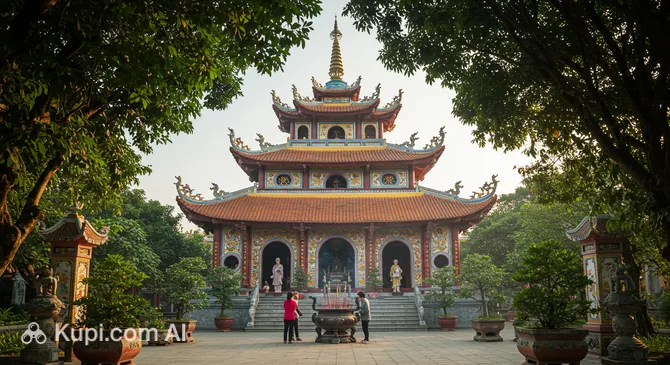
Pho Chieu Pagoda
Pho Chieu Pagoda. Иллюстрация. Источник: Kupi.com AI

Initially intended as a place of unity for three great ideologies—Buddhism, Confucianism, and Taoism—this was reflected in its first name, Tam Giao Duong. Today, this complex is the city's second-largest and attracts travelers with its traditional "Cong" style architecture, where every building is oriented strictly according to ancient architectural canons.

Pho Chieu Pagoda is recognized as a historical monument and serves as an important spiritual center for locals. Its spacious grounds and exquisite facade designs make it a must-visit on the itinerary of any tourist wishing to experience the authentic culture of Haiphong.

Contacts

For those planning a visit, it is important to note that the pagoda does not have an official website or a direct phone line for inquiries. Visitors are recommended to rely on the address details and information signs within the city.

How to contactContact
AddressRMRH+X27, Dư Hàng, Lê Chân, Hai Phong 180000, Вьетнам

What to Do

At Pho Chieu Pagoda, visitors can explore a rich collection of Buddhist art. The temple's main hall is adorned with nearly 100 wooden Buddha statues, masterfully finished with lacquer and gold leaf. The statue of Avalokiteshvara (Guanyin) with a thousand hands and eyes is particularly impressive—a true masterpiece of woodcarving symbolizing infinite compassion.

Be sure to notice the Lotus Tower—a nine-story structure considered the tallest in the city. It serves as a symbol of spiritual elevation and rebirth. Equally interesting is the miniature replica of Hanoi's One Pillar Pagoda, located in the center of a picturesque lotus pond and guarded by four stone dragons representing peace and prosperity.

A walk through the complex allows you not only to enjoy the silence among ancient trees but also to see monuments to national heroes such as Ngo Quyen and Tran Hung Dao. This place is ideal for those seeking solitude for meditation or wanting to capture beautiful shots of traditional Vietnamese architecture in a peaceful setting.

Getting There

The shrine is located in the Le Chan district, in the central part of the city, making it convenient for most travelers to visit. The easiest and fastest way to get there is by taxi or by calling a car through the Grab app. A ride from the city's central hotels will take about 10–15 minutes.

For those who prefer public transport, city buses run towards the Du Hang area. You can also rent a motorcycle—a popular way to get around Vietnam that allows for flexible route planning. GPS coordinates will help you find the main entrance to the temple complex without any trouble.

Ближайший город: Haiphong

History & Facts

The history of this site began in 1953 when the monk Ngo Tran Tu founded the hermitage, originally named Tam Giao Duong (Temple of the Three Teachings). This name symbolized a unique synthesis of Buddhism, Confucianism, and Taoism for that time. Later, when the monk Thich Thanh Quang became the abbot, the pagoda received its current name, Pho Chieu, and became a stronghold exclusively for Buddhist traditions.

During the years of Vietnam's struggle for independence, the temple played an important role not only as a religious center but also as a secret hideout for resistance forces. It provided shelter for party figures and fighters, earning the complex the status of a significant revolutionary monument. Commemorative steles on the grounds still serve as a reminder of the heroic past of this seemingly peaceful place.

A major renovation in 1985 allowed for the expansion of the shrines and the decoration of the grounds while preserving the ancient grandeur of the architecture. Today, the pagoda is considered a living testament to the city's cultural and spiritual development, carefully preserving the heritage of previous generations in the heart of the modern port city.

Time Needed

It usually takes about 1.5–2 hours to see the main sights of the temple complex. During this time, you can leisurely explore the main hall, the Lotus Tower, and stroll through the garden, admiring the pond and sculptures.

If you plan to visit the pagoda during holidays or want to dedicate time to meditation and quiet contemplation of the architectural details, it is worth setting aside a bit more time—about half a day. Visiting in the morning hours will allow you to catch the most peaceful atmosphere before the main groups of pilgrims arrive.

Working Hours

The doors of Pho Chieu Pagoda are open to visitors daily. The temple operates in two sessions: the morning session from 6:30 AM to 11:00 AM, and the evening session from 1:30 PM to 6:00 PM. Please note that during the lunch break, access to the main halls may be limited.

06:30–11:00, 13:30–18:00

Nearby

Exploring the area around the pagoda will allow you to dive deeper into local life and see the city from different angles—from religious monuments to modern public spaces. A walk through the Le Chan district can be a great addition to your temple visit.

NameDistance
Du Hang Pagoda0.6 km
Lê Chân Shopping Mall1.2 km
Aeon Mall Hai Phong Italian Restaurant1.4 km
Central Square Fountain1.6 km
Bandstand (Nhà Kèn) Haiphong2 km
Hai Phong Cathedral2.1 km
Hai Phong Museum2.2 km

Reached the end of the page?

That means the route is fully explored