Support

Goethe's Garden House

About

Goethe's Garden House (Gartenhaus am Stern) is a charming historic building nestled in the scenic park on the banks of the River Ilm in Weimar, Germany. This small early-Classical style house holds immense cultural significance, as it was the first property owned by the great German poet, writer, and thinker Johann Wolfgang von Goethe. Duke Karl August gifted this house to Goethe shortly after his arrival in Weimar, and it became a true refuge for the poet.
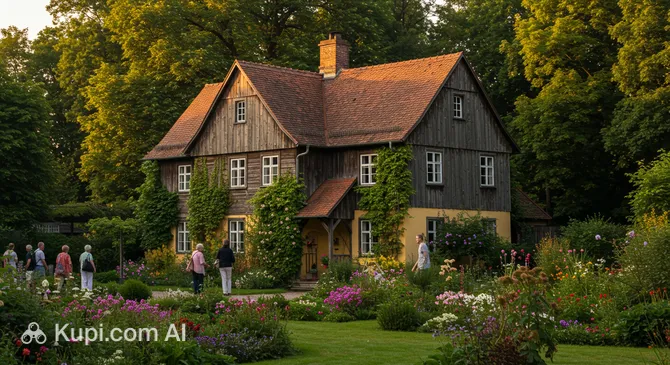
Goethe's Garden House. Illustration.
Source: Kupi.com AI

Traveller photos:

It was here, in the silence of the garden, that Goethe found seclusion and inspiration for his work. The house became a place where he could enjoy nature and work on many famous pieces. Although the poet lived here for a relatively short time before moving to the larger house on Frauenplan, this garden house remained closely linked to his life and creative path forever.

Today, Goethe's Garden House is an integral part of the "Classical Weimar" ensemble, which is rightfully listed as a UNESCO World Heritage site. Visiting this place allows you to touch history, feel the atmosphere in which the genius worked, and better understand his early period in Weimar. It is not just a museum, but a true island of peace and inspiration, attracting tourists and admirers of Goethe's talent from all over the world.

Contacts

To find the latest contact details, opening hours, and admission fees for Goethe's Garden House, we recommend visiting the attraction's official website or tourist information centers in Weimar. Usually, this information is available on-site or on city tourism portals.

The house is located in the park on the River Ilm, and you can reach it while strolling through this picturesque park.

How to contactContact
AddressPark, an der Ilm 1, 99425 Weimar, Germany
Phone+49 3643 545400
Websitewww.klassik-stiftung.de

What to Do

Visiting Goethe's Garden House in Weimar is a unique opportunity to get a glimpse into the everyday life of the great poet. Inside, you can see the modest but authentic setting where Johann Wolfgang von Goethe lived during his first years in the city. The preserved late-18th-century atmosphere, some of the writer's personal belongings, and, of course, his study where immortal lines were born, allow you to vividly imagine the genius's lifestyle and creative process.

An essential part of the experience is the garden itself, which Goethe lovingly designed and where he spent a lot of time conducting botanical research. Walking through this garden and the surrounding picturesque Park on the Ilm is a chance to follow the same paths the poet himself once walked. Here you can admire various plants, many of which were planted under his direction, and feel the harmony with nature that so inspired Goethe and was reflected in his "Theory of Colours."

Getting There

Goethe's Garden House is located in the scenic Park on the Ilm (Park an der Ilm) in Weimar. This spot is easily accessible as it is situated close to the city center. The most pleasant way to get there is on foot. From central Weimar, the walk takes about 10-15 minutes, allowing you to soak in the city's atmosphere and the park's beauty.

If you arrive in Weimar by train, you can also walk from the main station (Weimar Hauptbahnhof) to Goethe's Garden House. This walk takes about 20-25 minutes. Alternatively, you can use the city's public transport, which will take you closer to the park, leaving just a short walk.

The city of Weimar itself has good rail connections to other major cities in Germany. For instance, a train trip from Berlin takes about two hours, and from Frankfurt am Main, about 2.5 to 3 hours. Upon arrival in Weimar, you'll find the city very compact and walkable; most attractions, including Goethe's Garden House, are within easy walking distance of each other.

Nearest city: Weimar

History & Facts

Goethe's Garden House in Weimar was more than just a temporary residence for the great poet; it was a true creative sanctuary. Received as a gift from Duke Karl August in 1776, shortly after his arrival in the city, Goethe lived here during his first years in Weimar until 1782. It was in this secluded atmosphere, surrounded by the garden's greenery, that many famous works of his early Weimar period were born. Even after moving to a larger house on Frauenplan, this modest corner remained a favorite spot where he returned for solitary work and deep reflection.

The modesty of this place gives it a special charm, contrasting sharply with the greatness of the works created here. This seemingly simple house witnessed the birth of brilliant ideas and lines that would later enter the treasury of world literature. For Goethe, it was not just a summer house, but a source of inspiration where, in silence and unity with nature, he could fully dedicate himself to creativity, away from the city bustle and official duties.

The historical context of the time is also fascinating. When Goethe arrived in Weimar in November 1775 as a famous young writer, the city was strikingly different from its future glory. The poet himself described it as "some kind of misunderstanding, not a city: half-village, half-residence." The population of Weimar was only about six thousand people, and it seemed like a rather provincial place. Nevertheless, this is where Goethe chose to settle, and later, largely thanks to his tireless activity and the influence of his contemporaries, Weimar was transformed, becoming a true cultural center of Germany and giving its name to an entire era — "Weimar Classicism."

Time Needed

To explore Goethe's Garden House, located in the charming city of Weimar in Germany, it is usually recommended to set aside 1 to 2 hours. This time is generally enough to leisurely get to know the house itself, examine the exhibition dedicated to the great poet's life and work, and enjoy a walk through the picturesque Park on the Ilm that surrounds this historic site.

Of course, the length of your visit may vary depending on your interest in detail and your desire to dive deeper into the atmosphere. If you are a big fan of Goethe's work or plan to visit other significant sites related to him in Weimar, such as his main house-museum on Frauenplan, it is worth allowing extra time. In that case, the total time spent exploring Goethe's legacy could take half a day or even more.

Working Hours

As mentioned, it is recommended to check the current opening hours of Goethe's Garden House in Weimar on the official website or at local information centers. This is particularly important as the schedule may vary by season, and during peak tourist periods, advance ticket booking may be required.

Confirming this information in advance will help you plan your visit to Goethe's Garden House as comfortably as possible, as well as keep you informed about special events, temporary exhibitions, or possible schedule changes due to holidays or technical maintenance.

DayOpening hours
MondayClosed
Tuesday10:00 – 18:00
Wednesday10:00 – 18:00
Thursday10:00 – 18:00
Friday10:00 – 18:00
Saturday10:00 – 18:00
Sunday10:00 – 18:00

Nearby

Visiting Goethe's Garden House is undoubtedly a landmark event for any visitor to Weimar. However, to make your journey even more memorable and full of discoveries, we recommend exploring other interesting places nearby. This will allow you to immerse yourself more deeply in the unique atmosphere of this historic city.

A stroll around the surroundings of Goethe's Garden House will reveal new facets of Weimar. Many significant sights, cozy cafes, and picturesque spots are very close by, allowing for a rich and varied itinerary. Below is a list of some of them, along with their distance.

NameDistance
Park on the Ilm0.2 km
Duchess Anna Amalia Library0.4 km
Goethe House0.6 km
Market Square0.6 km
Cielo Weimar0.6 km
Lily's Waffle Bar & Café0.6 km
Schiller's House0.7 km

Reached the bottom of the page?

Looks like you know this route inside out

We use cookies for your convenience.