Lashkargah, located in southern Afghanistan, is the administrative center of Helmand Province and an important strategic hub of the region. The city is situated in a picturesque location at the confluence of the Helmand and Arghandab rivers, making it one of the few green oases in this arid part of the country. With a population of over 270,000, it serves as a key commercial and political hub while maintaining the atmosphere of a traditional provincial center.
The modern appearance of the city began to take shape in the 1950s, but its roots go deep into the past. The profound heritage of these lands is inextricably linked with the history of Lashkargah, once known as Bost. The city's name itself translates from Persian as "army barracks," recalling the times when the military camps of the Ghaznavids were located here.
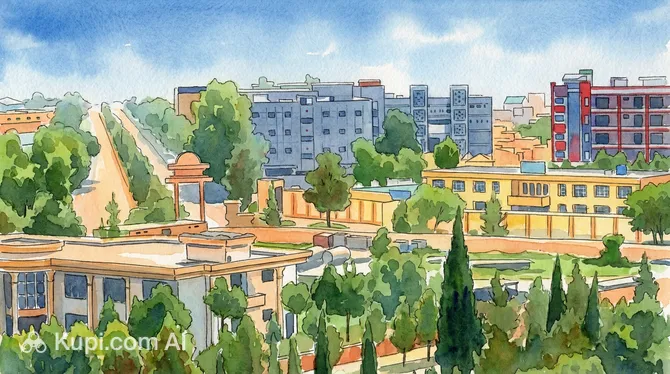
Lashkar Gah. Illustration.
Source: Kupi.com AI
Today, Lashkargah attracts attention with its unique architecture, which combines modern government buildings and traditional Eastern markets. Although the city is not a mass tourist destination, it offers guests an authentic introduction to the culture of southern Afghanistan and majestic views of the river valleys.
Weather Overview
The climate of Lashkargah is characterized as semi-arid, which is typical for the southern plains of the region. A long and hot summer prevails here, with temperatures in July and August regularly exceeding the +40°C mark. During this period, the air becomes very dry, and rain is almost entirely absent, which, combined with the proximity of the desert, often leads to dust storms.
Winters in the city are mild and short, with daytime temperatures around +15°C, although frosts are possible at night when the thermometer drops to +1°C. Most of the annual precipitation falls between January and March, but even then it remains insignificant. To better prepare for your trip, it is recommended to study the detailed forecast and characteristics of Lashkargah's climate in advance.
The best time to visit the city is considered to be spring (March–April) and autumn (October–November). During these months, the weather is most comfortable for getting around: the exhausting heat has either not yet arrived or has already subsided, and the air remains clear and fresh, creating ideal conditions for seeing historical monuments and walking along the rivers.
Average monthly temperature
Average monthly precipitation
Interesting Facts
The name Lashkargah translates from Persian as "army barracks" or "military camp," reflecting the city's historical past as a stationing point for Ghaznavid troops.
The city's modern layout was designed and built in the 1950s, making it one of the "youngest" cities in terms of construction in this ancient region.
Lashkargah is the country's second-largest trading hub after Kabul, playing a critical role in the economy of the southern provinces.
The city is home to Helmand University, which is an important educational and scientific center for the entire region.
The city is divided into 16 administrative districts (nahias), each having its own management and development characteristics.
How to Get There
Lashkargah is an important transport hub in the south of the country, connecting several key provinces. The main flow of passengers and cargo arrives here via roads that link the city with Kandahar to the east and Herat to the northwest. Traveling by car or bus allows you to see the changing desert landscapes; however, it is worth noting that road conditions and travel times can vary.
For those who prefer air travel, Bost Airport (BST) is located in the northern part of the city, near the confluence of the rivers. It primarily handles domestic flights, connecting the province with the capital and other major cities. Despite its small size, the airport is an important gateway for officials and business travelers.
There is currently no railway service in this area, so ground transport remains the only alternative to flights. Detailed information on routes and logistics can be found in the section describing how to get to Lashkargah using the most convenient methods.
Station
Passenger traffic
Distance
Nushki railway station
5
278 km
Quetta railway station
10
294 km
Main Attractions
The main historical pride of the Lashkargah area is the ancient fortress of Bost (Qala-e-Bost). This majestic structure is over 3,500 years old and is considered one of the most significant archaeological finds in the region. The famous decorative arch of the fortress, which has been preserved since the 11th century and is an outstanding architectural monument of the Ghaznavid era, always draws particular interest from visitors.
Equally interesting is Lashkari Bazar — the remains of an ancient palace complex and market that once served as the winter residence of rulers. Walking among the ruins, one can imagine the former greatness of this place, where trade routes crossed and life bustled thousands of years ago.
The Helmand River itself is considered a natural landmark of the city. Its banks serve as a relaxation spot for local residents and offer peaceful views of the water, which contrast with the harsh desert landscapes surrounding the city. Central squares and administrative buildings constructed in the mid-20th century are also of interest to those wishing to study the architectural style of that period in Afghanistan.
Local Cuisine
The gastronomic scene in Lashkargah is infused with the aromas of traditional Afghan cuisine, where rice, fresh meat, and various spices play the leading roles. Be sure to try the local pulao — a fragrant pilaf prepared here with special care, adding raisins and carrots. Also popular are lamb or beef kebabs, cooked over an open fire and served with hot naan bread straight from the tandoor.
The food culture in the city is closely linked to markets and street cafes. Locals often spend time in tea houses (chaihanas), where the latest news is discussed over a cup of green tea with cardamom. For a quick snack on the go, mantu (steamed dumplings with meat filling) and bolani (thin flatbreads stuffed with herbs or potatoes) are popular.
A specific feature of local dining is hospitality: portions are usually very generous, and fresh vegetables and mast (yogurt sauce) are always served with the main dish. Although there are no fine-dining restaurants in the Western sense, the authentic flavors and homey atmosphere of local establishments will leave a lasting impression on any gourmand.
Travel Tips
A trip to Lashkargah requires careful planning and an understanding of local specifics to ensure your stay is comfortable and safe.
Clothing and Dress Code: Choose modest clothing made of natural fabrics (cotton, linen) that will protect you from the sun and dust. Men are advised to wear trousers and shirts, women — loose-fitting clothing covering the arms and legs, and also to have a headscarf to cover the head when visiting public places.
Climate Protection: Lashkargah is located in an arid zone, so always bring sunglasses and skin protection. It is essential to have a supply of bottled water to avoid dehydration.
Finances: The main currency is the Afghan afghani (AFN). Cards are rarely accepted, so always carry enough cash. You can exchange currency at local "sarafi" exchange points.
Safety: Try not to leave the central areas of the city without an escort or a reliable driver. Always keep an eye on local news and the recommendations of official services.
Language and Communication: The main languages are Pashto and Dari. English is not widely spoken, so learn a few basic phrases or use an offline translator. A polite greeting of "Salam Alaikum" will always help win over your interlocutor.
Photography: Always ask for permission before photographing local residents. It is strictly forbidden to photograph military sites, government buildings, and checkpoints.
Local Etiquette: Show respect for local traditions and religion. During prayer times, life in the city slows down, and many shops may be closed.
Connectivity: A SIM card from a local operator can be purchased in the city center by presenting a passport. Mobile internet works stably within the city limits, but Wi-Fi in hotels can be slow.
Despite the specifics of the region, Lashkargah will welcome you with sincere hospitality and allow you to see the real, non-touristic Afghanistan. Be open to new experiences and follow precautionary rules.
Entertainment & Nightlife
Entertainment in Lashkargah is primarily quiet and traditional, reflecting the way of life in a provincial center. There are no noisy nightclubs or bars here, and public life after sunset focuses on family gatherings and traditional tea houses. The local leisure culture differs significantly from Western standards, offering thoughtful conversations over a cup of green tea instead of discos.
The daytime leisure of locals and the city's rare guests is often connected with walks along the Helmand River or visiting the central markets, which remain the main hubs of activity. For those looking for more modern forms of recreation or cultural events, such as cinemas or major concerts, city residents sometimes travel to neighboring Kandahar, which has a more developed urban infrastructure.
Evening walks are safest in the central areas, where government buildings and well-lit streets are located. Nevertheless, tourists are advised to plan their movements by taxi and avoid the outskirts of the city after dark to ensure their journey remains comfortable and peaceful.
Parks & Museums
Despite the dry and hot climate, efforts are made in Lashkargah to maintain green zones, although there are not many full-fledged city parks. The banks of the Helmand and Arghandab rivers remain the primary places for outdoor walks. These natural areas serve as the city's "lungs," where residents rest from the midday heat in the shade of the trees.
There are currently no specialized museums in the classic sense in the city; however, the territory around the Bost fortress functions as an open-air museum. This is a place where historical memory is concentrated, where every stone and fragment of ancient masonry tells of the flourishing and decline of the great empires of the past.
For those interested in culture, it is worth paying attention to the architecture of administrative buildings from the middle of the last century, which reflect an important stage in the development of modern Lashkargah. Although the city is only beginning to develop its cultural infrastructure, its historical landscape already offers many subjects for researchers and history buffs to explore.
Getting Around
The public transport system in Lashkargah is in the formation stage and is primarily represented by private carriers. There is no metro or trams in the city, and the main burden of passenger transport is carried by minibuses and shared taxis. They run between the main districts and markets, though there is often no fixed schedule — transport departs as it fills up.
The most convenient and popular way to get around for visitors is by taxi. The cars are easy to recognize in traffic, and the cost of the trip is usually discussed with the driver in advance, as meters are rarely used. For travel over longer distances, such as to the airport or neighboring settlements, you can rent a car with a local driver, which is the safest and most comfortable option.
Moving around the center of Lashkargah is quite possible on foot, especially in the morning or evening hours when the heat subsides. It is worth remembering that traffic can be chaotic, and sidewalks are not always in perfect condition. Bicycles are also popular among locals, but for tourists, this mode of transport may be unfamiliar due to heavy traffic and dust.
Accommodation
The choice of accommodation in Lashkargah is quite limited and primarily oriented toward business travelers, employees of international organizations, and transit passengers. You will not find luxury chain hotels here, but several guest houses and basic hotels offering a standard level of comfort and safety are available in the city center.
The city center, located near administrative buildings and the governor's residence, is considered the most convenient area to stay. Staying in this zone provides better transport accessibility and proximity to major shopping points. Most hotels offer standard rooms with air conditioning, which is crucial given the local hot climate.
Accommodation prices remain moderate; however, tourists are strongly encouraged to book in advance and contact the guesthouse owners directly. It should be noted that in most cases, payment is made in cash in the local currency, and online booking through familiar international services may be unavailable.
Nearby Cities
Due to its location, Lashkargah can serve as a starting point for exploring other significant cities in the southern region. Traveling through the surrounding areas provides access to important cultural and commercial centers that play a huge role in the life of the country.
One of the most interesting destinations is Kandahar, located approximately 124 kilometers to the east. It is one of the country's oldest and largest cities, known for its rich markets and historical mosques. You can also visit Sangin, a small town to the northeast, the path to which runs along the Helmand River bed through picturesque agricultural areas.
Exploring the nearby territories provides a more complete understanding of the diversity of the southern provinces, their economy, and way of life. When planning such trips, it is always worth considering the road conditions and the current situation in the region to ensure travel safety.
Shopping & Souvenirs
Shopping in Lashkargah is primarily an immersion into the atmosphere of an oriental bazaar. The city is famous as a major trade hub, and its markets offer a wide range of goods, from everyday products to traditional crafts. The most famous area is the district of the historical Lashkari Bazar, where trading traditions have been preserved for centuries.
Tourists should pay attention to the work of local artisans, particularly traditional Afghan clothing and accessories with hand embroidery. The region is also known for its high-quality dried fruits, nuts, and spices, which make excellent and tasty souvenirs. Hand-woven carpets, though presented in smaller volumes than in northern provinces, feature unique patterns characteristic of the south.
Shops and stalls usually operate from early morning until sunset, with a break for Friday prayers. Payment in Lashkargah is made almost exclusively in cash in Afghanis (AFN). The ability to bargain is welcomed and is part of the local communication culture — it is not just a way to lower the price, but also an opportunity to show respect to the seller and start a conversation.