Support

Quetta Airport

About the Airport

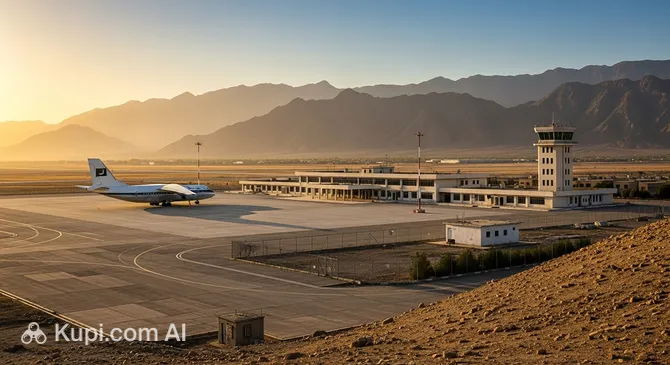
Quetta Airport. Source: Kupi.com Binoculars

Quetta International Airport (IATA: UET, ICAO: OPQT) is not just the air gateway to the capital of the Balochistan province, but also one of the highest-altitude airports in Pakistan. Located at an elevation of over 1,600 metres above sea level, it offers passengers breathtaking views of the surrounding mountain landscapes right during takeoff and landing. Being the fourth highest in the country, the airport serves as an important transport hub for both domestic and international flights, connecting this unique region with the rest of the world.

IATA Code UET
ICAO Code OPQT
City Quetta
Distance to centre approx. 12 km
Status International
Annual passengers approx. 250,000
Popular Airlines Pakistan International Airlines, Air Arabia, Flydubai
Schedule Quetta Airport online flight board

Despite its modest size, Quetta Airport possesses everything necessary for a comfortable wait for your flight. The terminal building, constructed in 1982, features several waiting lounges, small shops with snacks and beverages, as well as ticketing and baggage counters. The airport services both domestic destinations, connecting Quetta with cities such as Karachi, Islamabad, and Lahore, and international flights, primarily to the Gulf countries, for example, to Dubai. Thanks to its strategic location, it plays a key role in the development of tourism and business ties in the region.

Contact Information

  • Official Website: Quetta Airport is managed by the Pakistan Civil Aviation Authority (PCAA). The most up-to-date information can be found on their official resource: www.caapakistan.com.pk.
  • Inquiry Service Phone: +92-81-2882209. Please note that when calling from outside Pakistan, you must dial the international code.
  • Address: Airport Road, Quetta, Balochistan, Pakistan.
  • Email: There is no dedicated email address for passenger enquiries. It is recommended to use the contact form on the PCAA website or the phone number for communication.
  • Social Media: Quetta Airport does not have official pages on social media. News can be followed on the general resources of the aviation authorities of Pakistan.
  • Lost Luggage Information: If your luggage has been lost or damaged, you must contact your airline representative directly at the airport. The airline's baggage tracing service is responsible for resolving such issues.
  • Passenger Support Contacts: For general questions and enquiries, you can use the main airport inquiry phone number: +92-81-2882209.

How to Get to the Airport

You can get to Quetta International Airport (UET) from the city centre of Quetta in several ways. The choice of the suitable option depends on your budget, time, and comfort preferences. The airport is located approximately 12 kilometres from the city centre, and the journey usually takes from 25 to 45 minutes depending on traffic conditions.

Taxis and Ride-hailing Services are the most popular and convenient way to reach the airport. You can use local taxi services, which are easy to find anywhere in the city, or book a car through mobile apps popular in Pakistan, such as Uber or Careem. This guarantees a fixed and transparent trip cost. If you take a regular taxi, it is strongly recommended to negotiate the price with the driver before starting the trip to avoid misunderstandings. You can also book a private transfer in advance through your hotel or travel agency.

Public Transport represents a more budget-friendly but more complex option for tourists. There are no direct bus routes to the airport; however, you can use local minibuses (wagons) or auto-rickshaws to get to the main road nearest the airport, and take another taxi from there. This method is suitable for experienced travellers familiar with local nuances and without heavy luggage. Metro or commuter trains do not run to the airport.

Car Rental and Parking is another available option. Several car rental companies operate in Quetta. This option is suitable for those who feel confident driving in local traffic conditions. A more comfortable alternative might be renting a car with a driver. For those arriving at the airport in their own or rented vehicle, parking is provided on the terminal premises, where you can leave your car for both short and long terms.

Terminals and Map

Quetta International Airport Quetta (UET) has a fairly simple and clear structure, making navigation convenient for passengers. It is a key transport hub for the Balochistan province in Pakistan.

The airport consists of one main terminal that serves both domestic and international flights. This layout significantly simplifies movement: you will not have to search for connections between different buildings. All zones—check-in, security, waiting lounges, and baggage claim—are located under one roof, making orientation intuitive.

The terminal layout is logical. Airline check-in counters are located at the entrance. After receiving a boarding pass, passengers proceed to the security screening zone. Departure and arrival zones are clearly separated. The departure lounge, located after the control zone, offers basic amenities, including seating areas and small retail outlets. The arrival zone includes immigration control counters for international flights, baggage claim belts, and customs control.

Completing all formalities usually does not take much time, as the airport is not overloaded with huge passenger traffic, unlike capital airports. Nevertheless, it is recommended to arrive at the airport in advance: approximately 2 hours before a domestic flight and 3 hours before an international one. This time will be sufficient for a calm check-in, baggage drop, and pre-flight screening.

Airport History

Quetta International Airport (UET), located in the capital of the Balochistan province, has a rich history closely intertwined with the development of the entire region. Its story begins long before it became a major civil aviation hub: initially, it was the Samungli airbase, built by the British Royal Air Force (RAF) during the colonial period. The base played a strategic role during World War II, serving as an important logistical point in this part of British India.

After Pakistan gained independence in 1947, the airfield was transferred to civil aviation management and began to gradually transform into a passenger airport. In the 1950s and 1960s, the first domestic flights were launched, linking Quetta with major cities such as Karachi and Lahore. However, for decades, the infrastructure remained quite modest, and the airport served mainly a small number of flights.

A key moment in the airport's history was 1982, when a new terminal building was inaugurated. This large-scale reconstruction turned it into a modern airport for that time, capable of receiving international flights. From this period, the airport began serving pilgrimage flights during Hajj, which significantly increased its status and importance for the faithful from all over Balochistan.

In subsequent years, the airport was modernized repeatedly. The runway and navigation equipment were improved to meet international safety standards. The airport played a crucial humanitarian role during the relief efforts for the devastating 2008 earthquake in Balochistan, becoming a central hub for delivering aid and evacuating victims. Today, it is the second-largest airport in the province, continuing to serve as a vital transport artery for the entire region.

One of the interesting facts related to Quetta Airport is its location at an altitude of over 1,600 metres above sea level. This makes it one of the highest airports in Pakistan and creates special aerodynamic conditions for aircraft takeoff and landing, requiring special training for pilots and consideration of the thin air. Despite its civil designation, it still shares part of its territory with the Pakistan Air Force, retaining its original strategic significance.

Services and Amenities

Quetta International Airport (UET) provides passengers with all necessary services for a comfortable wait for their flight. In the terminal, you will find several cafes and snack bars where you can have a bite to eat and drink hot or cold beverages. Small shops are also open, selling travel essentials, fresh newspapers, and souvenirs to remember your trip to Pakistan.

For those who value enhanced comfort, CIP lounges (Commercially Important Person lounges) operate at the airport. Here you can relax in silence and enjoy complimentary snacks and drinks. Wi-Fi is available throughout the terminal, and charging stations and power outlets for electronic devices are located in the waiting areas so you can always stay connected.

Quetta Airport has infrastructure designed to solve practical issues. ATMs and currency exchange points are available to passengers. In case of illness or the need for emergency assistance, a medical centre is in operation. Mother and child rooms are equipped for travellers with children. Passengers with reduced mobility are provided with assistance in moving around the terminal and wheelchairs upon prior request.

There are no hotels or business centres within the airport territory itself. The nearest hotels with conference halls are located in the city of Quetta, which can be quickly reached by taxi. There, travellers will also find a wider selection of restaurants and shops.

Where to Eat

Quetta International Airport (UET) offers passengers basic but convenient options for a snack and rest before departure. Although the choice of establishments here is not as vast as in major global hubs, you will be able to find everything necessary to refresh yourself or drink a cup of tea while waiting for your flight.

The main food outlets are located in the main terminal building, both in the public zone (landside) and in the departure zone after passing security (airside). Typically, these are small cafes and kiosks offering drinks, snacks, and light meals. In the departure lounge, you can sit comfortably at a table to have a snack right before boarding the plane.

If you want to try something from the local cuisine, look for traditional Pakistani snacks such as samosas (pastries with spicy filling) or pakoras (battered vegetables), if they are on the menu. Of course, more universal options are always available: sandwiches, pastries, crisps, and chocolate. For a full meal, the choice may be limited, so it is better to plan for a hearty snack. Do not miss the opportunity to order aromatic Pakistani tea (chai) with milk and spices — this is a great way to experience the local culture.

Virtually all food at the airport is Halal. Vegetarians generally have access to meat-free dishes, such as vegetable sandwiches or pastries. However, for vegans or people on a gluten-free diet, the choice may be extremely small, so it is recommended to carry your own snacks. Prices in airport establishments are usually moderate, but slightly higher than in the city.

The opening hours of cafes and snack bars are generally tied to the flight schedule. They are open to serve passengers of morning, afternoon, and evening departures, but may be closed at night if there are no flights. For a quick bite, any kiosk with ready-made sandwiches and drinks will do, while for a more relaxed wait, it is better to choose a cafe with tables in the departure zone.

Tips for Travellers

Planning a trip through Quetta airport will be easier if you take into account a few useful tips. To ensure your journey starts without unnecessary stress, follow these recommendations, which will help you navigate the airport and save time and nerves.

Arrival Time and Check-in. Arrive at the airport well in advance: for international flights — 3 hours before departure, for domestic ones — 2 hours. This will give you enough time to go through all procedures. To save time, use online check-in if your airline provides such an option. However, note that airports in Pakistan may have additional security checks at the entrance to the terminal, so allow extra time.

Hand Luggage and Security. Standard rules for carrying liquids apply here: all containers must be no more than 100 ml in volume and packed in a single transparent bag. It is forbidden to carry sharp objects, weapons, and flammable substances in hand luggage. Screening procedures can be quite thorough, so be prepared to remove electronics and metal items from your bag.

Seat Selection and Transfers. If possible, select a seat on the plane during online check-in. Window seats will offer you beautiful views during takeoff and landing, while aisle seats allow you to stand up freely without disturbing neighbours. If you have a connecting flight, check in advance whether you need to collect your luggage and check it in again. Also, check visa requirements for the transit country if the connection is international.

Customs Control and Savings. When entering or leaving the country, be prepared to declare large amounts of cash and valuables in accordance with local laws. To save money, bring an empty water bottle that can be filled after passing security, and a light snack, as prices at the airport are usually higher.

In Case of Flight Delay. If your flight is delayed, first contact your airline representative. They will provide up-to-date information on the flight status and inform you about your rights to food, drinks, or hotel accommodation in case of a long delay. Stay calm and keep all necessary documents at hand.

Airports in nearby cities

Reached the end of the page?

That means the route is fully explored