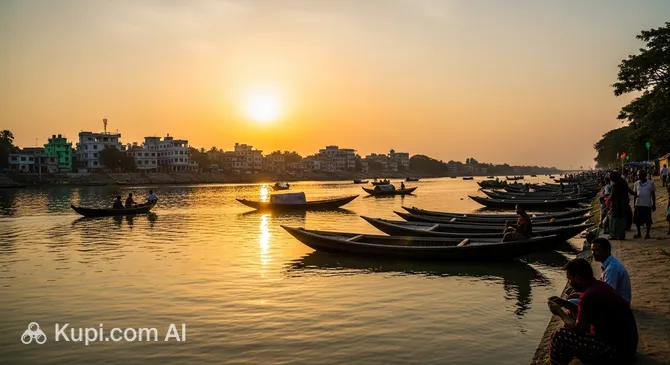
Jhenaidah is a quiet and welcoming city in the southwestern part of Bangladesh, serving as the administrative center of the district of the same name in the Khulna Division. Situated on the vital Daulatdia–Mongla highway, the city is a significant commercial and agricultural hub for the region. Its character is defined by a peaceful provincial atmosphere, fertile lands, and a sprawling network of rivers that create a picturesque landscape.
Jhenida. Illustration.
Source: Kupi.com AI
The urban landscape of Jhenaidah is crisscrossed by waterways, surrounded by endless fields where rice, vegetables, and jute are grown. Although the city is not a major industrial center, it plays a key role in the life of the district, which has a population of over two million people. The rich heritage of the region is reflected in ancient temple complexes and legends carefully preserved by local residents.
For the traveler, Jhenaidah is primarily an opportunity to see the real, non-touristy life of Bengal. It is worth visiting the historic Naldanga temple complex or simply strolling through the lively central markets to feel the rhythm of local life. This city is ideal for those seeking seclusion and wanting to get acquainted with the agrarian traditions and culture of southern Bangladesh.
Weather Overview
Jhenaidah is characterized by a typical tropical climate with pronounced seasonality. Most of the year is warm or hot, and the humidity level remains consistently high due to the abundance of rivers and rainfall. The average annual temperature fluctuates within comfortable limits; however, in the summer, the thermometer often rises to 37°C. You can find the current weather forecast in Jhenaidah on our specialized page.
Throughout the year, the city goes through three main periods: a dry and cool winter (from November to February), a hot summer (from March to May), and the monsoon season (from June to October). Expect a sunny and dry start to the year with pleasant average temperatures around 18–20°C, which by May are replaced by intense heat and tropical downpours. August is considered the wettest month, with up to 290 mm of precipitation, which sometimes leads to seasonal river flooding.
The flat terrain and proximity to waterways contribute to the fertility of the land, but also make the air in the city quite humid, especially during the monsoon period. For tourists, the most favorable time for a visit is from late October to early March, when rain is rare and the heat does not interfere with walking and exploring nearby attractions.
Average monthly temperature
Average monthly precipitation
Interesting Facts
Jhenaidah is a city with a rich past and interesting toponymy, capable of surprising the curious traveler with its hidden details.
The name Jhenaidah itself has a poetic origin: it arose from the words "Jhinuk" (pearl) and "Daha" (lake), pointing to the historical natural beauty of these lands rich in lakes.
The district boasts 21 officially recognized cultural heritage sites, including ancient temples and palace ruins scattered across six upazilas.
Jhenaidah Cadet College, founded in 1963, is considered one of the most prestigious and elite educational institutions in all of Bangladesh.
The region received independent district status relatively recently—in 1984, although the administrative unit itself had existed since the mid-19th century.
Despite its provincial status, the literacy rate in Jhenaidah is historically higher than the national average, emphasizing the importance of education for local residents.
How to Get There
Jhenaidah is an important road hub in the southwest of the country. The city is located on National Highway N7, which connects Daulatdia and Mongla, making it easily accessible for travelers moving by bus or private car. Main transport flows come from major cities such as Khulna, Kushtia, and Jessore. You can find more details about routes in the how to get to Jhenaidah section.
The city does not have its own airport. The nearest air gateway is located in Jessore, from where Jhenaidah can be reached by taxi or bus in about an hour. Also, many tourists arrive from the capital, Dhaka, using a ferry-road route via the crossing at Daulatdia. Travel time by bus from the capital is usually 4 to 6 hours, depending on traffic and ferry queues.
There is no direct rail service in the center of Jhenaidah, as the main tracks pass through neighboring districts. Travelers who prefer trains usually have to reach stations in Jessore or Kushtia and then transfer to local transport. Within the district and the city itself, the most popular ways to get around remain rickshaws and small intercity buses.
Station
Passenger traffic
Distance
Jashore Junction railway station
5
43 km
Rajshahi Railway Station
3
108 km
Kamalapur railway station
11
130 km
Airport railway station
6
131 km
Howrah railway station
21
136 km
Main Attractions
Although Jhenaidah is better known as an administrative center, history enthusiasts will find several truly unique sites here. One of the most significant attractions is the Naldanga Temple Complex. Built in 1656 by Maharaja Indrannarayan Debroy, this ensemble still impresses with its architecture, though many parts require restoration. This place is steeped in the spirit of Bengal's feudal past and surrounded by peaceful countryside.
Another architectural treasure of the region is the Jor Bangla Mandir. This temple is famous for its exquisite terracotta decorations, which are typical of medieval Bengali architecture. The detailed reliefs on the walls tell mythological stories and are a wonderful example of the craftsmanship of ancient artisans, making the temple a must-visit for all art lovers.
If you head toward Kaliganj, it is worth looking out for Naldanga Rajbari—the remains of a 19th-century palace. Once a majestic residence, today it serves as a reminder of a bygone era of landowners. Additionally, the city of Jhenaidah itself offers interesting walks along the banks of local rivers and participation in the Nabanna Utsab harvest festival, which allows tourists to immerse themselves in the atmosphere of an authentic agrarian celebration with songs and traditional rituals.
Local Cuisine
The gastronomic world of Jhenaidah is a celebration of simple and honest flavors based on the region's rich agricultural heritage. The staple of the diet is rice, served here in many different variations. Be sure to try bhat with dal (boiled rice with thick lentil soup), which is often complemented by fresh vegetables and fish caught in local rivers. Thanks to the fertile soils, vegetable dishes here are particularly fresh and flavorful.
A special place in the local cuisine is occupied by jute-based dishes and traditional sweets. During the Nabanna harvest festival, the city prepares many unique delicacies from fresh rice, coconut, and cane sugar. The food culture here is centered around markets and small tea houses, where locals gather to discuss the news over a cup of tea. Street food is represented by various pitha pies and spicy snacks prepared right in front of you.
Restaurants in Jhenaidah mainly offer traditional Bengali cuisine and are geared toward the local population. There are no refined fine-dining establishments, but in any modest eatery in the city center, you will be offered a truly hearty and authentic meal. It is customary to wash down the meal with freshly squeezed juices from seasonal fruits or aromatic tea with milk and spices, which is brewed here with special care.
Travel Tips
A trip to Jhenaidah will give you many unique experiences, and to make your journey as comfortable and smooth as possible, we have prepared several practical recommendations.
Clothing and Essentials: Choose light clothing made of natural fabrics, as it can be very hot and humid in the region. Remember modesty: when visiting temples and walking around the city, shoulders and knees should be covered. During the monsoon season, be sure to bring a reliable umbrella or raincoat.
Transport: The best way to get around the city is by CNG rickshaws. Always agree on the price of the trip in advance, as there are no meters here. Be prepared for traffic jams on Highway N7 during peak hours.
Finances: Cash is king in Jhenaidah. There are few ATMs, and they do not always accept foreign cards, so stock up on cash (BDT) in advance. Tipping is not mandatory, but a small reward in a cafe will be met with gratitude.
Health and Safety: The city is generally safe, but try to avoid walking alone at night on the outskirts. Use only bottled water and bring a basic first aid kit with you.
Communication: The main language is Bengali. English is not widely spoken, so learn a few simple phrases ("Namaskar/Salam" for greeting, "Dhonnobad" for thank you). It is best to buy a local SIM card in a large center.
Local Etiquette: Always remove your shoes when entering homes or certain temples. Use only your right hand for greeting and handing over money.
What to Avoid: You should not show public displays of affection (hugging, kissing) and do not photograph local residents without their explicit consent—it may be perceived as disrespectful.
Seasonality: Try to plan your visit for the winter months (November–February), when the weather is at its driest and coolest.
May your acquaintance with this authentic corner of Bangladesh be filled only with pleasant discoveries and warm encounters!
Entertainment & Nightlife
Nightlife in Jhenaidah is virtually non-existent in the sense familiar to Western tourists: you won't find noisy nightclubs or bars here. Life in the city quiets down after sunset, and the main evening entertainment for locals remains leisurely walks through central squares and long conversations in tea houses over a cup of strong sweet tea. The atmosphere here is as calm and family-oriented as possible.
Daytime entertainment in the city is closely linked to local culture and education. One of the centers of social life is Jhenaidah Cadet College, where cultural and sporting events are sometimes held on its grounds. It is also worth visiting the central markets in the pre-sunset hours—this is the liveliest time when you can observe the trade and try local street food.
If you are looking for more active recreation or modern entertainment such as cinemas and large amusement parks, locals recommend heading to the neighboring major cities of the division—Khulna or Jessore. Jhenaidah remains a place for those who appreciate peace, authentic festivals like Nabanna Utsab, and the opportunity to take a break from the hustle and bustle of megacities surrounded by traditional Bengali life.
Parks & Museums
In Jhenaidah, there are almost no classic museums or galleries; however, the city itself and its surroundings can be called a living open-air museum. The historical heritage of the region is represented by ancient temple complexes such as Naldanga. These sites, though in varying degrees of preservation, allow you to touch history through architectural details and ancient gardens that once surrounded the majestic buildings.
Urban parks as organized recreation areas are poorly developed in Jhenaidah, as the population prefers to spend time in nature—by the riverbanks or in open spaces near the fields. The rural landscapes surrounding the city offer a natural alternative to parks: here you can enjoy the silence, watching agricultural work or the flow of water in local canals.
For those looking for green zones, the grounds of Jhenaidah Cadet College can be an interesting place—it is one of the most well-kept and greenest spots in the city. Although access to the grounds may be limited, its surroundings remain an important space for walks. Overall, a holiday in Jhenaidah is focused on contemplating the natural beauty of the river region and exploring the ruins of ancient feudal estates hidden in the shade of trees.
Getting Around
The public transport system in Jhenaidah is simple and adapted to the city's compact size. The main means of transport for locals and tourists are rickshaws—both classic cycle and motorized (CNG). This is the fastest and most convenient way to move short distances; a trip through the center usually takes no more than 10–20 minutes. Urban transport is also represented by small buses and minibuses that connect the center with the outskirts and neighboring settlements.
Payment for the fare is always made in cash directly to the driver. Fixed tariffs for rickshaws often do not exist, so it is better to agree on the price in advance. The cost of a trip is extremely low, but it may increase slightly during peak hours. Be prepared for the fact that traffic jams often occur on the main streets and on Highway N7 due to heavy truck and bus traffic, which can slow your movement by 20–30%.
For longer trips around the district, you can use the services of private carriers or catch one of the many buses departing from the central station. There is no metro or tram in Jhenaidah, and walking through the center is quite comfortable, aside from the road dust during the dry season. For tourists, the rickshaw remains not only a mode of transport but also a great way to see the city while slowly immersing oneself in its daily bustle.
Accommodation
The hotel infrastructure in Jhenaidah is primarily oriented toward local travelers and business people, so the choice of accommodation here is quite specific. The city is dominated by budget hotels and guesthouses offering basic amenities. Luxury five-star hotels or international chains are not to be found here; however, for a short stop or a transit stay, the existing options are quite sufficient.
Most places to stay are concentrated along Highway N7 and in the central part of the city, which is convenient in terms of transport accessibility. When choosing a hotel, it is recommended to rely on reviews from local residents or use local booking services, as not all properties are listed on major international aggregators. If you are planning a long-term stay, apartment rental options can be found in the center.
We advise booking accommodation in advance, especially if your visit coincides with major holidays or festivals such as Nabanna Utsab, when the influx of visitors from neighboring areas increases. Overall, Jhenaidah offers modest but authentic accommodation options that allow you to feel the true rhythm of life in the Bengali province at very affordable prices.
Nearby Cities
Jhenaidah is an excellent starting point for those who want to explore the lesser-known corners of southern Bangladesh. Thanks to its location at a crossroads, the city allows for interesting day trips to neighboring districts, each possessing its own unique character and history.
One of the most popular destinations is Kushtia, located to the north. This city is known for its cultural traditions and markets. It is also worth paying attention to Jessore—an important commercial center that can be reached via Highway N7 in about an hour. For those interested in the daily life of small towns, a visit to Chuadanga or nearby Harinakunda will be interesting.
Exploring the surroundings of Jhenaidah will give you plenty of impressions of rural landscapes, endless jute fields, and the sincere hospitality of the local people. Every trip to neighboring cities is an opportunity to see new facets of Bengali culture hidden from the eyes of ordinary tourists in large metropolises.
Shopping & Souvenirs
Shopping in Jhenaidah is first and foremost about visiting the colorful local markets where the life of the city pulses. There are no huge shopping malls with international brands, but there is an abundance of handicrafts and high-quality fabrics. The main shopping points are concentrated in the central part of the city, where rows of stalls with vegetables and fruits sit alongside clothing stores and hardware shops.
The region is famous for its jute and products made from it: from sturdy bags to decorative interior elements. It is also worth paying attention to the products of local potters—ceramics from Jhenaidah are distinguished by their simplicity and durability. Woven items made of bamboo and cane make excellent and inexpensive souvenirs, reminding you of your trip to this agricultural land.
Shops in the city usually operate from early morning until late evening, though keep in mind that many establishments may be closed or work on a reduced schedule on Fridays. Payment is predominantly made in cash in the local currency (Taka); bank cards are rarely accepted. Do not hesitate to bargain in the markets—it is an important part of the local communication culture that will help you make a purchase at a fair price.