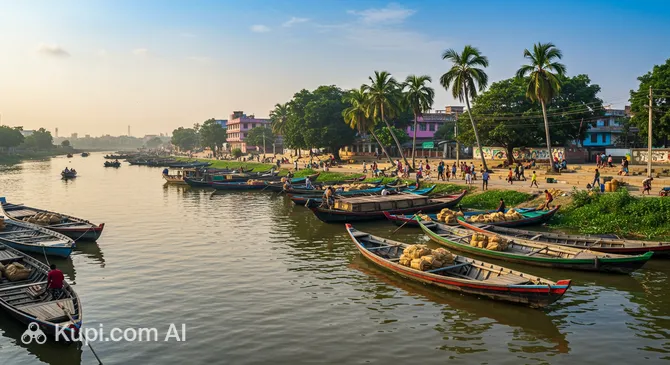
Faridpur is a dynamic commercial hub located in the heart of Bangladesh. The city stretches along the western bank of the Mara River, a tributary of the majestic Padma. As the largest municipality in its district, Faridpur attracts travelers not with the glitz of modern skyscrapers, but with its authentic, bustling business atmosphere and deep trading traditions.
The city's geographical location in the low-lying delta defines its economy: Faridpur is rightfully considered a major center for the trade of jute and the famous Hilsa fish. With a population of over 230,000, the city lives in a rhythm of constant movement—merchants, traders, and artisans are always to be found here, creating the unique flavor of the country's southern region.
Faridpur. Illustration.
Source: Kupi.com AI
Faridpur's rich historical heritage is closely linked to the names of Sufi saints and important 19th-century liberation movements. While primarily an industrial center, it offers tourists a rare chance to see modern Bengali life "as it is": from bustling river ports to quiet side streets where time seems to slow down. We invite you to visit this city to feel the true pulse of the Bangladeshi province.
Weather Overview
The climate of Faridpur is typical for tropical monsoon zones with pronounced seasonality. Throughout the year, the weather changes from pleasant coolness in winter to significant heat and high humidity in summer. Being located in a low-lying delta, the city often feels the influence of proximity to major water arteries, which makes the air here more humid than in northern regions.
Expect truly hot summers (from April to June), when temperatures often rise above +34°C. From June to September, the monsoon season arrives, bringing heavy rains that are vital for agriculture but can cause flooding. The most comfortable time to visit is during the winter months (December and January), when daytime temperatures are a sunny +23°C...+25°C, and nights bring a pleasant freshness.
If you are planning a trip, we recommend studying the detailed city's climate beforehand to choose the right wardrobe. During the dry season, keep in mind that air quality in the city center may decrease due to active trading in the ports, so people with sensitive respiratory systems should be cautious.
Average monthly temperature
Average monthly precipitation
Interesting Facts
The city was named after the famous 13th-century Sufi saint, Farid-ud-Din Masud, whose spiritual influence is still revered in the region.
In the early 19th century, Faridpur became the cradle of the Faraizi movement, which aimed at religious revival and the struggle against British colonial oppression.
The literacy rate in the city is an impressive 81.87%, which is significantly higher than the national average.
The city was the epicenter of the rebellion against forced indigo cultivation, led by the legendary folk hero Dudu Miyan.
Faridpur officially gained municipality status as early as 1869, making it one of the oldest administrative centers in Bangladesh.
How to Get There
Faridpur is conveniently located in the central part of Bangladesh, making it easily accessible from most of the country's major cities. The primary way to get here is by road. Comfortable buses run regularly from the capital, Dhaka; travel time is usually 2 to 3 hours, though potential delays due to traffic on national highways, especially at ferry crossings, should be considered.
For those who prefer air travel, the nearest major aviation hub is the international airport in Dhaka. Upon arrival, you can use transfer services or scheduled buses to reach Faridpur. Details about transport connections and schedules can be found on the page dedicated to how to get to the city.
Historically, water transport played a vital role in the region's connectivity. Traveling along the Padma River remains a scenic, albeit slower, way to move around. The city is also connected by rail to other districts, allowing tourists to choose the most convenient and budget-friendly travel option.
Station
Passenger traffic
Distance
Kamalapur railway station
11
62 km
Airport railway station
6
64 km
Jashore Junction railway station
5
82 km
Agartala railway station
10
148 km
Rajshahi Railway Station
3
151 km
Main Attractions
While Faridpur is not a classic tourist center with typical museums, it offers a unique experience for those seeking authenticity. The city's main "living" attraction is the Central Bazaar. This is a place where you can see firsthand the scale of the trade in jute and the famous Hilsa fish, which forms the basis of the region's economy. A walk through the market allows you to immerse yourself in the atmosphere of genuine Bangladeshi commerce with its sounds, smells, and endless energy.
The Faraizi movement monuments deserve special attention. These historical sites recall the events of the 19th century when the region became a center of struggle against colonial rule. Although many of them have not been turned into official museum complexes, they preserve the memory of resistance leaders such as Haji Shariatullah and Dudu Miyan, and are important points on the city's cultural map.
For those seeking tranquility, a walk along the banks of the Padma River is ideal. Observing traditional fishing and the slow pace of river life provides an insight into how people in this delta have lived for centuries. Golden sunsets over the river and the silhouettes of fishing boats create unforgettable landscapes that will be appreciated by lovers of natural beauty and photography.
Local Cuisine
A gastronomic journey through Faridpur is impossible to imagine without tasting Hilsa fish (or Ilish), which is a true symbol of the region. Freshly caught fish is prepared here in many ways: fried with spices, stewed in mustard sauce, or steamed with chili. The delicate taste of Hilsa combined with fragrant Bengali rice is something gourmets are willing to travel hundreds of kilometers for.
The local diet is based on classic dishes of Bangladeshi cuisine. Be sure to try various types of curry, freshly baked puri and paratha flatbreads, as well as dal (lentil soup). Street food in Faridpur is found at every turn: from spicy snacks to sweets prepared right in front of passersby. A characteristic feature of the local cuisine is the moderate but expressive use of spices that highlight the flavor of fresh products.
Tea culture in the city holds a special place. Numerous tea stalls serve as social hubs where the latest news is discussed over a cup of strong masala tea with milk and sugar. Local restaurants are usually simple and unpretentious, offering hearty portions at affordable prices. Dining in a typical city establishment will allow you to feel the true hospitality and culinary traditions of this trading region.
Travel Tips
A trip to Faridpur will provide you with many unique experiences if you prepare for your journey in advance and take the specifics of this business region into account. These practical tips will help you feel confident and comfortable during your visit.
Clothing and Dress Code: Choose light clothing made of natural fabrics, as the climate here is hot and humid. Given local traditions, it is recommended to wear modest clothing (trousers and long-sleeved shirts for men, long skirts or loose trousers for women), especially when visiting sacred sites.
Getting Around the City: The best way to travel is by rickshaw. Always carry small bills to pay the fare and don't forget to agree on the price before starting your journey.
Finances: The official currency is the Bangladeshi Taka. Cards are accepted very rarely, only in major hotels, so always carry a sufficient supply of cash.
Health and Water: Drink only bottled water and avoid ice in drinks at street cafes. Pharmacies can be found in central areas, but it's better to bring specific medications with you.
Communication: The main language is Bengali. English is understood in business circles and among young people, but knowing a few simple phrases in Bengali will greatly endear you to the locals.
Etiquette: Bangladeshis are very hospitable. Greet people with a slight nod or a traditional gesture. Remember that the right hand is considered clean; use it for passing money or food.
Safety: Faridpur is generally safe, but tourists should avoid industrial zones and deserted outskirts after dark due to heavy truck traffic.
Specific Tip: Be sure to visit the banks of the Padma at sunset—it is the most beautiful and peaceful time in the city, when the heat subsides and life slows down in the rays of the setting sun.
Following these simple rules will make your stay in Faridpur pleasant and help you gain a deeper understanding of the culture of this amazing trading region. Enjoy your trip!
Entertainment & Nightlife
Nightlife in Faridpur is quite understated, reflecting its status as a business and trading center. The main evening entertainment for locals revolves around cozy tea stalls and small cinemas where one can watch popular Bengali films. Unlike the capital, you won't find loud clubs or bars here, but you can enjoy the calm and safe atmosphere of a provincial city.
One of the most popular ways to spend an evening is walking along the Padma River embankment. After the working day, families and groups of young people gather here to breathe the fresh river air and discuss the news. This is the best time to try street snacks and watch the city gradually quiet down, sinking into twilight to the accompaniment of splashing water.
For those seeking more active nightlife, it is recommended to plan trips to nearby Dhaka, where the entertainment industry is much more developed. Nevertheless, Faridpur can surprise guests with its seasonal fairs and festive festivals that fill the streets with bright lights, music, and traditional performances, creating a unique celebratory atmosphere.
Parks & Museums
Faridpur is a city with dense commercial development, so there are few traditional European-style parks here. Nevertheless, the role of the city's main "green lungs" is played by the banks of the Padma River and its tributaries. Picturesque open spaces by the water are favorite places for walking and outdoor recreation. Here you can enjoy the cool river breeze and observe the local flora and fauna of the delta.
From the perspective of cultural enrichment, the city offers sites related to the historical heritage of the Faraizi movement. Local monuments and ancient mosques serve as open-air museums, telling the story of the people's struggle for their rights and religious identity. These places will be of particular interest to those who are fond of South Asian history and national liberation movements.
Despite the shortage of classic galleries, Faridpur's cultural life manifests in its craft workshops and public spaces, where local gatherings and festivals are often held. Exploring these corners allows tourists to touch the living heritage of the region, which is kept not behind museum display cases, but in the everyday life and traditions of the local residents.
Getting Around
Faridpur's transport system perfectly reflects the pace of life in this trading city. The primary and most popular way to get around is by rickshaw. These three-wheeled carriages are available on every corner and allow for easy maneuvering through narrow streets. A rickshaw ride is not just a way to reach a destination, but a full-fledged attraction that allows you to see the city in detail. The price should be agreed upon in advance, as meters are not used here.
Intra-city connection is also supported by a network of buses and minibuses, which link the center with the outskirts and neighboring settlements. During peak hours, public transport can be very crowded, so tourists are better off planning their trips for daytime. For more comfortable travel, you can use taxi services, which are easiest to call through hotel administrators.
A special role is played by water transport on the Padma River. Although it is more often used for cargo (especially jute), there are also passenger boats plying between the banks. The city's road network is fairly developed, but traffic can be chaotic due to the abundance of trucks and rickshaws, so pedestrians should exercise caution. Payment in transport is made in cash, and the cost remains one of the lowest in the region.
Accommodation
The hotel sector in Faridpur is primarily focused on business travelers and trade agents, so practical and functional accommodation options predominate here. You can find many inexpensive guesthouses and mid-range hotels in the city that offer a basic set of amenities: clean rooms, air conditioning, and access to hot water.
For tourists planning to stay in the city for a longer period, renting apartments in residential quarters could be an interesting option. This allows for a better acquaintance with local life and offers significant savings. Accommodation prices here are noticeably lower than in the capital, making Faridpur an attractive destination for budget travelers.
When choosing a hotel, it is recommended to focus on properties located near central shopping districts or administrative offices, as this will provide better access to transport and food outlets. During peak seasons or major trade fairs, rooms in the best hotels should be booked in advance by contacting administrators directly or through local booking services.
Nearby Cities
Faridpur serves as an excellent starting point for exploring the central and southern regions of the country, offering travelers interesting routes for day trips. Just 15 kilometers away is Goalundo Ghat—an important river port where you can observe large-scale shipping and feel the power of the Padma River. This place is ideal for those who want to see the country's industrial and transport life from the inside.
Another attractive destination is Manikganj, located 33 kilometers from the city. It is interesting for its cultural heritage and picturesque rural landscapes. Also worth noting are Dhubaria and Lohagara, which allow you to get acquainted with the traditional way of life in the Bangladeshi province and the region's craft traditions.
City
Population
Distance
Goalundo Ghat
91 675
15 km
Manikganj
20 000
33 km
Duptiair
26 336
43 km
Dhubaria
12 760
44 km
Lohagara
30 815
51 km
One should also not forget the proximity to the capital: a trip to Dhaka will allow you to swap the calm pace of Faridpur for the energy of a metropolis with its museums and palaces. We recommend not limiting yourself to city walks and making sure to explore the surroundings to fully appreciate the diversity and hospitality of this part of the country.
Shopping & Souvenirs
Shopping in Faridpur is primarily an immersion into the atmosphere of traditional oriental markets. The city is famous for its high-quality jute, and you can purchase unique products made from this eco-friendly fiber here: from durable bags and rugs to exquisite decorative items. The region is also known for the production of cotton fabrics, which make for an excellent and practical souvenir.
The heart of commercial life is the Central Bazaar. It houses a huge number of stalls offering everything from fresh spices and the famous fish to traditional clothing. Prices in Faridpur's markets are significantly lower than in the capital, and the purchasing process is always accompanied by the opportunity to politely haggle with the seller, which is an integral part of the local culture.
Modern shopping centers in the city are modestly represented, so for branded items, it is better to head to Dhaka. However, it is in Faridpur that you should look for handcrafted items. Shops usually operate from morning until late evening, and cash is most often accepted as payment. Visiting local markets will give you not only interesting purchases but also many vivid impressions from interacting with the locals.