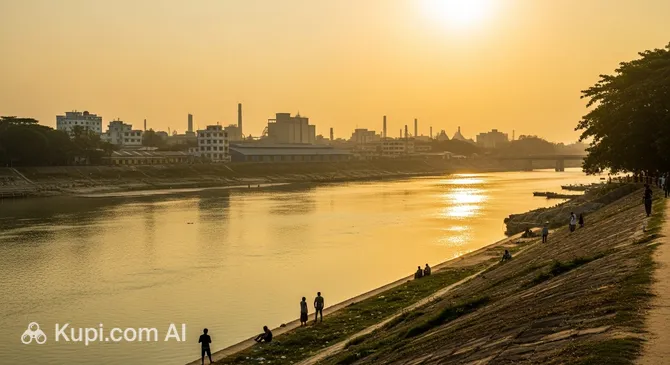
Siddhirganj is a dynamically developing industrial center located in Bangladesh on the banks of the scenic Shitalakshya River. As an important hub of the Narayanganj District, this city does not claim to be a classic tourist resort; however, it possesses a unique atmosphere as the "working heart" of the region. It is home to more than 15,000 factories and enterprises, making it one of the country's key industrial hubs.
The city's geographic location historically favored its development as a major river port. Siddhirganj. Illustration.
Source: Kupi.com AI
The rich history of Siddhirganj is inextricably linked to the production of legendary muslin, for which the region was once nicknamed the "Dundee of the East." Today, the city's population exceeds 250,000 people, most of whom are employed in the textile and jute industries.
Despite the dense urban development, tourists may find interest in the city's industrial scale, including the historical site of the Adamjee Jute Mills, once the largest jute mill in the world. A visit to this location allows you to see firsthand how the region's modern industrial sector lives and works. We recommend considering the city as an interesting stop for a brief visit to experience the country's economic way of life.
Weather Overview
Siddhirganj is dominated by a tropical monsoon climate, characterized by high humidity and significant seasonal changes. You can find out more about the current weather in the city on the corresponding page of our guide.
The summer period, lasting from April to May, brings intense heat to the region with temperatures often exceeding 33°C, accompanied by frequent thunderstorms. The rainiest time occurs in June–August when monsoons bring up to 300–400 mm of precipitation per month. Winter (December–January) here is moderately cool and dry, with an average temperature of around 19°C, which is considered the most comfortable time for visits.
It is worth noting that due to the high density of industrial buildings and the operation of power plants, a "heat island" effect is observed in the city, making heat and humidity feel more intense than in rural areas. During calm periods, air quality may decrease due to industrial emissions, which is important for travelers with sensitive health to consider.
Average monthly temperature
Average monthly precipitation
Interesting Facts
The tradition of making Jamdani muslin in this region is recognized by UNESCO as a Masterpiece of the Oral and Intangible Heritage of Humanity.
Founded in 1951 in Siddhirganj, the Adamjee Jute Mills held the status of the world's largest jute enterprise for decades.
The city is a vital energy hub: it houses four power plants, including a modern 335 MW combined cycle power plant.
The export volume from the Adamjee EPZ industrial zone alone exceeded an impressive $4 billion USD in 2018–2019.
Due to the vast number of textile enterprises and its historical role in the fabric trade, Siddhirganj and its surroundings are often called the "Dundee of the East," in analogy to the Scottish industrial city.
How to Get There
Siddhirganj's accessibility is defined by its proximity to the nation's capital and its status as a major economic hub. The main transport routes connect the city with Dhaka and the administrative center of the district, Narayanganj. To plan your route in more detail, you can explore the ways to get to the city on our dedicated page.
The nearest international aviation hub is Hazrat Shahjalal International Airport in Dhaka, located approximately 30–40 kilometers away. The journey from the terminal to Siddhirganj by taxi or private car can take between 1.5 and 2.5 hours, depending on traffic density, which can be very high on this route.
Rail communication also plays an important role in the region's logistics. Passengers often use stations in neighboring Narayanganj, from where Siddhirganj can be reached by rickshaw or CNG (auto-rickshaw) in 10–15 minutes. Bus routes from Dhaka run regularly along the Dhaka-Narayanganj highway.
Station
Passenger traffic
Distance
Kamalapur railway station
11
7 km
Airport railway station
6
20 km
Agartala railway station
10
82 km
Shaistaganj Junction railway station
5
118 km
Jashore Junction railway station
5
143 km
It is important to keep in mind that during peak hours—in the morning and evening when factory shifts begin or end—the roads can be heavily congested with freight transport and buses. It is recommended to plan trips for the middle of the day to avoid long waits in traffic jams.
Main Attractions
Siddhirganj is primarily an industrial zone, so classic architectural monuments or museums are hard to find here. Nevertheless, the main geographical and historical landmark remains the Shitalakshya River. On its banks, you can observe the heavy traffic of cargo ships and boats, conveying the spirit of an ancient port center once famous for the trade of the finest muslin.
Among the significant infrastructure sites, the Adamjee EPZ (Export Processing Zone) stands out, established on the site of the legendary jute mill. Although access to the factory grounds is restricted, the scale of this industrial giant is impressive. For those interested in modern engineering, the views of local power plants, with a combined capacity exceeding 400 MW, may be of interest as they power a significant portion of the region.
In recent years, an urban improvement project has been underway — Siddhirganj Lake. It is planned that the waterfront, stretching over 5 kilometers, will become the primary place for residents to walk and relax, featuring bridges and pedestrian paths. Although work is still ongoing, this site promises to become a major "green" oasis amidst the factory quarters.
Local Cuisine
The culinary scene in Siddhirganj is a true kaleidoscope of traditional Bangladeshi flavors. The foundation of the local diet is rice with various curries. Dishes made from fresh fish caught in the Shitalakshya River are particularly popular. It is worth trying local interpretations of fish curries prepared with mustard oil and aromatic spices.
Street food plays a huge role in the city's life. At every turn, you can find vendors selling fuchka (crispy shells filled with chickpeas and spicy sauce) and cha. The tea culture here is unique: strong black tea with milk and sugar ("cha") is the main drink, over which deals are made and friendly conversations are held. Freshly squeezed tropical fruit juices are also popular in season.
As an industrial city, most establishments are simple canteens and food courts near markets, offering hearty and inexpensive food for workers. If you are looking for more refined restaurants with a diverse menu, it is worth heading to neighboring Narayanganj, where the gastronomic choice is significantly wider. Nevertheless, the authentic taste of homemade Bengali dishes in the simple eateries of Siddhirganj will leave a vivid impression.
Travel Tips
Siddhirganj is a unique place that will reveal Bangladesh at its most hardworking and energetic. To ensure your trip goes smoothly and leaves only pleasant impressions, check out our practical recommendations.
Clothing and Essentials: Choose light clothing made from natural fabrics, as the city is often hot and humid. Be sure to bring an umbrella during the rainy season. Keep in mind that the city is conservative, so clothing should be modest, especially when visiting mosques.
Transport: For moving around the city, CNG auto-rickshaws are the most convenient. For trips to Dhaka or the airport, it is better to call a taxi through the Uber app to avoid long haggling over the price.
Finances: The main currency is the Bangladeshi Taka (BDT). Cards are rarely accepted in Siddhirganj, so always carry a sufficient supply of cash. ATMs can be found in central areas and near major industrial zones.
Health and Safety: Due to the high concentration of enterprises, the air can be dusty, so people with respiratory sensitivities should carry a mask. Drink only bottled water and avoid ice in street drinks.
Communication: The primary language is Bengali. English is understood by employees of large companies and the youth. It is helpful to learn a few basic phrases in Bengali—locals greatly appreciate the gesture.
Local Etiquette: Greet people with the traditional "Assalamu Alaikum." Always remove your shoes before entering someone's home or a mosque. The right hand is considered "clean"; use it for handshakes and eating.
What to Avoid: Do not photograph strategic sites or power plants without special permission. Also, try not to plan important travel during peak hours (6–9 AM and 5–8 PM) to avoid getting stuck in traffic.
Additional Tip: If you have the opportunity, visit a local Jamdani weaving workshop—it is a rare chance to see an ancient art that has survived to this day.
Following these simple rules will help you feel the true rhythm of life in this industrial giant and make your visit as comfortable as possible!
Entertainment & Nightlife
The entertainment scene in Siddhirganj is primarily geared toward local residents and shift workers, so there are no large nightclubs or fashionable bars. The city's nightlife winds down quite early, and the main evening gathering spots are the street tea houses and small eateries near markets, where people gather over a cup of hot tea to discuss the day's news.
For more diverse leisure activities, such as visiting cinemas or large shopping centers, residents usually head to neighboring Narayanganj or Dhaka, which are just a short trip away. Daytime entertainment within the city is limited to walks along the banks of the Shitalakshya River or visits to the colorful local bazaars.
Safety in the city is at a moderate level, typical for industrial suburbs. Tourists are advised to avoid walking in deserted factory outskirts late at night and to use official taxis or motorized rickshaws for traveling between districts.
Parks & Museums
Due to the dense industrial development, Siddhirganj is not rich in extensive park areas. Traditional museums in the classic sense are also absent in the city. However, the industrial quarters themselves and the banks of the Shitalakshya River serve as a "living museum," where one can observe traditional methods of river navigation and trade that have survived for centuries.
The main urban greening project is the creation of a recreational zone along Siddhirganj Lake. This ambitious project aims to provide a modern space for relaxation with walking paths and bridges, which will be a welcome relief for the residents of the industrial center. Although the site is still in the completion stage, its waterfronts already attract those who want to take a break from the city noise.
To visit full-fledged museums dedicated to the history or art of Bangladesh, travelers usually head to Dhaka. Nevertheless, industrial heritage enthusiasts will find much of interest in the architecture of Siddhirganj's old factory buildings, which stand as silent witnesses to the region's rapid economic growth.
Getting Around
The public transport system in Siddhirganj is typical for the region's large industrial hubs. The majority of passengers are carried by numerous buses and minibuses that connect the city with Dhaka and other parts of the Narayanganj District. Fares are very inexpensive, but be prepared for transport to be overcrowded with factory workers during peak hours.
For short-distance trips within the city, rickshaws and CNG (three-wheeled motorized rickshaws running on compressed natural gas) are indispensable. These are the most maneuverable modes of transport in conditions of narrow streets and heavy traffic. The price for a rickshaw ride should always be negotiated in advance, as they do not have meters.
There is no metro or tram system in Siddhirganj, and traveling by car can be difficult due to the abundance of trucks serving the industrial zones. If you are planning a trip to Dhaka or the airport, it is best to use ride-hailing services through mobile apps (such as Uber), which provide a fixed price and more comfortable travel conditions.
Accommodation
The hotel infrastructure in Siddhirganj is primarily oriented toward business travelers, engineers, and employees of industrial enterprises. There are practically no luxury five-star hotels here, but budget guesthouses and apartments designed for long-term stays are widely available.
Accommodation prices in local guesthouses are quite affordable, usually starting from 500–1,500 Bangladeshi Taka per night. Conditions in these establishments are basic but perfectly suitable for those visiting the city for business purposes. For travelers who prefer a higher level of comfort, the best option would be to stay in hotels in Dhaka or central Narayanganj.
When choosing accommodation, it is worth paying attention to the distance from power plants and large manufacturing facilities to minimize noise levels. It is better to book rooms in the most popular guesthouses in advance, as they may be occupied by employees of international companies working in the industrial zone.
Nearby Cities
Thanks to its location in a densely populated region, Siddhirganj can serve as a starting point for short trips to interesting nearby locations. Proximity to major cities makes it easy to swap industrial landscapes for historical landmarks or bustling capital markets.
Just 5 kilometers away is Narayanganj, the administrative and commercial center of the district. This city is a must-visit for its colorful markets and the chance to see old buildings from the colonial era. Also, in just an hour or two, you can reach Dhaka—a massive metropolis that houses the country's main museums, parks, and shopping centers.
Exploring the surroundings of Siddhirganj provides a more complete picture of life in the Ganges and Brahmaputra delta, allowing you to see the contrast between the powerful industrial sector and the centuries-old traditions of Bengali cities.
Shopping & Souvenirs
Shopping in Siddhirganj is primarily practical in nature. The city is famous for its markets located near the factories, where you can find high-quality fabrics and textile products at very attractive prices. Jute goods—ranging from durable bags to decorative items produced at local enterprises—deserve special attention.
Although the city itself lacks massive modern shopping malls with glass storefronts, the local bazaars are striking in their energy. Here you can purchase authentic muslin or fabrics with Jamdani patterns, which have been created by the region's artisans for centuries. This is perhaps the most valuable souvenir you can bring home from this trip.
Most retail outlets operate from early morning until late evening, except during prayer times. Payments are primarily made in cash (Bangladeshi Taka); bank cards are rarely accepted. For a wider range of branded clothing or electronics, local residents typically travel to the shopping centers of neighboring Narayanganj.