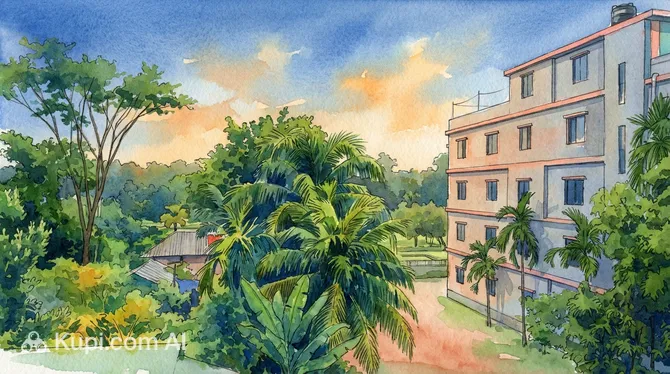
Barura is a picturesque corner of the Chittagong Division that reveals the authentic face of rural Bangladesh to travelers. Located in the Cumilla District, this upazila (administrative sub-district) features endless emerald plains where life flows in harmony with nature and age-old traditions. There are no noisy highways or neon signs here, but instead an abundance of genuine hospitality and a peaceful atmosphere.
Barura. Illustration.
Source: Kupi.com AI
Geographically, Barura spans an area of over 240 square kilometers, crisscrossed by a network of small rivers and canals. The population of the district is about 473,000, most of whom are engaged in agriculture. It is the agrarian nature of the region that shapes its unique landscape: neat rectangles of rice fields give way to dense groves of fruit trees, creating a perfect backdrop for those seeking inspiration in simplicity.
The town gets its name from the Barua ethnic group, who historically inhabited these lands. You can learn about the past of this land by talking with local elders and visiting traditional villages where the ancestral way of life has been preserved. Barura does not strive to be a tourist center in the conventional sense, and it is precisely this authenticity that is its main attraction. We invite you to visit this place to see the real Bangladesh, hidden from the eyes of the mass tourist.
Weather Overview
Barura is characterized by a classic tropical monsoon climate, which dictates the rhythm of life for the entire region. The main weather changes here are divided into two main periods: a dry, relatively cool winter and a hot, humid summer accompanied by heavy monsoon rains. The variety of natural colors depends directly on the amount of rainfall, which turns the fields into lush green carpets.
The winter months, from November to February, are considered the most comfortable for visiting: the average temperature in January is about 18.8°C, and the air remains dry. Warming begins in March, reaching a peak in April and May when the thermometer can show above 34°C. The summer season brings monsoons — the maximum amount of precipitation (more than 300 mm per month) falls in June and July, which is important to consider when planning trips on dirt roads. More detailed information about the regional climate can be found in our special section.
Expect a very hot and humid summer with frequent downpours followed by a mild and sunny winter. High humidity is characteristic of most of the year, which contributes to the fertility of local soils but requires travelers to pay attention to their choice of clothing and hydration.
Average monthly temperature
Average monthly precipitation
Interesting Facts
The name of the town comes from the self-designation of the Barua people, which literally means "land of the Barua."
The region's economy is almost entirely dependent on rice — Barura's fertile soils allow for the harvesting of rich crops of this key staple for the country.
Over the past thirty years, the population of the upazila has grown by almost one and a half times: from 310,000 people in 1991 to more than 450,000 in 2022.
Despite the predominant Muslim population (about 93%), Hindu, Buddhist, and Christian communities have historically coexisted peacefully in Barura.
The district is known for its "floating" landscapes during the monsoon season, when low-lying fields turn into huge mirror-like lakes with islands of villages rising among them.
How to Get There
The transport accessibility of Barura largely depends on its proximity to a major regional center — the city of Cumilla. There are no direct air connections or major railway hubs within the upazila itself, so a traveler's journey usually involves transfers in the nearest major cities of Bangladesh. To plan your route as effectively as possible, we recommend reading the detailed information about the route to Barura.
The primary way to reach this region is by land transport. From Dhaka or Chittagong, you need to take a bus or train to Cumilla (the journey from the capital takes about 3–4 hours). From Cumilla to the center of Barura, minibuses and three-wheeled CNG rickshaws run regularly. A rickshaw ride along rural roads takes between 45 and 90 minutes, depending on the condition of the road and traffic congestion.
Barura does not have its own airports; the nearest air hub is Cumilla Airport, however, its operational status often changes, so it is more convenient for international travelers to use Dhaka Airport.
Railway service is also not extended directly to Barura. Travelers should aim for the station in Cumilla, which receives trains from the country's key cities, and then transfer to local transport.
Station
Passenger traffic
Distance
Agartala railway station
10
51 km
Kamalapur railway station
11
75 km
Airport railway station
6
84 km
Shaistaganj Junction railway station
5
108 km
Chattogram University railway station
4
126 km
Main Attractions
In Barura, you won't find grand architectural monuments or noisy theme parks, as the main attraction here is nature itself. Endless rice fields, which change their color from tender green to golden depending on the season, create a meditative landscape ideal for walking and photography. Quiet village streets and the banks of local rivers allow you to touch the unhurried rhythm of life in the Bengali countryside.
Among the architectural sites, the Alhaj Zamir Khan Jame Mosque stands out — it is one of the most significant and beautiful mosques in the district. It serves not only as a spiritual center for local residents but also as a striking example of modern Islamic architecture in the region. Also noteworthy are the traditional haats — local markets that come alive on certain days, turning into a bustling stream of colors, sounds, and aromas where you can see the fruits of the labor of local farmers.
For those ready for a short trip outside the town, the famous ruins of Lalmai-Mainamati are located just 20–30 kilometers away. This archaeological complex holds the remains of ancient Buddhist monasteries and is a must-see for history buffs. In Barura itself, it is worth taking time for simple joys: watching the sunset over the flooded fields and getting to know the traditional crafts of the local residents.
Local Cuisine
The cuisine of Barura is a celebration of freshness and natural flavors, typical of the country's agrarian heartland. The staple of the diet is bhat (boiled rice), served with a variety of curries. Be sure to try local river fish, such as Ilish or Magur, prepared with mustard oil and hot spices. The fish here is always very fresh, as it is caught in local waters immediately before cooking.
A special place in the meal is occupied by dal — a thick lentil soup that serves as the perfect complement to rice. Popular vegetable dishes include fried eggplant and potatoes with spices. Don't forget to taste the fresh homemade paneer cheese, which farmers often prepare according to ancient recipes. In season, juicy mangoes, guava, and jackfruit are available in abundance and can be bought right by the roadside.
The food culture in Barura is centered around home-cooked lunches and small street tea stalls. Locals often eat at haujo — roadside eateries in markets where a lively atmosphere prevails. The main drink is cha — strong black tea with plenty of milk and sugar. A visit to the local bazaar will give you the best idea of the gastronomic traditions: here you can see mountains of aromatic spices and freshly harvested vegetables.
Travel Tips
A trip to Barura is a chance to see Bangladesh without filters, but such a journey requires some preparation. These tips will help you feel confident and comfortable in the rural heartland.
Clothing and Essentials: Choose lightweight, modest clothing made from natural fabrics to protect yourself from the sun and respect local conservative traditions. Be sure to bring comfortable closed shoes for walking on dirt roads and a power adapter for type C, D, or G sockets.
Transport: Rely on CNG rickshaws within the district. Agree on the price before starting the trip. For longer trips, it's better to rent a car with a driver in Cumilla.
Finances: Have a sufficient supply of cash in Bangladeshi Taka. Cards are accepted almost nowhere in Barura, and ATMs may be unavailable or may not work with international cards.
Health: Drink only bottled or filtered water. Always use repellents, especially during the rainy season, to avoid mosquito bites.
Communication: The main language is Bengali. Few people understand English, so learn a couple of basic phrases: "Dhonnobad" (thank you) and "Namashkar/Assalamu Alaikum" (hello).
Local Etiquette: Be sure to remove your shoes when entering homes or mosques. Be moderate in your behavior and always ask for permission before taking photos of local residents.
What to Avoid: Do not walk alone in remote fields at night and avoid eating street food if you are not sure about the conditions of its preparation.
Seasonality: The best time to visit is from November to February, when the weather is at its coolest and driest.
Following these simple rules will make your immersion into the rural life of Barura safe and unforgettable. Have a great trip!
Entertainment & Nightlife
Entertainment in Barura is exclusively quiet and traditional. There are no nightclubs, bars, or discos here — life in this rural region quiets down at dusk, following natural rhythms. The main places for evening leisure for local residents are tea stalls and market squares, where the latest news is discussed and community affairs are resolved over a cup of hot drink.
The public here is predominantly conservative and friendly, and the main style of communication remains unhurried conversation. Evening strolls through the central streets of the villages allow you to feel the cool air after a hot day and enjoy the silence, interrupted only by the sounds of nature. For those looking for a more active nightlife with restaurants and cinemas, the only option would be a trip to neighboring Cumilla, located half an hour away.
Daytime entertainment in Barura involves exploring local landscapes. You can organize a picnic on the riverbank or go on a short bicycle trip through the surrounding villages. The region takes on a special charm during religious and folk festivals, such as Eid al-Fitr, when the streets are decorated and local residents hold fairs and family celebrations, inviting guests to share their joy.
Parks & Museums
In the traditional sense, there are practically no museums or developed city parks in Barura. The role of parks here is performed by natural landscapes: riverbanks, shady groves, and open spaces of the fields. Locals use these natural zones for relaxation and unhurried strolls, enjoying the fresh air away from the industrial smoke of megacities.
The absence of formal museums is compensated for by the living history that can be seen in the architecture of old village mosques and the way of life of local communities. Each village in the upazila is a kind of open-air ethnographic museum, where farming traditions and crafts are passed down from generation to generation in virtually unchanged form.
For those who need a cultural program with exhibits and guides, it is recommended to head to neighboring Cumilla. There are archaeological museums there that house artifacts of the ancient civilizations of the region. In Barura itself, the best "exhibit" will be the sunset over the endless green horizon, which will leave no one indifferent.
Getting Around
The transport system in Barura is fully adapted to rural conditions and the needs of local residents. You won't find a metro or standard city buses here. The main means of transportation around the upazila are three-wheeled CNG auto-rickshaws (running on compressed natural gas) and traditional cycle rickshaws. They are ideal for moving along narrow roads between villages, offering a budget-friendly and colorful way to get around.
Minibuses and small trucks converted for passenger transport are used for connections between distant villages and travel toward Cumilla. It is worth considering that the roads in the region are often narrow, and during the monsoon season, dirt sections can become difficult to pass. This makes trips slow but allows you to see the surrounding landscapes in detail.
Fares are always paid in cash to the driver; there are no fixed tariffs or unified travel cards, so it is better to agree on the price for a rickshaw ride in advance. Bicycle rental is not officially developed, but if desired, you can arrange to rent a bike from local residents. The main advice for tourists is to allow more time for travel and be prepared for some shaking on rural roads.
Accommodation
The hotel infrastructure in Barura is underdeveloped, as the town is not a mass tourist destination. Most accommodation options are small private guesthouses or rooms in the homes of local residents. This is a great chance for those who want to fully immerse themselves in local life, but keep in mind that the level of comfort here will be basic, without standard Western amenities.
For travelers who prefer classic hotels with stable Wi-Fi, air conditioning, and service, the best solution would be to stay in neighboring Cumilla. There is a wide range of accommodation there, from budget hotels to mid-range options. You can travel from Cumilla to Barura daily, spending no more than an hour on the road.
If you still decide to find accommodation directly in the countryside, we recommend arranging a booking in advance through local intermediaries or acquaintances, as such properties are rarely listed in international search engines. During the peak agricultural season or major holidays, vacancies in the private sector can fill up quickly.
Nearby Cities
Barura serves as an excellent starting point for exploring the surroundings, allowing travelers to see the diversity of the eastern part of the country. Neighboring towns and upazilas offer unique historical and cultural discoveries that are easily accessible as part of a day trip.
The most popular destination is the city of Cumilla, located just 15–20 kilometers away. It is a major administrative and cultural center, famous for its educational institutions, museums, and proximity to the archaeological sites of Mainamati. It is also worth stopping by the town of Bharella or visiting Brahmanpara to see how the rural landscape and way of life change in different parts of the region.
Exploring the surroundings of Barura will allow you to get a more complete picture of life in Bangladesh, moving from quiet rice fields to bustling city markets and ancient ruins. Each such trip is a new chance to meet amazing people and the hidden treasures of this land.
Shopping & Souvenirs
Shopping in Barura is primarily about visiting local bazaars, known as haats. There are no glittering shopping malls with global brands here, but there is the authentic atmosphere of an Eastern market. The main trading points are concentrated in the center of the upazila and come alive on certain days of the week when farmers from all around bring their goods.
The main items in the markets are food products: various types of rice, piles of fresh vegetables and fruits, as well as aromatic spices that will make a great gift for cooking enthusiasts. You can also find high-quality locally produced fabrics and ready-made clothing in the national style. Look out for folk crafts: woven baskets made of bamboo and jute, which are durable and feature an authentic design.
Shops usually operate from early morning until late evening, closing during the Friday noon prayer. Payment is accepted exclusively in cash in the local currency (Taka), so it is worth taking care to change money in larger cities beforehand. The process of buying at the market is often accompanied by friendly bargaining, which is an integral part of the local trading culture.