Support

Lacerda Elevator

About

The Lacerda Elevator (Elevador Lacerda) is not just urban transport, but one of the most recognized symbols of Salvador and all of Brazil. This unique public lift is not only an important transport artery but also a popular attraction drawing tourists from all over the world. It performs a key function by connecting two parts of the city separated by a steep slope—the historical Upper City (Cidade Alta) and the business Lower City (Cidade Baixa).
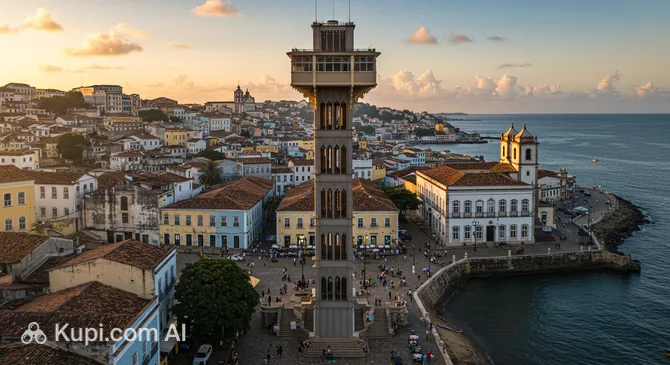
Lacerda Elevator. Illustration.
Source: Kupi.com AI

Traveler photos:

The 72-meter structure is an impressive example of Art Deco architecture. The construction consists of two towers, one of which houses four elevator cabins, each of which transports passengers up quickly and comfortably. The ride takes only about 30 seconds, but the impressions last a long time. Thousands of residents and tourists use the lift's services daily.

In addition to its practical use, the Lacerda Elevator serves as a magnificent observation deck. Its upper platform offers a breathtaking panoramic view of the Bay of All Saints, the famous Modelo Market, and other iconic landmarks of Salvador. It is the perfect place to appreciate the scale of the city, take beautiful photos, and feel its unique atmosphere.

Contacts

To plan your visit to the Lacerda Elevator, here is the basic contact information. It is recommended to check the operating hours and prices on official resources or on-site, as they may change.

How to contactContact
AddressPraça Tomé de Souza, S/N - Centro, Salvador - BA, 40020-000, Brazil
Websitemobilidade.salvador.ba.gov.br

What to Do

The main attraction of the Lacerda Elevator is, of course, the ride itself between the two levels of Salvador. This short but memorable journey allows you not only to move quickly from the commercial Lower City to the historical Upper City but also to enjoy breathtaking panoramic views of the Bay of All Saints. From the upper platform, the view is especially impressive at sunset, when the sun paints the sky in warm tones, and in the evening, special lighting is turned on, transforming the elevator into a glowing art object.

After going up, travelers find themselves in the heart of colonial history—the Pelourinho district. This part of the city, recognized as a UNESCO World Heritage site, charms with its cobblestone streets, brightly colored building facades, and numerous Baroque-style churches. A walk through Pelourinho is an immersion into a rich culture and history, where at every turn you can encounter street musicians, capoeira dancers, and cozy cafes with local cuisine.

When going down to the Lower City, you should definitely visit the famous Mercado Modelo market, located in the old former customs building. It is a true center of crafts where you can find a wide variety of local souvenirs: from leather goods and musical instruments like the berimbau to ceramics, lace, and traditional jewelry. Here you will also find restaurants serving Bahian cuisine, allowing you to combine shopping with gastronomic discoveries.

Getting There

Getting to the Lacerda Elevator in Salvador is quite simple, as it is one of the city's most central and recognizable landmarks. The lift is located in the heart of the city and connects its two key parts: the Upper City (Cidade Alta) with its historical center, and the Lower City (Cidade Baixa), which houses business districts and the famous Modelo Market. Thanks to its strategic location, it is easy to reach on foot if you are already in one of these areas.

For those who prefer public transport, many city bus routes pass in the immediate vicinity of both lift entrances. To reach the upper station, look for buses heading toward the Pelourinho historical center or Praça da Sé. If your goal is the lower station, look for routes heading to the Comércio district or the Mercado Modelo market. The bus network in Salvador is well-developed, making this method of travel accessible and convenient.

The most comfortable way to reach the Lacerda Elevator is to use a taxi or the ride-hailing apps popular in Brazil. Simply tell the driver "Elevador Lacerda" and specify which entrance you want to go to—the upper part (parte alta) or the lower part (parte baixa). This is especially convenient if you are traveling from the airport, a distant neighborhood, or if you simply value speed and comfort. The trip from most tourist areas of the city will not take long.

Nearest city: Salvador

History & Facts

The history of the Lacerda Elevator is a tale of engineering bravery and modernization. Its construction began in 1869 on the site of a simple manual lift used by the Jesuits. The ambitious project was initiated and led by engineer Augusto Frederico de Lacerda. High-quality steel imported from Great Britain was used for the construction. In December 1873, the lift, equipped with two hydraulic cabins, was officially opened and originally named Elevador do Parafuso. It was only in 1896 that it was renamed in honor of its creator, immortalizing Lacerda's name.

The twentieth century brought iconic transformations to the lift. In 1906, the hydraulic system was replaced with an electric one, significantly increasing its efficiency. But the most extensive reconstruction took place in 1930, when the Lacerda Elevator acquired its current, globally recognized appearance. The towers were rebuilt in an elegant Art Deco style, and two more cabins were added to the existing two to handle the growing passenger traffic. It was this modernization that turned a utilitarian structure into a true architectural masterpiece.

Over time, the lift has been repeatedly improved to meet modern safety and comfort standards. In the 1980s, the supporting structures were reinforced, and in 1997, a modern electronic control system was installed. In 2002, the lift gained impressive night lighting that highlights its architectural forms and makes it a prominent landmark in nighttime Salvador. Recognition of its historical and cultural value came with its inclusion in the Brazilian Heritage list in 2006. An interesting fact: during the 2016 Olympic torch relay, one of the participants made a dramatic descent from the elevator tower with the torch in hand.

Time Needed

A visit to the Lacerda Elevator can take varying amounts of time depending on your plans. The ride itself in one of the cabins lasts only about 30 seconds. However, to fully enjoy this place, it is worth setting aside a little more time. For a tourist, the main value, besides quick transport, lies in the panoramic views from the upper observation deck. If your goal is simply to go up or down and take a few photos, 20–30 minutes may be enough, especially if there are no queues.

A more realistic estimate is about 1-2 hours. This will be enough to wait for your turn without rushing (queues can be small during peak hours), take the ride, and enjoy the views of the Bay of All Saints and the Lower City. Many tourists spend 15 to 30 minutes on the observation deck taking photos and studying the panorama. It is also worth considering time for a short walk through the squares where the elevator exits lead: Praça Tomé de Souza at the top and Praça Cairu at the bottom.

It is important to understand that the Lacerda Elevator is rarely visited in isolation from its surrounding attractions. It serves as a gateway to the historical Pelourinho district in the Upper City and the Modelo Market in the Lower City. Therefore, most travelers incorporate a visit to the lift into a longer walk. If you plan to explore the colonial streets of Pelourinho after going up or go shopping at the market, the total time spent in this area could easily be from 2-3 hours to half a day. Thus, the elevator itself is a quick but essential part of a large and fascinating route through Salvador.

Working Hours

The Lacerda Elevator functions as public transport and is open to visitors year-round. According to the latest data as of March 2024, the lift operates on a new schedule: from Monday to Friday it is open from 6:00 AM to 11:00 PM, and on Saturdays, Sundays, and public holidays from 7:00 AM to 10:00 PM. These hours may change depending on the season or city events, so it is recommended to check the information on-site or on the city's official portals before your visit.

Since the Lacerda Elevator is an important part of Salvador's transport system, advance ticket booking is not required. The fare is paid on-site and is usually very symbolic. Due to recent renovation work, access to the lift may be temporarily free. Queues are possible during the tourist season and peak hours, but the four lift cabins ensure high capacity, transporting thousands of passengers daily.

DayOpening hours
Monday6:30 – 21:30
Tuesday6:30 – 21:30
Wednesday6:30 – 21:30
Thursday6:30 – 21:30
Friday6:30 – 21:30
Saturday7:00 – 21:30
Sunday7:00 – 21:00

Nearby

Visiting the Lacerda Elevator is just the starting point for discovering the rich culture of Salvador. Located on the border of two unique city districts, it serves as the perfect start for exploring the surroundings. A walk through the nearby streets will allow you to dive deeper into the history and daily life of this colorful city in Brazil.

A variety of iconic spots are concentrated in the immediate vicinity of the lift: from museums and historical centers to colorful markets and cozy bars. Exploring these attractions will enrich your journey, adding vivid impressions and allowing for a more complete understanding of the soul of Salvador. Below is a list of interesting sites located within walking distance.

NameDistance
Afro-Brazilian Museum0.2 km
Museum of Mercy0.2 km
Mercado Modelo0.2 km
O Cravinho0.3 km
House of Carnival of Bahia0.3 km
Cuco Bistrô0.4 km
São Marcelo Fort0.7 km

Have you reached the end of the page?

So the route has been studied inside and out