Support

Wat Phnom

About

Wat Phnom is an iconic Buddhist temple complex and one of the primary historical landmarks of Phnom Penh, the capital of Cambodia. This revered temple, known among locals as the "Mountain Temple," sits majestically atop an artificial hill, giving it a special significance in the urban landscape.
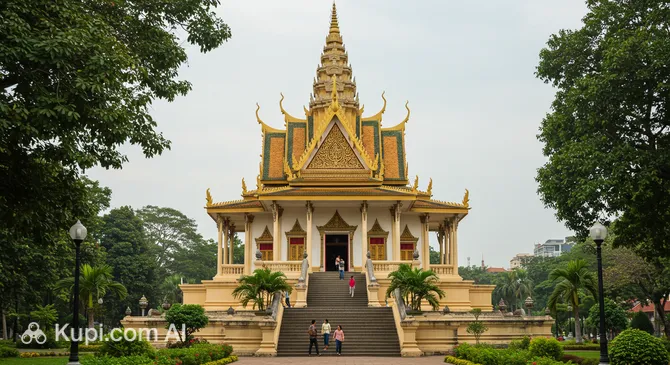
Wat Phnom. Illustration.
Source: Kupi.com AI

Traveler photos:

The hill on which Wat Phnom stands reaches a height of 27 meters, making it the highest point in the city and the tallest religious structure in Phnom Penh. For residents of the capital, it is not just a temple but a sacred place of pilgrimage and an important cultural heritage site, held in deep respect and veneration.

The area surrounding Wat Phnom is lush with the greenery of a picturesque park, creating an atmosphere of peace and tranquility right in the center of the bustling city. A beautiful, richly decorated staircase leads to the main entrance of the temple, guarded by mythical lions and nagas (serpent-like creatures). Visiting Wat Phnom is a wonderful opportunity to touch the history and spiritual culture of Cambodia and experience its unique atmosphere, which attracts both believers and curious travelers.

Contacts

Since Wat Phnom is a significant historical and religious site, specific contact details like a phone number or email address may be unavailable or outdated. For the latest information regarding opening hours, potential tours, or events, it is recommended to consult the official tourist resources of Phnom Penh or Cambodia, as well as the information boards located directly at the attraction.

The temple is situated in the heart of Phnom Penh, on a hill, and can be reached by taxi, tuk-tuk, or even on foot from nearby city districts. The hill itself serves as a landmark visible from a distance.

How to contactContact
Addressផ្លូវវត្តភ្នំ, Phnom Penh, Cambodia

What to Do

A visit to Wat Phnom offers a variety of experiences. You can begin with a leisurely stroll through the picturesque, well-maintained park surrounding the hill. Then, a climb awaits you up an impressive stone staircase "guarded" by sculptures of lions and mythical nagas—serpent-like creatures. Upon reaching the top, you will be rewarded with a panoramic view of Phnom Penh. Inside the temple itself, your attention will be drawn to numerous Buddha statues and bright, colorful frescoes depicting scenes from the life of Buddha and ancient local legends.

Wat Phnom is not only an architectural monument but also an active spiritual center. Traditional Buddhist ceremonies are often held here, and important holidays, such as the Cambodian New Year, are celebrated. Visitors have a unique opportunity to observe the prayers of the faithful and sometimes even participate in certain rituals, immersing themselves in an atmosphere of deep peace and spirituality. This is a wonderful chance to experience the living traditions of Cambodia.

In addition to spiritual and aesthetic impressions, the area around Wat Phnom offers more earthly delights. At the foot of the hill and in its vicinity, there are many small shops where you can buy souvenirs of your trip or try various street foods, enjoying local flavors. This makes a visit to Wat Phnom even more fulfilling and pleasant.

Getting There

Wat Phnom is conveniently located in the northern part of central Phnom Penh, at the intersection of busy city streets, making it easily accessible for visitors. If you are staying in the central areas of the city, the temple can be reached effortlessly on foot, allowing you to enjoy the atmosphere of Cambodia's capital along the way.

For those who prefer a faster mode of transportation or are located in more distant parts of Phnom Penh, numerous tuk-tuks and taxis are always available. A ride from any point in the city center to Wat Phnom will take only a few minutes and is quite affordable. This is a popular and convenient option, especially in hot weather.

If you are traveling independently, the temple's high pagoda rising on the hill serves as an excellent landmark—it is visible from afar. There are parking spaces near the attraction for those arriving by rented transport, as well as public transport stops, making a visit to Wat Phnom convenient for all types of travelers.

Nearest city: Phnom Penh

History & Facts

The history of Wat Phnom, which literally means "Mountain Temple," is shrouded in an ancient legend closely tied to the founding of Phnom Penh itself. According to legend, in 1372, a pious widow named Penh (or Daun Penh) discovered four Buddha statues on the riverbank, washed ashore and caught in the branches of a tree. To house these sacred relics, she ordered an artificial hill to be built and a small altar to be erected on top of it. This modest shrine became the progenitor of the majestic temple we see today and gave rise to the future capital of Cambodia.

The significance of this site grew in the 15th century. In 1437, after King Ponhea Yat moved the capital of the Khmer state to Phnom Penh, he ordered a significant increase in the hill's height and a reconstruction of the temple. This was done to ensure the sanctuary harmonized with the new Royal Palace being built nearby. It is because of this hill and the name of its founder, Lady Penh, that the city received its name: "Phnom" means "hill," and "Penh" is the name of that very widow. Thus, Wat Phnom is not just a temple, but the symbolic heart and the starting point for Phnom Penh.

Over the centuries, Wat Phnom has been rebuilt and expanded with new structures several times, reflecting the change of eras and rulers. For instance, in 1467, a stupa was erected next to the main temple, where the remains of King Ponhea Yat are believed to be kept. In 1534, the Vihara sanctuary was added. At the foot of the hill, as a sign of respect for the founder, a statue of Lady Penh herself was installed in 1473, whom residents revere as the savior and patroness of the city. The last major reconstruction of the temple complex was carried out in 1926, giving it the appearance that attracts pilgrims and tourists to this day.

Time Needed

To fully enjoy a visit to Wat Phnom, explore the main temple, climb the picturesque hill, take a leisurely stroll through the surrounding park, and take commemorative photos, most visitors usually need about 1–2 hours. This amount of time is generally sufficient to get acquainted with the main area of the complex and its primary shrines.

Of course, the duration of your visit may vary depending on personal interests. If you wish to study the architectural features and wall paintings in more detail, spend time in meditation, or simply enjoy the peaceful atmosphere of this place for longer, you might stay here for a more extended period. Some may prefer a quick look, finishing within an hour, while others will find tranquility for several hours.

Overall, Wat Phnom is a fairly compact attraction, and even a slow-paced tour will not take half a day. When planning your itinerary through Phnom Penh, you can safely set aside a couple of hours for this iconic site, which will allow you to immerse yourself in its unique atmosphere without rushing.

Working Hours

Wat Phnom hospitably opens its doors to visitors daily. Generally, you can explore this iconic temple from 7:00 AM to 6:00 PM. It is worth keeping in mind that these hours may vary slightly depending on the season or during special religious holidays and ceremonies.

Typically, for individual visits to Wat Phnom, advance ticket booking or special registration is not required, and the attraction is available for visits year-round. Nevertheless, to obtain the most accurate and up-to-date information regarding opening hours on the specific day of your visit, as well as to learn about potential changes or special events, it is always recommended to check the official tourist resources of Phnom Penh or confirm information directly on-site at the entrance to the complex.

7:00 – 19:00

Nearby

A visit to Wat Phnom is certainly a highlight when exploring Phnom Penh. However, to make your journey even more enriching and complete, it is worth paying attention to other interesting places located nearby. Exploring the surroundings will allow you to dive deeper into the atmosphere of Cambodia's capital and see more facets of its culture and daily life.

There are several notable sites near Wat Phnom, each interesting in its own way and worthy of attention. From museums to lively markets and other temples—a short walk or ride can open up new experiences and complement the overall picture of your visit to Phnom Penh. Below is a list of some of these, along with their approximate distances.

NameDistance
SOSORO – Preah Srey Içanavarman Museum0.3 km
Phnom Penh Night Market0.5 km
Sisowath Riverside Park1 km
Wat Ounalom1.1 km
313 Quayside1.2 km
National Museum of Cambodia1.3 km
Plantation Urban Resort & Spa1.5 km

Have you reached the end of the page?

So the route has been studied inside and out