Support

National Museum of Cambodia

About

The National Museum of Cambodia, located in the heart of Phnom Penh, is the largest and most significant repository of Cambodia's cultural heritage. Its magnificent building, constructed in a traditional Khmer architectural style, is a work of art in its own right and catches the eye at first glance. Located on Street 13, north of the Royal Palace, it is easily accessible to anyone interested in the history and culture of this amazing country.
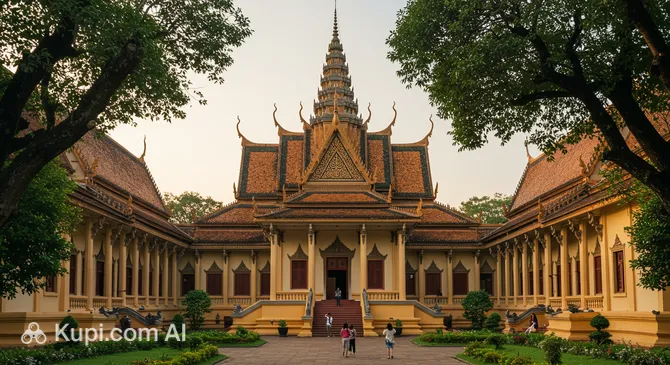
National Museum of Cambodia. Illustration.
Source: Kupi.com AI

Traveler photos:

Inside the museum, visitors will find one of the world's most extensive and impressive collections of Khmer art. The collection comprises over 14,000 items covering a vast period—from prehistoric times to the present day. Here, you can see unique sculptures, delicate ceramics, ancient bronze artifacts, and various ethnographic items. The permanent exhibition includes about 1,877 of the most valuable and interesting pieces, each telling its own part of the rich history of the Khmer people.

The National Museum of Cambodia operates under the Ministry of Culture and Fine Arts, highlighting its vital role in preserving and promoting national heritage. Adjacent to the museum on its west side is the Royal University of Fine Arts, creating a true cultural enclave in this corner of Phnom Penh that is a must-visit for all art and history lovers.

Contacts

To find the current contact details for the National Museum of Cambodia, including phone numbers or email addresses, we recommend visiting the museum's official website. You can also find helpful information in travel guides or at information centers located directly in Phnom Penh.

How to contactContact
AddressPreah Ang Eng St. (13), Phnom Penh 120211, Cambodia
Phone number+855 23 217 643
Websitewww.cambodiamuseum.info

What to Do

Immerse yourself in the rich history and culture of Cambodia by exploring the extensive collection at the National Museum of Cambodia in Phnom Penh. Here, you can admire impressive examples of Khmer art spanning various historical eras. The museum's galleries display ancient sculptures, exquisite ceramic ware, unique bronze pieces, and many other archaeological artifacts, each telling its own fascinating story.

In addition to the permanent exhibition, which is a treasure trove of knowledge in itself, the museum regularly hosts temporary exhibitions. This is a wonderful opportunity to deepen your understanding or discover new, previously unknown aspects of Cambodian art and history. The current schedule of temporary exhibitions can always be found on the museum's official website, allowing you to plan your visit to see as much as possible.

Don't miss the chance to appreciate not only the interior and the exhibits but also the museum building itself. It is an outstanding example of traditional Khmer architecture, with its distinctive roofs, carved details, and harmonious proportions. A walk through the courtyard and an inspection of the building's facades will provide as much aesthetic pleasure as contemplating the ancient artifacts. It is a place where history comes alive, not just in the displays but in the very atmosphere.

Getting There

The National Museum of Cambodia is conveniently located in the heart of Phnom Penh, making it easily accessible for travelers. Thanks to its central position, reaching the museum is simple from any part of the city, whether from your hotel or another attraction. It is one of the key cultural institutions of Cambodia's capital, and a visit is often included in major tourist itineraries.

The museum is situated on Street 13, north of the Royal Palace and west of Veal Preah Man Square. The visitor entrance is located at the busy intersection of Streets 13 and 178. You can easily get here by taxi or, for a more authentic experience, by local tuk-tuk—just tell the driver "National Museum." The ride from most central areas of Phnom Penh is short and straightforward.

Given the close proximity of the National Museum of Cambodia to other iconic landmarks in Phnom Penh, such as the Royal Palace, many tourists choose to combine their visits into a single day. This allows for efficient planning and a more comprehensive understanding of Cambodia's culture and history. A walk from the Royal Palace to the museum takes only a few minutes, making such a route particularly convenient and enjoyable.

Nearest city: Phnom Penh

History & Facts

The history of the National Museum of Cambodia is inextricably linked to the name of George Groslier, a French historian and passionate admirer of Khmer art. It was his initiative and design that led to the construction of this landmark institution. The foundation stone was laid on August 15, 1917, and the grand opening took place in 1920 on the eve of the Cambodian New Year. The ceremony was attended by King Sisowath I, the French Governor François-Marius Baudoin, and George Groslier himself, who became its first director and curator. A year earlier, in 1919, the institution was officially named the Museum of Cambodia.

The original look of the museum buildings, designed by Groslier, underwent some changes in 1924. During an expansion of the museum area, additional wings were added to the eastern facade to increase exhibition space. For a long time, until 1951, the museum was under the administration of the French colonial authorities. After Cambodia gained independence in 1953, the museum's status and management became the subject of bilateral agreements between Cambodia and France.

A significant milestone in the museum's history was the appointment of its first Khmer director, Chea Thay Seng, in 1966, who also served as the dean of the Royal University of Fine Arts. In 1968, the museum buildings were renovated. Although the museum faced a turbulent period in the late 20th century and suffered damage, it was quickly restored thanks to the efforts of dedicated individuals and reopened its doors to visitors. In 2018, the National Museum of Cambodia received international recognition when it was included in the World List of Objects of Particular Tourist Attraction, highlighting its immense cultural and historical value.

Time Needed

When planning a visit to the National Museum of Cambodia in Phnom Penh, you should expect to spend an average of 1.5 to 3 hours exploring it. This time is usually sufficient to familiarize yourself with the main exhibition, which includes an impressive collection of Khmer art—from ancient sculptures to delicate ceramics and bronze artifacts. The museum is not overly vast, but its exhibits deserve thoughtful study.

The duration of your visit may vary depending on your level of interest in the history and art of Cambodia. If you plan to read all the information plaques carefully, study each exhibit in detail, and perhaps visit temporary exhibitions (if any are being held), it is better to set aside about 3 hours. For a quicker but still meaningful introduction to the museum's masterpieces, 1.5 to 2 hours may be enough.

It is also worth taking the time to enjoy the architecture of the museum building itself, which is designed in a traditional Khmer style, and stroll through its cozy courtyard with a pond. Overall, the National Museum of Cambodia offers a rich cultural experience, and there is no need to rush to fully appreciate its treasures.

Working Hours

The National Museum of Cambodia in Phnom Penh is typically open to visitors daily, including most holidays. Generally, museums of this caliber operate from morning until evening, for example, from 8:00 or 9:00 AM to 5:00 or 6:00 PM. However, exact opening hours can vary, so it is highly recommended to check the latest information on the museum's official website or inquire at local tourist information centers before your visit. This is especially important if you plan to visit during national holidays.

Regarding ticket booking, it is usually not required for individual visitors. However, if you are traveling in a large group or wish to book a guided tour, prior arrangements may be desirable or even mandatory. To avoid any misunderstandings and plan your visit in the best possible way, it is always helpful to check the visitation rules on the official resources of the National Museum of Cambodia in advance.

8:00 – 17:00

Nearby

A visit to the National Museum of Cambodia is undoubtedly a vibrant and educational experience. However, to make your exploration of Phnom Penh even more rewarding, it is worth exploring the attractions located in the immediate vicinity. Discovering the museum's surroundings will allow you to immerse yourself deeper into the city's atmosphere, see more interesting sites, and gain a more complete picture of its cultural and historical wealth.

Often, the most fascinating discoveries are just around the corner. A stroll through the nearby streets after your museum visit can offer unexpected impressions and introduce you to other iconic landmarks of Phnom Penh, located just steps away. Below is a list of some of these sites, along with their distance from the National Museum of Cambodia.

NameDistance
Royal Palace of Cambodia0.3 km
313 Quayside0.3 km
Plantation Urban Resort & Spa0.3 km
Royal Palace Park0.3 km
Wat Ounalom0.3 km
Sisowath Riverside Park0.5 km
Mara Steak, Wok & Wine0.6 km

Have you reached the end of the page?

So the route has been studied inside and out