Support

Montreal-Pierre Elliott Trudeau International Airport

About the Airport

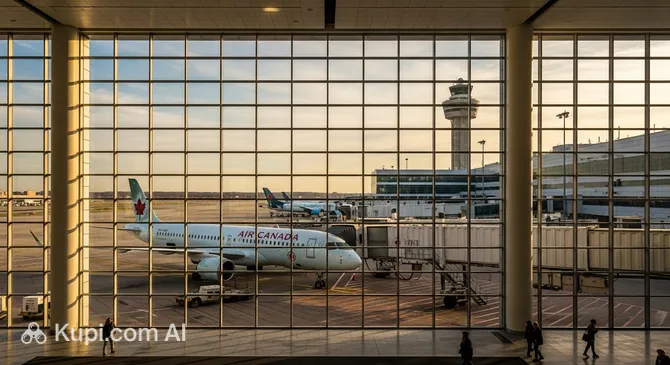
Montreal-Pierre Elliott Trudeau International Airport. Source: Kupi.com Binoculars

Montréal-Pierre Elliott Trudeau International Airport (YUL) is not merely the main air gateway to Montreal and the province of Quebec, but also a vital cultural and transport hub for Canada. Named in honour of the distinguished Prime Minister Pierre Elliott Trudeau, this airport welcomes travellers with a unique atmosphere where modern architecture blends with works of art. As one of the country's busiest airports, it serves as a hub for flights across the globe, connecting North America with Europe, Asia, and other continents.

IATA Code YUL
ICAO Code CYUL
City Montreal
Distance to Centre approx. 20 km
Status International
Annual Passengers 21.2 million (2023)
Popular Airlines Air Canada, Air Transat, WestJet
Schedule Online Board "Montréal-Pierre Elliott Trudeau International Airport"

One of the key features of Trudeau Airport is its single terminal, which is thoughtfully divided into three zones: for domestic, transborder (to the USA), and international flights. This makes navigation simple and intuitive for passengers. The airport is renowned not only for its efficiency but also for its cultural component — exhibitions by contemporary artists are regularly held here, turning the waiting halls into something resembling an art gallery. For travellers with children, play areas and stroller rental services are provided, while special family lanes help expedite security checks.

Contact Information

For your convenience, we have compiled the essential contact information for Montreal — Pierre Elliott Trudeau International Airport (YUL). Please note that some details, such as phone numbers, may change, so it is always recommended to verify them on the official website.

  • Official Website: www.admtl.com. Here you will find the most up-to-date information regarding flights, services, and airport regulations.
  • Information Service Phone: +1 514-633-3333. A toll-free number is also often available for calls from within Canada and the USA: 1-800-465-1213.
  • Airport Address: Romeo-Vachon Blvd N, Dorval, Quebec H4Y 1H1, Canada.
  • Email: The airport typically does not provide a direct email address for general inquiries. For communication, it is recommended to use the dedicated contact form on their official website.
  • Social Media: You can follow news and ask questions on the airport's official pages on Facebook (YULaéroportMTL), X (formerly Twitter) (@yulaeroport), and Instagram (@yulaeroport).
  • Lost Luggage Information: If your luggage has been lost by the airline, you should immediately contact your carrier's baggage claim counter. If you left personal items in the terminal (not on board the aircraft), information regarding the Lost and Found service can be found on the airport website.
  • Passenger Support Contacts: General support can be obtained by calling the main information service number or by speaking with staff at the information desks directly within the airport building.

How to Get to the Airport

Getting to Montréal-Pierre Elliott Trudeau International Airport (YUL) from the centre of Montreal is possible via several convenient methods suitable for any budget and travel style. Depending on the chosen transport and traffic conditions, the journey will take between 30 to 70 minutes.

Public Transport: 747 Express Bus
The most economical and popular method is the dedicated 747 Express bus route. It operates 24 hours a day between the airport and the central bus station (Berri-UQAM metro station), making several stops along the way, including Lionel-Groulx metro station. The journey takes 45–70 minutes. A major advantage is that the ticket cost (approximately 11 Canadian dollars) also provides you with a 24-hour pass for the entire Montreal bus and metro network (STM). This makes it an ideal choice for tourists.

Taxis and Ride-Hailing Services
For those who value comfort and speed, a taxi is an excellent option. There is a fixed fare from the city centre to the airport, which is approximately 41 Canadian dollars (excluding tips). This allows you to avoid price surprises due to traffic jams. Popular services such as Uber also operate in the city, with trip costs varying based on demand. A pre-booked transfer may be convenient for large groups or families with bulky luggage.

Car Rental and Parking
If you are travelling by rental car, driving to the airport is straightforward — it is conveniently located near major highways. All major rental companies have counters and parking facilities directly at the airport, simplifying vehicle return. Several types of parking are available on the airport grounds: from short-term near the terminal to more budget-friendly long-term options. It is recommended to book a parking space online in advance, as this often allows for savings.

Terminals and Map

The Montreal Pierre Elliott Trudeau International Airport (YUL) features a structure that is well-thought-out and convenient for passengers. Instead of several separate buildings, the airport consists of a single two-level terminal, which significantly simplifies navigation and movement between different zones.

The entire passenger terminal is divided into three main sectors depending on the flight destination:

  • Domestic Flights: For flights within Canada. Boarding gates in this zone are typically designated by the letter A.
  • International Flights: For all destinations excluding the USA. This is the largest zone with gates designated by the letter B.
  • Transborder Flights: For departures to the United States of America. Gates in this zone are designated by the letter C.

The airport layout is logical: the departure zone with check-in counters and self-service kiosks is located on the upper level, while the arrival zone with baggage claim and customs control is on the lower (ground) floor. After check-in, passengers pass through a centralized security screening point and then disperse to their respective sectors (A, B, or C). All zones are interconnected, and movement between them is done on foot, without the need for shuttles or trains.

A key feature of the terminal is the presence of the U.S. Preclearance facility in Sector C. This means that passengers flying to America undergo all necessary formalities while still in Montreal. Upon arrival in the USA, their flight is treated as domestic, which saves time and avoids queues at the border.

It is recommended to arrive at the airport well in advance: approximately 2 hours before a domestic flight departure and at least 3 hours before an international or transborder flight to the USA. The preclearance procedure for flights to America may take additional time. Overall, navigation at YUL is intuitive thanks to clear signage and the thoughtful layout of the single terminal.

Airport History

The history of Montreal — Pierre Elliott Trudeau International Airport, known as YUL, is closely tied to the development of aviation in Canada. It was opened on September 1, 1941, under the name Dorval Airport. Its creation was dictated by the needs of the Second World War: it served as a vital base for the British Commonwealth Air Training Plan and a departure point for ferrying aircraft to the United Kingdom.

After the war, the airport quickly became the main international gateway of Canada, serving a growing flow of transatlantic flights. In 1960, a new terminal building, modern for its time, was opened and became a symbol of the jet age. For decades, it was considered one of the busiest airports in the country. However, its history took a sharp turn in 1975 with the opening of Mirabel Airport, built for the 1976 Summer Olympics. All international flights were forcibly transferred to the new airport, leaving Dorval to serve only domestic and US destinations.

The experiment with two airports proved unsuccessful. The remoteness of Mirabel and inconvenient logistics led many airlines to prefer Toronto. In 1997, a historic decision was made to return all passenger operations back to Dorval. This process was completed in 2004, and since then, the airport has experienced a renaissance.

To mark this new phase, on January 1, 2004, the airport was officially renamed in honour of Pierre Elliott Trudeau, the 15th Prime Minister of Canada. Since the early 2000s, massive reconstruction and modernization worth several billion dollars have been carried out here. New piers for international and transborder flights were built, the departure and arrival zones were updated, and the general infrastructure was significantly expanded. Today, YUL is a modern and efficient hub that has fully recovered from historical vicissitudes and looks confidently to the future, remaining the busiest airport in the province of Quebec.

Services and Amenities

Montréal-Pierre Elliott Trudeau International Airport (YUL) offers passengers a wide range of services and amenities to make waiting for a flight as comfortable as possible. In the terminal, you will find numerous restaurants, cafes, and lounges to suit every taste: from fast-food outlets to à la carte restaurants where you can experience local cuisine. For shopping enthusiasts, duty-free shops, boutiques of famous brands, souvenir stalls, and bookstores are open.

For those who value enhanced comfort, VIP lounges and airline lounges operate at the airport. Here you can relax in silence, catch up on work, or enjoy complimentary beverages and snacks. Free Wi-Fi is available throughout the terminal, and numerous charging stations for electronic devices will allow you to stay connected at all times.

Financial matters can be handled at bank branches and currency exchange points. ATMs are also located throughout the airport. In case of necessity, passengers can seek medical assistance at the dedicated health unit.

The airport has also taken care of the youngest travellers: play areas are equipped for them, where children can have a fun time before the flight. For passengers with reduced mobility, all necessary facilities are provided, including ramps, elevators, specially equipped restrooms, and escort services.

If you have a long layover or an early departure, you can stay at the Montreal Airport Marriott In-Terminal Hotel, which is directly connected to the terminal building. Additionally, several other hotels are located in the immediate vicinity of the airport, served by free shuttles. For business travellers, conference rooms and a business centre are available, where meetings can be held or work can be done in a quiet environment.

Where to Eat

Montréal-Pierre Elliott Trudeau International Airport (YUL) delights travellers with a variety of establishments reflecting the rich gastronomic culture of Quebec. Whether you are looking for a quick snack before departure or wish to enjoy a full meal, there is an option here for every taste and budget.

What and Where to Eat at YUL Airport:

Pre-Security Zone (Landside): In the public area, the selection is generally focused on cafes and fast-food points. Here you will easily find coffee shops where you can grab a sandwich, pastries, and coffee to go. This is an ideal option if you are seeing someone off or have arrived at the airport well before flight check-in.

Post-Security Zone (Airside): The main variety of restaurants and dining venues is found in the secure zone, after passing through screening. Establishments are distributed across the three main sectors: for domestic flights, international flights, and flights to the USA.

Signature Dishes and Local Flavours: Be sure to take the opportunity to taste Quebecois cuisine. Look for places serving the famous poutine (fries with cheese curds and gravy), Montreal smoked meat sandwiches, or fresh Montreal-style bagels. The airport features branches or concepts of well-known local brands, for example, establishments like Archibald Microbrasserie or cafes inspired by local bistros.

Recommendations by Establishment Type:

  • For a quick snack, the ubiquitous Tim Hortons, Starbucks, bakeries, and food courts with pizza or burgers are excellent choices. They are located in all terminals.
  • For a full lunch or dinner, choose restaurants with à la carte service. Here you can find everything from steakhouses and Irish-style eateries to restaurants serving Asian and European cuisine. This is a wonderful opportunity to relax while waiting for your flight.

Special Dietary Needs and Prices: Most restaurants offer vegetarian dishes. Finding vegan, gluten-free, or Halal options is also possible, though it is best to study the menu of the specific establishment in advance. Prices at the airport are traditionally higher than in the city. The average bill for a quick snack will be 15-25 Canadian dollars, and for lunch in a restaurant — from 30-40 dollars and up. The operating hours of most cafes and restaurants are adapted to the flight schedule; many are open from early morning until late at night.

Tips for Travellers

Travelling through Montréal-Pierre Elliott Trudeau International Airport (YUL) will be simpler and more pleasant if you prepare in advance. Here are several useful tips to help you navigate one of the busiest airports in Canada.

When to arrive at the airport? The general rule is 2 hours before domestic flights and 3 hours before international ones. This applies especially to flights to the USA, as Montreal airport operates a US Preclearance system which requires additional time. Arrive with time to spare to avoid stress.

Check-in and Security Control. Save time by completing online check-in on the airline's website. Upon arrival at the airport, be ready for standard screening procedures: all liquids in carry-on luggage must be in containers of no more than 100 ml and packed in a transparent bag, while laptops and other large electronics will need to be removed from bags.

Selecting a Seat on the Plane. If the airline allows, choose your seat in advance. Window seats offer beautiful views during takeoff and landing, whilst aisle seats ensure more freedom to move around the cabin. For long flights, it is worth studying the aircraft layout on specialized websites to avoid being seated next to the lavatory or in a seat with limited legroom.

Carry-on Luggage. Before packing, be sure to check your airline's carry-on luggage allowance — weight and size limits may vary. Besides standard restrictions on liquids, remember that sharp objects, weapons, and flammable substances cannot be brought into the cabin.

For Passengers with Connections. If you have a connecting flight at YUL, follow the "Connections / Correspondances" signs. For transit to the USA, you will need to go through the US Preclearance procedure. This means you will pass US customs and border control right in Montreal, allowing you to proceed directly to the exit upon arrival at the American airport, just like a domestic flight.

Customs Control upon Arrival. To enter Canada, you will need to complete a customs declaration. This can be done at electronic kiosks upon arrival or via the ArriveCAN mobile app. Keep your passport and other travel documents ready to speed up the process.

Saving Time and Money. To avoid spending money on water, bring an empty reusable bottle with you and fill it at drinking fountains after the security checkpoint. The most budget-friendly way to get to the city centre is the 747 Express bus, which runs 24/7. If you are driving to the airport, book parking online in advance — this is often cheaper.

If the Flight is Delayed. In case of a flight delay, monitor updates on information boards and in your airline's app. Contact the carrier's counter for information regarding possible compensation (vouchers for food, drinks, or a hotel during long delays). Travel insurance may also cover unforeseen expenses, so do not forget to arrange it before your trip.
Reached the end of the page?

That means the route is fully explored