Support

Niagara Falls

About

Niagara Falls is not just a waterfall but a true natural wonder and one of the most famous tourist destinations in the world. Located on the Niagara River, it serves as a natural border between Canada and the USA. This majestic complex of waterfalls is situated in the city of Niagara Falls and attracts millions of travelers with its thunderous roar and breathtaking views. This geological marvel is estimated to be about 12,000 years old.
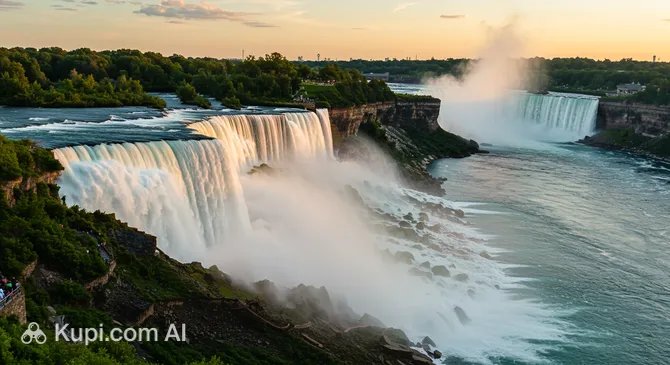
Niagara Falls. Illustration.
Source: Kupi.com AI

Traveler photos:

What makes Niagara Falls unique is that it consists of three separate parts: the Horseshoe Falls (also known as the Canadian Falls), the American Falls, and the smallest one, the Bridal Veil Falls. Although the drop is not the highest in the world, ranging from about 53 to 57 meters, Niagara Falls is the most powerful in North America in terms of water volume. It is this incredible power that creates the famous "thunder of water" that can be heard for miles around.

The most impressive panoramic views of all three cascades are found on the Canadian side, where you can get very close to the edge of the Horseshoe Falls. Besides viewing the falls themselves, the region offers many other activities, from vibrant city life with numerous attractions to visits to award-winning wineries. Visiting Niagara Falls is an opportunity to experience the incredible force of nature and witness a sight that will stay in your memory for a lifetime.

Contacts

To plan your visit and get the most up-to-date information on attraction hours, special events, and ticket prices, it is recommended to contact the Niagara Parks Commission—the organization that manages the park area on the Canada side. You can find more details on the official website or by phone.

How to contactContact
AddressNiagara Falls, NY 14303, USA
Phone number+1 716-286-8579
Websitewww.discoverniagara.org

What to Do

A visit to Niagara Falls offers many unforgettable experiences, allowing you to feel the power and beauty of this natural wonder from different perspectives. One of the most popular activities is the "Journey Behind the Falls" tour. This unique excursion begins with a descent of 38 meters (125 feet) through bedrock to reach the very heart of Niagara. You can stand on an observation deck at the foot of the Horseshoe Falls and feel the thunder and power of the falling water.

For a breathtaking bird's-eye view, be sure to head up the 235-meter Skylon Tower. High-speed elevators will whisk you to the observation deck in just 52 seconds, offering a stunning view of all three waterfalls, the city of Niagara Falls, and the surrounding region. After dark, the falls are transformed by evening illumination—a sight not to be missed. Every night, the cascades are lit with multi-colored lights, creating a truly magical atmosphere. The best place to watch this light show is Queen Victoria Park.

Beyond the falls themselves, the surrounding area offers other interesting spots. Located about 8 kilometers from the falls on the Canadian side are the picturesque Niagara Parks Botanical Gardens. This is a lovely place for a peaceful stroll among manicured flowerbeds and gardens along the scenic Niagara Parkway. Thus, a trip to this corner of Canada can be filled with both active adventures by the water and relaxing moments in nature.

Getting There

Getting to Niagara Falls is quite simple, as it is one of Canada's major tourist hubs. Most travelers arrive via Toronto Pearson International Airport (YYZ), located approximately 125 kilometers away. From the airport or downtown Toronto, you can reach the city of Niagara Falls by rental car in about 1.5–2 hours. There are also regular train and intercity bus services, such as Megabus and Flixbus, which offer a convenient and affordable way to reach your destination.

Once in the city, you'll find that the falls are located right in the heart of the tourist area. If your hotel is nearby, you can walk to the observation decks while enjoying the scenery. To get around the main tourist districts, including the falls, the promenade, and other attractions, the WEGO bus system is ideal. Its color-coded routes are specifically designed for tourist convenience, covering all key points and operating year-round. Taxis and popular ridesharing services are also readily available in the city.

For those who prefer organized travel, many tour companies offer day trips from Toronto. These packages usually include round-trip transfers as well as tickets to popular attractions, such as the boat cruise to the base of the falls or the "Journey Behind the Falls" tour. This is an excellent option for those who want to maximize their experience in a single day without having to plan the logistics themselves.

Nearest city: Niagara Falls

History & Facts

Niagara Falls is a geologically young natural wonder, only about 12,000 years old. It was formed at the end of the last ice age when melting ice created the Great Lakes and the Niagara River began its journey toward the Atlantic Ocean. The first European to document the majesty of the falls was the French missionary priest Louis Hennepin in 1678, though the region remained sparsely populated for a long time. Active development of the land began in the late 18th century when Loyalists—supporters of the British crown—started moving to the Canadian side.

One of the most remarkable facts is that the falls serve as a natural international border, separating the American state of New York and the Canadian province of Ontario. This line, running right through the Niagara River, was established following historical events in the early 19th century. Today, the two countries are connected by the famous Rainbow Bridge, opened in 1941, which offers breathtaking views of the water cascades. This bridge has become more than just a transportation artery; it is a symbol of the friendly relationship between Canada and the USA.

The modern appearance of Niagara is inseparable from its famous man-made additions. A true symbol of the area is the Skylon Tower, which began construction in May 1964. It opened to visitors in October 1965, offering incredible panoramic views from a height of 160 meters. The history of the falls' illumination is equally rich: it was first lit in 1860 in honor of the Prince of Wales' visit, using fireworks and Bengal lights. Permanent electric illumination was introduced in 1925, and today, modern LED systems are used to create a magical evening show, painting the churning waters in thousands of different shades.

Time Needed

When planning a trip to Niagara Falls, it is important to budget your time wisely to fully enjoy this natural wonder. If your goal is simply to see the falls, take some photos from the main observation decks, and admire the panorama, 1–2 hours might be enough. This is sufficient time to walk along the promenade in Queen Victoria Park and feel the power of the cascades from a safe distance.

However, for a more immersive experience, you should set aside at least half a day. Famous attractions like "Journey Behind the Falls" or a boat cruise to the base of the Horseshoe Falls usually take about 1.5–2 hours each, including wait times. Adding a trip up the Skylon Tower for a panoramic view or a leisurely stroll around the area can easily fill 4–6 hours. Many tourists recommend staying until evening to see the famous illumination, which transforms the falls into a magical spectacle.

For those wanting to explore not only the falls themselves but also the scenic surroundings in the city of Niagara Falls, it is worth planning a full day or even two. This will allow you to visit the Botanical Gardens and the Butterfly Conservatory or take a trip to the charming town of Niagara-on-the-Lake, known for its wineries, without rushing. Thus, while a brief introduction is possible in a couple of hours, it is better to allow as much time as possible for a complete and unforgettable experience in this part of Canada.

Working Hours

One of the main advantages of Niagara Falls is that the observation decks in the park area on the Canada side are accessible to visitors 24 hours a day, year-round. You can admire this natural wonder for free at any time of day or night, watching its appearance change with the sunrise or under the cover of darkness. The falls are open in any season, although it is worth noting that some areas may be icy in winter.

While the falls themselves are always accessible, paid attractions like the boat cruise to the base of the cascades or "Journey Behind the Falls" operate on their own schedules, which vary by season. It is highly recommended to book tickets for popular attractions online in advance, especially during the peak tourist season, to avoid long lines and guarantee your spot. In the evening, the falls are transformed by colorful illumination, the schedule of which also depends on the time of year. For the most accurate and up-to-date information on specific attraction hours and light show times, always check the official Niagara Parks website.

Open 24 hours

Nearby

A visit to Niagara Falls is an unforgettable event in itself, but to make your trip truly complete, it is worth exploring the surrounding area. The city of Niagara Falls is more than just a viewpoint for admiring the power of the water; it is a full-fledged tourist center with many attractions located within walking distance. Exploring these sites will allow you to dive deeper into the atmosphere of this unique corner of Canada.

Strolling through the picturesque streets adjacent to the falls will reveal other interesting spots that will enrich your experience and offer new perspectives for photos. Many of the key attractions are so close that they can be easily reached on foot, turning your sightseeing into a pleasant walk. Below is a list of nearby tourist sites with their distances from Niagara Falls.

NameDistance
Nikola Tesla Monument0.2 km
Fallsview Casino Resort0.5 km
Skylon Tower0.5 km
Niagara SkyWheel0.9 km
Clifton Hill0.9 km
Locomoland Model Train Museum1.1 km
The Dhaba On The Falls1.1 km

Have you reached the end of the page?

So the route has been studied inside and out