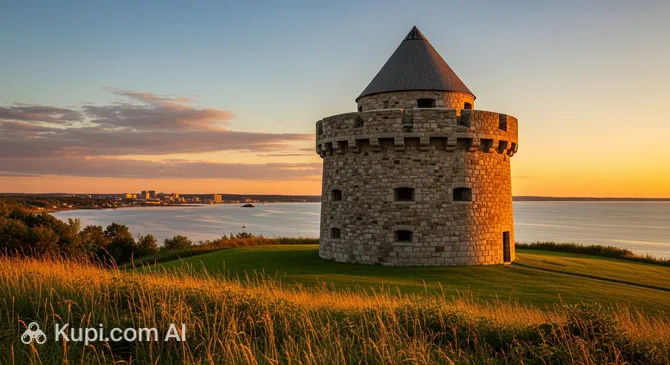
Carleton Martello Tower National Historic Site is a remarkable monument of military architecture located in the city of Saint John. This circular stone fortress was built by the British between 1812 and 1815 to protect Canada from potential land-based attacks. The tower crowns the steep, rocky hill of Carleton Heights, rising 68.5 meters above sea level and providing a strategic vantage point over the entire harbor.
Carleton Martello Tower National Historic Site. Illustration.
Source: Kupi.com AI
Traveler photos:
The structure is a massive construction 15 meters in diameter with thick walls that taper toward the top. It is one of nine surviving Martello towers in the country, characteristic of British coastal defenses during the Napoleonic era. Inside the building lies a bombproof design featuring a central column and vaulted ceilings, highlighting the strength of 19th-century engineering.
While the interior of the tower is currently closed for restoration, the surrounding grounds and the modern visitor center are open to guests. From here, you can enjoy some of the best panoramic views of the city center, the Bay of Fundy, and the defensive structures of Partridge Island, making it a must-visit spot for history enthusiasts.
Contacts
To plan your visit to this historic landmark, you can use the official contact details. Parks Canada staff are available to answer questions about current operating hours and the availability of exhibits.
Begin your visit at the modern Visitor Center. Here, interactive galleries reveal the tower's engineering secrets and the daily life of its garrison. Be sure to watch the documentary film "Carleton Martello Tower: Sentinel of Saint John," which vividly brings to life the dramatic history of this outpost.
The highlight of your visit will be the panoramic views. From the top of Carleton Heights, you get a magnificent overlook of the harbor and the legendary Bay of Fundy. It is an ideal spot for photography and peaceful walks across the rugged terrain. You can examine the tower's exterior features in detail, including the loopholes and an ancient cannon, as well as see the preserved gunpowder magazine.
The area surrounding the tower is perfect for an outdoor picnic amidst a historic backdrop. During the summer season, Parks Canada often hosts special events and cultural programs that help guests dive deeper into the past and learn more about the heritage of New Brunswick.
Getting There
The attraction is located at 454 Whipple St, in the western part of the city. The most convenient way to reach it is by car. The tower is situated at the top of a hill accessed via Whipple Street; free visitor parking is available on-site. The drive from the city center by car or taxi takes about 10–15 minutes.
If you plan to use public transport, choose bus routes heading to the Carleton area. From the nearest stop, you will need to walk uphill. A walk from the city center is also possible (the distance is about 3.5–4 km), but keep the steep terrain in mind — comfortable shoes are a must for an easy climb.
During the summer months, tourist shuttles are sometimes organized, and information about them can be found at city visitor centers. Cyclists also frequently include this site in their routes, enjoying views of the harbor and Partridge Island along the way.
Nearest city: Saint John
History & Facts
Construction of the tower began in 1813 by the British Army during the War of 1812. It was designed as a key link in the fortification system blocking the western approaches to the city. Although work was not completed until 1815 when the threat of attack had passed, Carleton Martello Tower became an essential element of the third line of defense alongside Forts Howe and Dufferin.
Interestingly, the heavy guns originally planned were not installed immediately after construction. In the mid-19th century, the building's role changed: a bombproof room and gunpowder magazine were equipped here, and in the late 1860s, the tower briefly served as barracks. During the First World War, it was used as a center for holding deserters.
The most noticeable architectural modification was the concrete superstructure added between 1939 and 1944. During World War II, anti-aircraft machine guns and a modern fire control post were placed on top. In 1930, the site was officially designated a National Historic Site of Canada for its role in the defense system and its unique military architecture.
Time Needed
A thoughtful exploration of this attraction typically takes between 1 and 2 hours. This is enough time to walk leisurely through the grounds, examine the external fortification elements, and enjoy the ocean views.
Plan for about 20–30 minutes for a stroll along the hillside and another 45 minutes to visit the Visitor Center, where you can watch the historical video and browse the exhibits. If you enjoy photography or plan to have a short break outdoors, your visit may take a bit longer.
Working Hours
The site grounds and Visitor Center typically welcome guests during the tourist season, from mid-May to late October. During this period, the complex is open daily from 10:00 AM to 5:00 PM. In the winter months, the infrastructure may be closed to visitors.
Please note that since 2016, entry inside the tower itself has been temporarily closed due to extensive restoration work. However, exploring the exterior fortifications and the exhibits in the visitor center remains accessible. It is recommended to check the current schedule on the official Parks Canada website before your trip.
Nearby
Exploring the area around the tower will allow you to dive deeper into the region's history and enjoy the coastal atmosphere. Many interesting sites are within a short drive or walk in the city's West Side.
Below are the nearest attractions to help you plan a full itinerary: