Support

Guzhou

About

Guiyang is the picturesque capital of Guizhou Province, often called the "City of Forests" for its incredible abundance of greenery and parks. Located in the southwest of the country, this city serves as the perfect gateway for travelers wishing to discover an authentic and multifaceted China. Here, modern skyscrapers coexist harmoniously with karst hills, creating a unique atmosphere where urbanism meets wilderness.
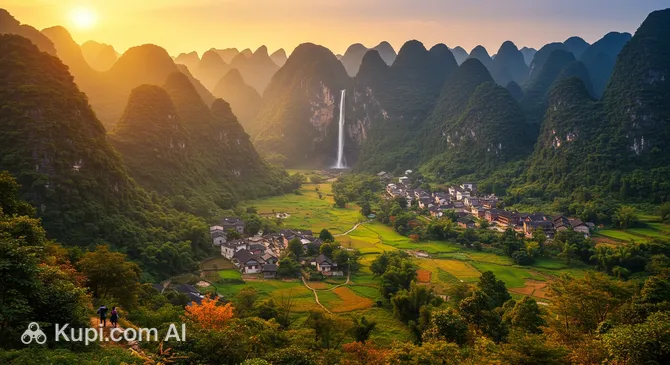
Guiyang. Illustration.
Source: Kupi.com AI

Geographically, the city is situated in a mountainous area at an altitude of about 1,100 meters above sea level, providing it with a mild and comfortable climate. Even in the height of summer, exhausting heat is rare here, which is why Guiyang is famous as a popular summer vacation destination. Although today it is a dynamically developing metropolis and a hub for the big data industry, Guiyang's history is rooted in the deep past, preserving the traditions of many ethnic minorities living in the region.

Among the must-see attractions, the majestic Jiaxiu Pavilion stands out. Built on a rock in the middle of the Nanming River, it is considered the symbol of the city and is particularly beautiful when illuminated in the evening. Walking enthusiasts should visit Qianling Park—an oasis of tranquility where you can climb to an ancient Buddhist temple and encounter free-roaming macaques. The city is also known for its unique cuisine with bright sour and spicy flavors that won't leave anyone indifferent.

Guiyang will give you unforgettable impressions, whether you're exploring ancient streets or enjoying the fresh mountain air in the heart of a metropolis. It is a welcoming city that is definitely worth including in your travel itinerary.

Weather Overview

The climate of Guiyang is often called one of the most comfortable in China, which has earned the city a reputation as a great place for summer vacations. There is no exhausting heat here: even in the warmest months, July and August, the average temperature is about +24°C, and maximum values rarely exceed +28°C. This allows you to enjoy long walks without the discomfort of the scorching sun.

Winters in the city are cool but mild, without severe frosts. In January, the temperature usually fluctuates between +2°C and +8°C. However, the high humidity of the region should be taken into account: rain is a frequent occurrence here, especially in spring and early summer. For example, in May, the number of rainy days can reach 24, so waterproof shoes and a raincoat will be an important part of your luggage.

In general, expect moderately warm summers and cool winters with frequent precipitation throughout the year. Before your trip, we recommend checking the current weather forecast in Guiyang to properly plan your wardrobe and excursions. Autumn, especially October, often brings pleasant coolness (around +15°C) and less rain, making this a wonderful time for tourism.

Average monthly temperature

Average monthly precipitation

Interesting Facts

Beyond the main attractions, Guiyang holds many fascinating secrets and urban wonders that surprise even experienced travelers. Here are a few facts revealing the unique character of this metropolis, of which China is rightfully proud:

  • The Mysterious "White House": In the Huaguoyuan district stands a colossal building resembling a luxurious European palace. Locals and tourists have nicknamed it the "White House." This architectural giant is a private residence, and it is almost impossible for outsiders to get inside, which only fuels interest in this mysterious landmark, especially when it is brilliantly lit at night.

  • A Navigator's Maze: Guiyang is famous for its incredibly complex road infrastructure, the crown of which is the Qianchun Interchange. It consists of 5 levels and 11 ramps, rising to a height of over 50 meters above the ground. Due to the elevation changes and the complexity of the design, it is often compared to a "roller coaster," and even modern GPS navigators sometimes get lost in this tangle of roads.

  • "Cloud" Valley in Caves: The city is officially recognized as a national big data zone. Thanks to the cool climate, global tech giants have placed their data centers here. The uniqueness lies in the fact that many server farms are hidden directly inside natural mountain caves, allowing the use of natural cold to save energy on cooling the equipment.

  • The Most Densely Populated Neighborhood: The Huaguoyuan residential complex is located here—one of the largest residential projects in Asia. This "city within a city" is home to about half a million people, and its architectural centerpieces are the twin towers, which visually resemble famous skyscrapers from other world capitals, creating a futuristic landscape.

How to Get There

Guiyang is an important transportation hub in the southwest of the country, so getting here is quite easy. The city has a developed infrastructure that welcomes travelers by both air and rail. You can find out more about how to get to Guiyang to choose the most convenient route and mode of transport for you.

The main air gateway to the city is Guiyang Longdongbao International Airport (IATA: KWE). This is a large, modern aviation hub that handles many flights. It is located directly within the Guiyang city limits, just 11.4 km from the center. A taxi or bus ride will take you approximately 40 minutes. Thanks to its proximity to the city, this is the most comfortable option for tourists.

If there are no direct flights to Guiyang, you can consider flying into the neighboring city of Anshun, where Anshun Huangguoshu Airport (IATA: AVA) is located. Please note: this airport is NOT in Guiyang itself, but in Anshun, which is located about 91.3 km from the destination. The journey from Anshun Airport to central Guiyang by taxi or intercity transport will take about 2.5 hours.

For convenience, here is a summary of the main airports in the region:

AirportPassenger trafficDistance
Guiyang Longdongbao International Airport22.3 mln11 km
Anshun Huangguoshu Airport71 23791 km
Zunyi Xinzhou Airport1.6 mln114 km
Kaili Huangping55 289133 km
Zunyi (Maotai)1.6 mln140 km

Rail connections are also excellent. The main arrival point for trains is Guiyang Railway Station (IATA: EMJ). The station is in the very heart of Guiyang, only about 4.4 km from the central districts. This allows you to reach your hotel by taxi in literally 20–25 minutes. A huge number of trains arrive here, connecting the province with other regions of China.

An alternative option is Duyun Railway Station (IATA: OCD). However, keep in mind that this station is NOT in Guiyang, but in the city of Duyun, at a distance of about 89.6 km. Traveling from there to Guiyang will require an additional transfer taking about 2.5 hours.

Below is a table with information on the nearest railway stations:

StationPassenger trafficDistance
Guiyang Railway Station7 mln4 km
Anshun West railway station487 km
Duyun Railway Station1.5 mln90 km
Kaili South railway station4118 km
Lijiawan Railway Station2142 km

Main Attractions

While the city center is rich with interesting locations, the region's true treasures are hidden a bit further from the busy avenues. To get a complete impression of the province, it's worth expanding your walking geography to include places where nature and history intertwine in the most amazing way.

One of the main natural gems of the surrounding area is the Tianhetan Scenic Area. It is often called "Guizhou in miniature" because all the characteristic landscapes of the region are gathered here in a relatively small area: mysterious karst caves, thundering waterfalls, and emerald pools. The uniqueness of the place lies in the ability to explore the caves in two ways: part of the path is on foot through dry grottoes, and part is by boat along an underground river, where stalactites are illuminated with multi-colored lights, creating a fairy-tale atmosphere.

For a dive into history, head to Qingyan Ancient Town, located in the southern suburbs. Founded over 600 years ago as a military garrison, today it attracts tourists with its authentic Ming and Qing dynasty architecture. It is an amazing place where temples of four religions—Buddhism, Taoism, Christianity, and Catholicism—peacefully coexist on the same street. While walking through the paved alleys, be sure to try the local delicacy—braised pig trotters, which foodies from all over the region come here to enjoy.

If you want to gain a deeper understanding of the local cultures, visit the Guizhou Provincial Museum. This modern building with impressive architecture houses a vast collection of ethnographic artifacts. China is a multi-ethnic country, and Guizhou is home to many ethnic minorities (Miao, Dong, and others). The museum showcases their unique costumes, finely crafted silver jewelry, and everyday items. It’s an ideal place to visit on a rainy day, allowing you to experience the region's vibrant heritage for free.

Outdoor enthusiasts will enjoy Huaxi Park and the adjacent national wetland park. This is a vast green zone with rivers, bridges, and scenic trails, perfect for cycling or picnics. Locals love this spot for its fresh air and pastoral landscapes, which offer a break from the rhythm of the big city without having to travel far into the wilderness.

Local Cuisine

Guiyang's gastronomic scene is a true universe of vibrant flavors that can surprise even seasoned foodies. The local cuisine is famous for its unique combination of sour and spicy, which distinguishes it from the famous Sichuan cuisine. There is even a saying in the province: "Three days without a sour dish, and your legs go weak and your stride wobbles." The food here is spicy, aromatic, and very colorful, and the use of fermented ingredients gives dishes a unique character.

The main culinary symbol of the city, which every traveler must try, is Fish in Sour Soup (Suan Tang Yu). This dish is prepared based on a broth made from fermented tomatoes and rice, with fresh river fish, many herbs, and, of course, chili peppers added. The second most popular dish can be called Siwawa or "Silk Dolls." This is a vegetarian snack: you receive a set of many small plates with chopped vegetables, pickles, and noodles, which you must wrap yourself in thin rice pancakes and dip into a spicy sauce.

Street food in Guiyang is its own form of art. Be sure to try "Lover's Tofu" (Lian'ai Doufu)—fried tofu cubes stuffed with a mixture of mint, garlic, and pepper. The snack got its romantic name because, in the past, couples often shared it on dates. For breakfast, locals often choose beef noodles or a more exotic option—noodles with intestines and blood (Changwang Mian), which, despite the intimidating name, has a rich and pleasant taste.

As for drinks, Guizhou Province is the home of the legendary spirit—Maotai. This expensive and strong baijiu (sorghum vodka) is produced near Guiyang and is considered the national drink of China. If you prefer non-alcoholic beverages, pay attention to local varieties of green tea, such as Duyun Maojian, which is grown in the ecologically clean mountain areas of the province. Freshly squeezed juices and herbal decoctions, which help cope with the spiciness of the food, are also popular on the streets.

The food culture in Guiyang is inextricably linked with night markets. With the onset of darkness, the streets fill with the aromas of grilled meat and spices. Locals love to gather in large groups at low tables right on the sidewalks to enjoy "hot pot" or skewers. An important feature of the local meal is zhanshui—an individual bowl of dipping sauce that each guest mixes themselves from peppers, soy sauce, vinegar, and herbs, adjusting the spiciness to their own taste.

Travel Tips

Guiyang is a city with a special rhythm, where modern technologies are intertwined with the traditions of mountain peoples. To make your journey to this green metropolis as comfortable and hassle-free as possible, we have prepared a list of practical recommendations considering local specifics.

  1. Clothing and Essentials: Due to its location in the mountains, the weather here is changeable. Even in summer, evenings can be cool, so the principle of layering clothes is your best friend. Be sure to bring comfortable, broken-in shoes, as the city's terrain is hilly. An umbrella or raincoat should always be in your backpack: rains in Guizhou Province are frequent and sudden.

  2. Transport: The fastest way to get around is the metro, which continues to develop actively. For taxi trips, we strongly recommend installing the Alipay app (it has a built-in DiDi service in English), as it can be difficult to catch a car by waving, and explaining yourself to a driver without knowing the language is even harder. Renting a car is not worth it: traffic is chaotic, and international licenses are not valid here.

  3. Finance: China is a country where cashless payment has triumphed. Cash (yuan) is accepted reluctantly, and sellers may not have change. Link your card to the Alipay or WeChat Pay payment systems in advance—you can use them to pay even for a bunch of greens at the market. Tipping is not customary in taxis or restaurants; an attempt to give money above the bill may embarrass the staff.

  4. Health and Safety: Guiyang is a safe city, but standard precautions are still wise. Pharmacies are marked with a green cross, but finding an English-speaking pharmacist is difficult, so keep a supply of necessary medicines and photos of packages with names in Chinese. The main health risk is unusually spicy food; keep digestive aids with you.

  5. Communication: Few people know English, so download an offline translator (such as Baidu Translate or Google Translate with a downloaded pack). To access your usual social networks and messengers, you will need a pre-purchased eSIM with roaming or a good VPN, as many Western services are blocked.

  6. Local Etiquette: A greeting is usually limited to a nod or a light handshake. In restaurants, don't be surprised by the noise—loud conversations are considered a sign of fun and a good atmosphere. Never stick chopsticks vertically into rice—this resembles memorial candles and is considered bad luck.

  7. What to Avoid: Avoid public displays of anger or shouting in conflict situations. In local culture, the concept of "saving face" is critically important: a calm smile and politeness will help solve a problem much faster than emotions.

  8. Additional Tip: Guiyang is the "summer capital," but UV rays in the mountains are very active. Even if the sky is overcast and you're not hot, be sure to use sunscreen to avoid getting burned while walking in the parks.

By following these simple tips, you can focus on the main thing—enjoying the unique nature and culture of Guiyang. Be open to new experiences, and this hospitable city will surely return the favor!

Entertainment & Nightlife

Guiyang's nightlife is a vibrant kaleidoscope of neon lights, the aromas of street food, and bustling fun. Unlike many other cities, life here doesn't stop at sunset; on the contrary, it picks up speed. Locals love spending their evenings out, so the streets remain lively well past midnight. The city offers entertainment for every taste: from authentic night markets to ultra-modern clubs with electronic music.

The epicenter of evening leisure is rightfully considered Qingyun Road. This is not just a night market but a true cultural space, recently renovated in a retro style with bright signs and photo zones. An atmosphere of endless celebration reigns here: hundreds of stalls offer local delicacies, craft beer, and souvenirs. People come here not only to eat but also to listen to live music from street performers. It is an ideal place to start the evening, where you can safely walk until late at night, immersing yourself in the city's local color.

For fans of bar culture and club parties, the main point of attraction is the Huaguoyuan district. This is where young people gather, right at the foot of the famous "White House." The area is home to many bars, pubs, and karaoke clubs (KTV) that stay open until dawn. The atmosphere here is democratic and relaxed. Another popular location is the waterfront in the Future Ark (Weilai Fangzhou) area. This is a more upscale spot with beautiful views of the river at night, where you can find lounge bars with good cocktails and more laid-back music.

The dress code in Guiyang's venues is generally casual: strict rules are rare, as long as you look neat. In bars, you will often see groups of people engrossed in playing "Liar's Dice"—a popular Chinese drinking game. If you want to join in, the locals are usually very friendly toward foreigners. The average price for a cocktail or beer in a bar ranges from 40 to 80 yuan. The best time to visit clubs is after 10:00 PM when the main crowd arrives.

From a safety perspective, Guiyang is very comfortable for tourists. Central areas are well-lit and patrolled; night walks are common. However, it's worth being careful on the roads: traffic can be chaotic even at night. To get home, it's best to use official ride-hailing apps, as catching a taxi on the street in popular nightlife spots can be difficult due to high demand.

If you're interested in daytime entertainment, the city offers an equally rich program. Culture lovers should visit the Guizhou Grand Theater, which regularly hosts colorful shows telling stories of the legends and traditions of the province's ethnic minorities. For family outings, modern shopping malls with cinemas and entertainment zones are perfect; in Guiyang, they are striking in their scale and futuristic design.

Parks & Museums

Guiyang rightfully bears the title of "City of Forests": green zones occupy a significant part of the territory here, creating an amazing symbiosis of modern urbanism and wilderness. For tourists, this is a unique opportunity to get acquainted with the natural wealth and deep cultural heritage that China is famous for, without leaving the metropolis.

The main natural attraction within the city is Qianling Mountain Park. This is not just a square, but a real forest on a mountain covering more than 400 hectares. Tourists come here to climb to the ancient Buddhist Hongfu Temple, built in the 17th century, and walk around the picturesque lake. A feature of the park is its population of wild macaques, which interact freely with visitors. This place is ideal for those who want to see locals practicing tai chi, dancing, or calligraphy in the open air.

For a more quiet and contemplative rest, it's worth visiting the Guanshanhu National Wetland Park. This is a modern ecological zone where the urban environment gives way to the silence of lakes and flowering gardens. The park is especially beautiful in spring and autumn when the trees change color. Comfortable wooden boardwalks are laid out for walking, and unlike the bustling Qianling, there are much fewer people here, allowing you to enjoy solitude.

The Guizhou Provincial Museum will help you dive into the rich history of the region. This is a large-scale complex whose exhibition focuses on the cultural diversity of the province. It houses an impressive collection of national costumes, silver jewelry, and everyday items of numerous ethnic minorities (Miao, Dong, Buyi). The museum will be of interest to those who want to understand the complex ethnographic map of the region and see unique artifacts that have no analogues in other parts of the country.

Another important cultural spot is the Guizhou Geological Museum. The province is known for its karst landscapes and paleontological finds. The museum features rare fossils of Triassic marine reptiles found in this region. This place will be especially fascinating for families with children and natural history enthusiasts.

Among architectural monuments, the Jiaxiu Pavilion remains the undisputed leader. Built on a stone boulder in the middle of the Nanming River, this three-story wooden pavilion, 20 meters high, serves as a symbol of the city's literary and cultural history. It is connected to the shore by a picturesque bridge, which is illuminated by hundreds of lights in the evening, creating one of Guiyang's most recognizable panoramas.

If you're looking for non-touristy experiences, check out Hebin Park. Although it is smaller than its famous neighbors, this is where you can feel the true atmosphere of the city: ride the old Ferris wheel, watch mahjong players, and drink tea in a simple gazebo by the river, away from the hustle and bustle of the main attractions.

Getting Around

Guiyang's transport system has taken a huge leap in development in recent years, becoming modern and convenient even for those who do not speak Chinese. The backbone of getting around the city is the metro. Currently, several lines are in operation, connecting key transport hubs: the international airport, railway stations, and main tourist areas. Stations are equipped with bilingual signs (Chinese and English), and ticket vending machines are intuitive. This is the fastest way to avoid traffic jams and reach the main attractions.

Surface transport is represented by an extensive network of buses, including the BRT (Bus Rapid Transit) system. BRT buses move along dedicated lanes and overpasses, making them an excellent alternative to the metro. Regular city buses run everywhere, and the fare is usually 2 yuan. However, tourists should be prepared for the fact that route maps and stop announcements are often only in Chinese, so it is recommended to use smartphone maps for navigation, tracking your movement in real-time.

The fare payment system in Guiyang, as in many metropolises in the region, is highly digitalized. The most convenient way for a tourist is to use a QR code in the Alipay app (Transport section), after linking their bank card. This code can be used to pay for travel on the metro and buses by simply placing the phone screen against the scanner on the turnstile or validator. If you prefer classic methods, you can buy single-trip tokens at vending machines in the metro for cash (coins and small bills are accepted); the price depends on the distance and varies from 2 to 7 yuan.

For comfortable travel, taxis or ride-hailing services are an excellent option. Local taxis have affordable rates, with the flag-down fare costing around 10–12 yuan. We strongly recommend using the built-in taxi ordering service in the Alipay app (similar to DiDi): this will save you from having to explain your destination to the driver, as the address can be entered in English, and the system will automatically translate it. This also protects you from overpaying, as the cost of the trip is fixed by the app.

Given Guiyang's mountainous terrain, bicycles are not as popular here as in flat cities, and bike rentals are less developed. On the other hand, walking in the center can be very scenic, although it requires some physical preparation due to the elevation changes. It's important to remember that public transport stops running quite early: the metro closes around 11:00 PM, and many bus routes end even earlier, so for late returns to the hotel, it's better to rely on taxis.

Accommodation

Guiyang, as a dynamically developing provincial center, offers travelers a wide range of accommodation options: from budget youth hostels and cozy boutique hotels to luxury hotels of international chains. When visiting China, many tourists are pleasantly surprised by the prices in this region: the cost of living here is generally noticeably lower than in metropolises like Beijing or Shanghai, making a trip here even more attractive.

When choosing a place to stay, you should be guided by the purpose of your visit. The most popular areas for tourists remain the central districts of Nanming and Yunyan. By staying here, you will be within walking distance of major attractions, such as the Jiaxiu Pavilion, and in the epicenter of the gastronomic scene with its night markets. This is the old city center with its unique charm, narrow streets, and developed public transport network.

If you prefer modern comfort, peace, and space, look into the new Guanshanhu district. This is where government buildings, exhibition centers, and most of the world-brand five-star hotels are located. The streets here are wide, there are many parks, and this is where the Guiyang North Railway Station is located, serving high-speed trains. This is an ideal choice for those who value high-level service and plan to take day trips around the province.

For lovers of urban exoticism and nightlife, the Huaguoyuan residential complex area is a good fit. Many apartments are for rent here with views of the famous "White House" and the twin towers. Staying here will allow you to feel the rhythm of a modern metropolis with its high population density and round-the-clock activity.

Booking Tips and Prices:

  • Important nuance: In the Middle Kingdom, not all hotels have a license to accommodate foreigners. When booking via online platforms, be sure to check the hotel description. If it says "Mainland China ID only," this option will not work for you. It is recommended to message the hotel in advance to confirm they can check you in.
  • Seasonality: The peak of the tourist season is in July and August, when people travel to Guiyang to escape the summer heat. During this time, as well as during national holidays (the first week of May and October), it is necessary to book accommodation 3–4 weeks in advance, as the best options are quickly taken and prices rise.
  • Price range: A bed in a hostel will cost about 50–80 yuan. A decent room in a mid-range hotel (3–4 stars) will cost from 250 to 450 yuan per night. Luxury hotel stays start from 700–900 yuan, which is significantly cheaper than global counterparts.

Nearby Cities

For those who want to explore the surrounding area, Guiyang serves as an excellent starting point for day trips to several interesting nearby locations:

Just 85 kilometers west of the city lies Anshun. This destination is hugely popular thanks to the famous Huangguoshu Waterfall—the largest in Asia. A trip here will allow you to enjoy the power of the water and explore the scenic karst caves that abound in this area.

If you're interested in the region's unique ethnography, you should head to Kaili. This city is considered the gateway to the world of the Miao culture. Here you can see traditional wooden architecture, learn about ancient crafts, and purchase famous handmade silver jewelry. The atmosphere in Kaili and the surrounding villages is drastically different from the modern metropolis.

History buffs will be interested in the city of Zunyi. It plays an important role in the country's historical context, but for many travelers, it is known primarily as the birthplace of the legendary drink Maotai. Here you can not only immerse yourself in the past but also learn more about the production culture of China's main national alcohol.

CityPopulationDistance
Guiyang3 299 7249 km
Qingzhen467 99224 km
Baipingshan16 33037 km
Liuguang19 54052 km
Guding20 05153 km

These nearby destinations provide an insight into the diverse culture and landscapes of the region.

Shopping & Souvenirs

Shopping in Guiyang reflects the city's contrasting character: here, modern malls sparkling with glass stand alongside colorful street stalls. The city is not a world fashion capital, but it is the perfect place to buy authentic Guizhou Province products. Shopping here is primarily an opportunity to bring home a piece of the unique culture of local peoples, as well as to enjoy a high level of service in new shopping complexes at prices that are often lower than in the metropolises of the East Coast.

The heart of the city's commercial life has historically been the area around Pen Shu Chi square and Zhonghua Road. This is a busy commercial artery where both old department stores and modern boutiques for clothing, shoes, and electronics are concentrated. A walk along this street will allow you to feel the rhythm of the city and look into numerous shops for any budget, from mass-market to premium brands.

Among the many modern complexes, Hunter City (Hunter Shopping Plaza) stands out. This is an architecturally impressive mall with a huge selection of international and local brands, restaurants, and entertainment zones. Another important point for shopaholics is the Huaguoyuan Shopping Center (often called Garland). Located in the city's most densely populated district near the architectural giant "White House," this large-scale shopping center offers endless shopping opportunities and is a magnet for young people.

To find something truly unique, head to the Yangming Flower and Bird Market. Despite its name, it sells not only plants and pets but also antiques, jade products, wood carvings, calligraphy, and strangely shaped stones. This is an atmospheric place where you can observe the daily life of citizens, haggle, and find interesting trinkets with a history.

From a trip to China and specifically from Guiyang, it is worth bringing back items that reflect the local flavor:

  • Silver Jewelry: Masters of the Miao people are famous for their silverwork. Massive necklaces, bracelets, and earrings with the finest chasing make for a unique gift.
  • Batik and Embroidery: Fabrics with traditional wax printing and bright embroidery are the pride of local ethnic groups.
  • Tea: Be sure to buy Duyun Maojian—one of the ten famous varieties of tea in the country, grown in the ecologically clean mountains of the province.
  • Gastronomy: A popular souvenir is Lao Gan Ma sauce—the famous chili condiment originally from Guizhou, as well as a bottle of the legendary Maotai vodka, if your budget allows.

Most shopping centers and shops are open seven days a week from 10:00 AM to 10:00 PM. Small private stalls may close earlier or later, depending on the flow of customers. As elsewhere in the country, cash is used less and less. The main payment method is mobile apps Alipay and WeChat Pay. Major shopping centers accept international bank cards, but in small shops and at markets, you won't get far without mobile payments or cash yuan.

In some large department stores in Guiyang, a Tax Free system is available for foreign tourists. Look for shops with the "Tax Free Shopping" logo. With a one-time purchase of goods totaling over 500 yuan, you can expect a refund of part of the VAT (usually 11%). A passport is required for the application, and the refund procedure itself is usually completed at a special point at the airport before leaving the country.

Have you reached the end of the page?

So the route has been studied inside and out