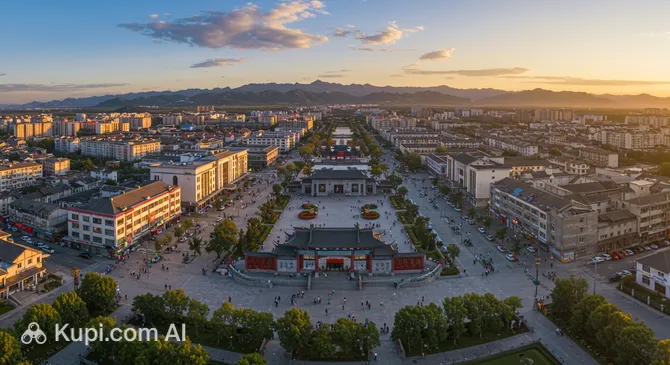
Hebi is a fascinating city in Henan Province, China, whose name poetically translates as "Crane Cliff." According to legend, flocks of graceful birds once rested on the local cliffs. Today, the city, with a population of approximately 1.57 million people, harmoniously combines deep antiquity with the features of a modern industrial center.
The city's geographical location makes it attractive to nature lovers: Hebi is nestled among picturesque hills and rivers. The rich history of this region dates back to the Shang Dynasty, when the capital, Zhaoge, was located here. In later periods, the city served as the political center of the Kingdom of Wei, while its modern stage of development began in the mid-20th century with the exploration of coal deposits.
Hebi. Illustration.
Source: Kupi.com AI
Travelers here will find not only archaeological sites but also magnificent landscapes along the Qi River, which has been celebrated in the oldest Chinese poems. Hebi invites those who want to see the real China — without the bustle of the capital, but with a profound cultural heritage and sincere hospitality.
Weather Overview
Hebi enjoys a temperate continental climate, characterized by a clear change of four seasons. Summer here is hot and quite humid, with temperatures often reaching +30–35°C, especially in July and August. Winter, by contrast, is dry and frosty: the thermometer often drops to -10°C, and the average January temperature hovers around zero.
The most favorable time for a visit is spring and autumn. During these periods, the weather in the city is as comfortable as possible for long walks, offering mild warmth in the range of +15–25°C and a picturesque change of colors in the Qi River valley. Precipitation falls mainly during the summer months, so it's worth bringing an umbrella for trips at that time.
Average monthly temperature
Average monthly precipitation
Interesting Facts
Hebi holds many secrets and fascinating facts that offer a new perspective on this industrial center of Henan Province:
The city's name is directly linked to an ancient legend: it is believed that cranes nested on the cliffs in these parts, which gave the settlement its name — "Crane Cliff".
The Hebi region is of colossal historical significance — it was the site of Zhaoge, the last capital of the legendary Shang Dynasty, from where four emperors ruled.
The local Qi River is a true literary celebrity: it is mentioned as many as 18 times in "The Book of Songs" (Shijing), one of the oldest collections of Chinese poetry.
The city features a 66-meter clock tower on New Century Square, which is often called the "Chinese Big Ben" due to its outward resemblance and scale.
Although the region has been inhabited for thousands of years, Hebi received its modern city status only in 1957, initially developing as an important coal mining center.
How to Get There
Thanks to Henan Province's well-developed transport network, getting to Hebi is quite simple. The city is conveniently located at the intersection of important routes, making it accessible for travelers moving by train as well as those who prefer air travel. Detailed information about routes and tickets can be found in the section on how to get to Hebi.
The nearest major air hub is the international airport in Zhengzhou. From there, you can reach Hebi by comfortable intercity bus or taxi. The journey by car along the modern Beijing–Hong Kong–Macau Expressway takes about 2.5 hours, offering views of the region's agricultural lands along the way.
Railway communication is the most popular way to travel. Hebi is part of China's high-speed rail network, allowing for quick travel from Beijing, Zhengzhou, or Anyang. The city is served by modern stations with navigation that is easy to understand even for foreign tourists.
The main attractions of Hebi are inextricably linked to its status as one of the cradles of Chinese civilization. Be sure to visit the ancient city of Zhaoge, which was once the capital of the Shang Dynasty. Here, pages of ancient history come to life, and archaeological finds allow you to touch a culture that existed more than three thousand years ago.
For lovers of nature and tranquility, the banks of the Qi River are the perfect destination. Often called the "Northern Lijiang," this river is famous for its crystal-clear waters and lush vegetation. A stroll along its banks allows you to feel the atmosphere of classical Chinese poetry, as these very landscapes inspired the authors of antiquity.
In the Heshan district lies the scenic Mount Wuyan (Wuyanshan) area. This place is famous for its Yaowandong cave grottoes, dating back to the Sui and Tang dynasties. Here, you can see unique colored sculptures and grottoes where, according to legend, the famous "King of Medicine," Sun Simiao, lived in seclusion.
Another gem of the region is the Ancient City of Junxian, which holds the status of a National Historical and Cultural City. Its architecture and traditional way of life have preserved the spirit of old China, and annual festivals and fairs attract thousands of pilgrims and tourists.
Local Cuisine
The gastronomic scene in Hebi is an interesting blend of Henan provincial traditions with an emphasis on fresh local products. The basis of many dishes is fish caught in the clean waters of the Qi River. Local chefs masterfully prepare river fish, highlighting its delicate flavor with a minimum of spices and vegetable side dishes.
Be sure to try the traditional snacks sold at street markets and in small family-run restaurants. The cuisine of this region, known as Yubei, is characterized by its heartiness: various types of noodles, meat dishes, and flatbreads are popular here. In Hebi, simplicity and the natural taste of ingredients are highly valued.
As for drinks, it is customary in Hebi to accompany a meal with classic Chinese tea. It is also worth paying attention to the local alcoholic beverages of Henan Province, which are often served during festive feasts. The best places to get acquainted with local cuisine are traditional establishments with a view of the river or the lively shopping districts in the city center.
Travel Tips
To make your trip to Hebi as comfortable as possible and leave you with only pleasant impressions, we have prepared several useful recommendations.
Clothing and Essentials: Choose your wardrobe according to the season: light clothing and sun protection are necessary in summer, while warm clothes are needed in winter as the climate is dry and windy. For visiting the Wuyanshan hills and walking along the Qi River, be sure to bring comfortable sports shoes.
Transport: It is most convenient to get around the city by bus or taxi. For trips to remote counties such as Qixian or Junxian, you can use local bus routes or rent a car with a driver.
Finances: The official currency is the Chinese Yuan. Major shopping centers accept UnionPay cards, but for markets and small cafes, it is better to have cash or mobile payments set up (Alipay/WeChat Pay), as international Visa/Mastercard cards do not work everywhere.
Health and Safety: Hebi is considered a safe city, but when hiking in the mountains or near waterfalls in the summer, exercise caution on slippery steps. Pharmacies are easy to find in the city center, but it is better to have a basic set of medicines with you.
Communication: The main language is Mandarin (Putonghua). English is not widely spoken, so download an offline translator in advance and save the addresses of your hotel and attractions in Chinese.
Local Etiquette: Residents of Hebi are friendly to tourists. A greeting with a nod or a slight bow is appropriate. Tipping is not customary in restaurants or taxis.
What to Avoid: You should not plan important trips during major national holidays (e.g., Chinese New Year), as transport will be overcrowded and many attractions may be closed or too crowded.
Additional Tip: Visit the Ancient City of Junxian in the evening — modern lighting transforms the historic streets into a fairytale sight.
Following these simple rules will help you dive deeper into the atmosphere of ancient China and enjoy the hospitality of Hebi!
Entertainment & Nightlife
Hebi is primarily a city of history and industry, so classical nightlife with noisy clubs is less developed here than in major metropolises. Nevertheless, the city at night offers its own unique entertainment. One of the most atmospheric places is the Ancient City of Junxian, where magnificent illumination is switched on after sunset, cultural shows are held, and night markets with local delicacies operate.
The center of attraction for evening strolls by locals and tourists is New Century Square with its famous clock tower. Here, you can enjoy a peaceful atmosphere, observe the daily life of the citizens, and take beautiful photos against the backdrop of illuminated buildings. The Qibin and Shancheng districts also offer a selection of cozy restaurants that stay open late.
Nature lovers will enjoy evening walks along the Qi River. During the warmer months, the riverbanks become venues for small festivals and folk celebrations. Although there is no active club scene, safety in the city is high, allowing for peaceful walks along the central streets even at late hours.
Parks & Museums
The park areas of Hebi are striking in their scale and historical significance. One of the main natural sites is the scenic Mount Wuyan (Wuyanshan) area. This is not just a park, but an entire complex combining mountain landscapes with the ancient Yaowandong cave grottoes. Here, you can see unique sculptures from the Sui and Tang dynasties and enjoy the silence in places where philosophers and healers sought seclusion for centuries.
For those interested in military history, Yanbing Ridge will be of interest. It is believed that the legendary generals Sun Bin and Pang Juan practiced martial arts tactics here during the Warring States period. A walk through these places allows you to combine active recreation with the study of China's ancient history.
A special place in the city's culture is held by the Ancient City of Junxian, which is an open-air museum in itself. The layout and architecture characteristic of old China have been preserved here, and numerous archaeological zones in the Zhaoge area allow you to see artifacts from the Shang Dynasty. While large modern galleries are rare here, the city's historical sites fully compensate for this with their cultural richness.
Getting Around
The public transport system in Hebi is focused on the convenience of moving between residential areas and key attractions. The main mode of transport is buses, which cover the entire city. For example, the popular Route No. 1 connects the Heshan district with the scenic Wuyanshan area, allowing tourists to easily reach the grottoes for a modest fee.
To pay for fares on city buses, cash is most often used (it is better to have small bills) or local transport cards. Hebi is also actively implementing payment systems via QR codes in the Alipay and WeChat apps, which significantly simplifies life for travelers. Fares are low, and buses run regularly from early morning until evening.
An alternative to public transport is taxis, which can be hailed on the street or called via the Didi mobile app. This is a convenient and affordable way to reach distant counties like Qixian or Junxian, especially if you are traveling in a group. For trips through hilly areas and suburbs, it is recommended to use navigation maps to plan routes more accurately.
Accommodation
The choice of accommodation in Hebi offers suitable options for both business travelers and tourists visiting for sightseeing. The main concentration of hotels is in the Qibin, Heshan, and Shancheng districts. For those who want to be in the heart of the action and have access to the best transport links, hotels in the Qibin district are the best choice.
If your primary goal is nature and visiting cave grottoes, consider hotels in the Heshan district. Here, you can find accommodation options in close proximity to the picturesque Wuyanshan hills. The city is dominated by mid-range and budget hotels that offer a decent level of comfort, clean rooms, and a traditional Chinese breakfast.
It is recommended to book accommodation in advance, especially if your trip coincides with Chinese national holidays. For searching and booking, it is best to use major international or Chinese services. The cost of living in Hebi remains quite affordable compared to megacities, making the city attractive for long-term exploration of the region.
Nearby Cities
Hebi serves as an excellent starting point for exploring the northern part of Henan Province, which is rich in historical monuments of global significance. Thanks to its proximity to high-speed highways, you can easily plan several exciting day trips to neighboring cities.
Just 40 kilometers from Hebi lies ancient Anyang, one of the eight great ancient capitals of China. Here, it is worth visiting the UNESCO World Heritage site — the Yin Xu ruins, where oracle bones with the oldest Chinese characters were found. Also of interest is Puyang, known as the "Hometown of Chinese Dragons," where an ancient dragon figure made of shells was discovered.
For those ready to travel a little further, the road is open to Handan, a city with a three-thousand-year history that has never changed its name. These trips will allow you to dive deeper into the chronicles of Chinese civilization, returning by evening to the cozy atmosphere of Hebi.
Exploring the surroundings of Hebi will provide you with a wealth of impressions: from archaeological discoveries to modern urban landscapes. Each of these destinations is accessible by train or car within a 1–2 hour journey.
Shopping & Souvenirs
Shopping in Hebi is primarily geared towards meeting the daily needs of the locals, but tourists will also find plenty of interest. The main shopping area is considered the zone around New Century Square in the Qibin district. Clothing stores, electronics, and daily necessities are concentrated here, as well as small shops selling local products.
If you are looking for unique souvenirs, pay attention to porcelain products. Hebi is famous for its ceramic production traditions, which are rooted in the deep past. Souvenirs depicting cranes — the symbol of the city — and replicas of historical artifacts from the Shang Dynasty, which can be purchased in specialized museum shops and in the ancient city of Junxian, are also popular.
Gourmet gift seekers should bring back local tea and dried delicacies from Hebi. The city's markets, especially in the older districts, offer a lively atmosphere and the opportunity to buy fresh produce and spices. Most shops are open from 9:00 to 21:00, and mobile payments such as Alipay and WeChat Pay are accepted everywhere.