Support

Tashilhunpo Monastery

About

The name of this majestic place translates from Tibetan as 'all happiness and well-being gathered here,' and once you step onto its grounds, it is easy to believe these words. Tashilhunpo Monastery is not just a religious site, but a colossal architectural complex in the city of Shigatse, which for centuries served as the seat of the Panchen Lamas, the second highest-ranking figures in Tibetan Buddhism.
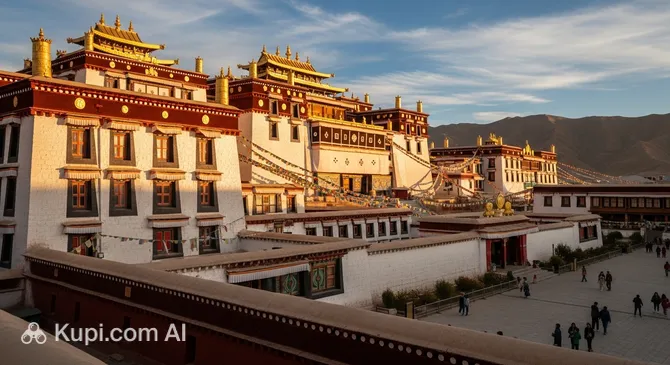
Tashilhunpo Monastery
Tashilhunpo Monastery. Иллюстрация. Источник: Kupi.com AI

Sprawling across a hillside at an altitude of about 3,800 meters, this spiritual center in China captures the imagination with its golden roofs, white walls, and a monumental nine-story wall for hanging sacred thangkas. Around 900 monks reside here, and the atmosphere is permeated with tranquility and the sounds of prayer chants. The complex harmoniously combines Tibetan and Chinese architectural traditions, creating a unique ensemble of temples, palaces, and stupas.

The monastery's main treasure is a massive statue of Maitreya Buddha, which took over 270 kilograms of pure gold and a vast number of precious stones to create. Tashilhunpo is living history, where ancient frescoes, rare relics from the Ming and Qing eras, and modern rituals blend seamlessly, making it a must-see for any traveler in Tibet.

Contacts

To help plan your visit to this spiritual center, we recommend saving these contact details. Tashilhunpo Monastery is within walking distance of the central city areas, and its golden roofs serve as an excellent landmark.

How to contactContact
Address7 Ji Ji Lang Ka Lu, Sang Zhu Zi Qu, Ri Ka Ze Shi, Xi Zang Zi Zhi Qu, Китай, 857003
Phone+86 892 882 2933

What to Do

Start your exploration of the monastery grounds with a visit to the main Kelsang temple, where you can see the Panchen Lama's throne and an elegant five-meter statue of Shakyamuni. The Jampa chapel is particularly impressive: it houses the world's tallest gilded statue of a seated Future Buddha — Maitreya. You can spend quite some time admiring its details, encrusted with diamonds, pearls, and turquoise.

Be sure to complete a kora — the traditional clockwise circumambulation of the monastery walls alongside local pilgrims. This path offers magnificent panoramic views of the city and lets you feel the true rhythm of Tibetan life. If you are lucky enough to be here during the Buddhist debates in the courtyard, you can watch the monks emotionally discussing sacred texts, punctuating their arguments with characteristic gestures and hand claps.

A stroll through the narrow labyrinths between buildings will reveal secluded corners with ancient frescoes and painted mandalas dating back to the 14th century. And if your visit coincides with the festival in May, you will witness a rare spectacle — the hanging of giant sacred thangkas on the high Thangka wall, visible from anywhere in the city.

Getting There

Finding your way to the monastery is easy: it is located at 7 Ji Ji Lang Ka Lu in Samzhubze District, right in the heart of the city. If you are near the Shigatse Dzong fortress, the walk to the entrance will take no more than 10–15 minutes. For those who prefer comfort, a taxi ride from any part of the city is quite inexpensive.

Travelers often arrive here from Lhasa by high-speed train or comfortable bus (the journey takes about 5–6 hours). Many tourist routes heading to Everest Base Camp also include a mandatory stop at this sanctuary. The main entrance is at the foot of the hill, with stone steps leading to the main temples.

It is important to remember that the site is located at an altitude of about 3,800 meters above sea level. To ensure the climb up the monastery stairs doesn't cause discomfort, don't forget about acclimatization, drink plenty of water, and try to move at a measured pace. Entrance tickets can be purchased directly at the ticket office at the entrance.

Ближайший город: Shigatse

History & Facts

The monastery's founding in 1447 is inextricably linked with the name of Gendun Drup, a talented disciple of the great reformer Tsongkhapa. Gendun Drup was later recognized as the First Dalai Lama, which immediately granted the monastery high status. Construction took 12 years, funded by donations from locals and nobility on the site of an ancient fortress, laying the foundation for the main stronghold of the Gelug school in Western Tibet.

A new milestone in its history began in the 17th century when the Fourth Panchen Lama declared Tashilhunpo his official residence. From that point on, the complex began to expand rapidly, becoming a powerful religious, educational, and political center. For centuries, the abbots of the local colleges played a key role in regional life and the search for new incarnations of spiritual leaders.

Remarkably, Tashilhunpo Monastery managed to avoid serious destruction during the turbulent historical events of the last century, preserving unique artifacts, statues, and the tombs of former Panchen Lamas. One of the most significant structures of recent decades is the majestic stupa of the Tenth Panchen Lama, covered in gold and adorned with jewels, which was solemnly consecrated in 1989.

Time Needed

A typical visitor should set aside 3 to 4 hours for a thoughtful exploration of the monastery complex. This is usually enough time to see the main temple halls, climb up to the impressive Maitreya chapel, and examine the detailed frescoes in the galleries. If you plan to take many photos or decide to complete a full kora (sacred circuit) around the monastery, allow about half a day for your visit.

For those who want to catch the morning ceremonies or observe the monks' philosophical debates, it is best to arrive right at the opening. During major religious festivals, when giant thangkas are displayed, the flow of pilgrims increases significantly, so your stay may be extended due to queues at the most revered shrines.

Working Hours

Typically, the monastery gates are open to visitors daily from 9:00 AM to 5:00 PM or 6:00 PM, though it is worth noting that the schedule may change slightly depending on the season or local religious holidays. It is recommended to arrive in the morning, as this is when most halls are guaranteed to be open for viewing.

For the most up-to-date information on opening times and potential restrictions, we advise visitors to check official travel resources or confirm the schedule with local guides shortly before their visit.

Nearby

Exploring the surroundings of the monastery allows you to transition smoothly from the sublime spiritual atmosphere to the modern rhythm of the city. Within walking distance, you will find cozy places to relax after a long tour, try local cuisine, or simply watch city life over a cup of tea.

Name Type
A Cup Bar & CoffeeCafe & Drinks
JingdianwuAttraction
Xiangyue 98 ClubClub/Bar
Sangji Chumu BarBar
新世纪亚吉查姆堆谐康Cultural Center
New Feelings BarBar
Haozun Business LoungeLounge
Tianying BarBar
Shangku Music BarMusic Bar
80 Niandai Music PubPub

Reached the end of the page?

That means the route is fully explored