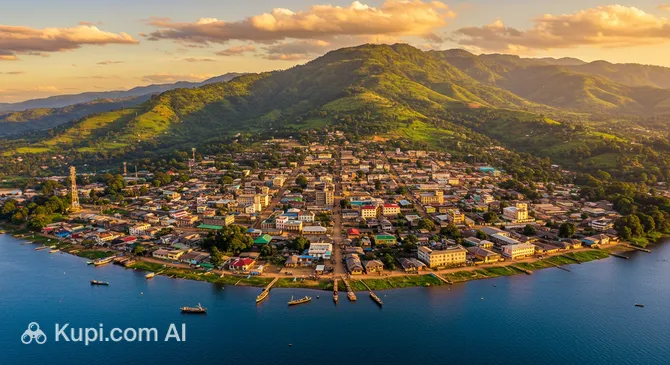
Uvira is a dynamic port city stretching along the northern coast of the legendary Lake Tanganyika in Congo (DRC). Located in the South Kivu province, the city serves as a vital link between regions, combining the features of a busy transport hub and a picturesque coastal settlement. Situated at an altitude of 746 meters above sea level, it offers travelers a unique glimpse into East African life, where water routes meet mountain serpentines.
Uvira. Illustration.
Source: Kupi.com AI
The city's geographical position defines its importance: it is a key transport node connecting Bukavu and Bujumbura. With a population modernly estimated at 590,000 people, Uvira is constantly growing and developing. Although the city is not a classic tourist resort, its atmosphere is filled with the energy of transit, market bustle, and the daily rhythm of life on the shores of one of the deepest lakes on the planet.
The main pride and economic artery of the city is the Port of Kalundu, which provides river connections with Tanzania and Burundi. The historical heritage of this place is closely linked to its role as an administrative center and a trading gateway for the region. A visit to this city is an opportunity to see the real, unvarnished life of provincial Congo, enjoy views of the endless waters of Tanganyika, and feel the hospitality of the local residents.
Weather Overview
The climate of Uvira is typical for equatorial Africa: tropical humidity prevails here, tempered by the proximity of a massive body of water. Lake Tanganyika creates a special microclimate, providing the city with pleasant ventilation. Temperatures remain fairly stable throughout the year, with averages around 25–28°C during the day, while nighttime temperatures rarely drop below 15°C.
The city has two distinct rainy seasons, the most intense of which lasts from October to May. During this period, rainfall can be quite heavy, which affects the condition of the roads in the region. A short dry season occurs during the summer months when humidity decreases and the sky becomes clearer. If you want to study the climate of Uvira by month in more detail, you should pay attention to the period from June to August, which is considered the most comfortable for a visit.
Expect warm and sometimes hot weather with short but heavy downpours, after which the air fills with freshness. High humidity requires some acclimatization, but the cool breeze from the lake makes staying in the port area quite pleasant even on the sunniest days.
Average monthly temperature
Average monthly precipitation
Interesting Facts
Uvira holds many interesting features that make this port city unique within the region.
The city is located on the shores of Lake Tanganyika—it is not only one of the deepest lakes in the world but also the longest freshwater lake on the planet.
Port Kalundu, located within the city limits, is a vital hub connecting the DRC with Tanzania and Burundi exclusively by water.
Despite its significance, Uvira is not a major industrial center—its economy is almost entirely tied to trade and transport.
The city is in the UTC+2 time zone, and French is used as the official language for documentation, although Swahili is more commonly heard on the streets.
The city's population is showing rapid growth, making it one of the fastest-growing administrative centers in the eastern part of the country.
How to Get There
Reaching Uvira is a small journey in itself that requires planning. The city is an important hub, but its accessibility depends largely on weather conditions and road status. The main flow of travelers arrives here by land or water, as direct air service to the city is currently limited.
The main road arteries are the routes from Bukavu (a distance of about 200 km, travel time can take 4 to 6 hours due to difficult terrain) and from Bujumbura in Burundi (about 100 km, 2–4 hours). It is worth considering that during the rainy season, roads can become washed out, significantly increasing travel time. Detailed information on routes can be found in the section describing ways to reach the city.
Water transport plays an equally important role. Regular service is established through Port Kalundu to Kalemie, as well as to Kigoma in Tanzania and Bujumbura in Burundi. Ferries and cargo-passenger vessels are a great way to see the beauty of Lake Tanganyika, although such a journey can take from one to two days.
Station
Passenger traffic
Distance
Kigoma station
1
175 km
Main Attractions
Uvira is a city where everyday life itself is the main attraction. There are no classic monuments or world-famous museums here, but the atmosphere of a coastal hub creates a unique flavor. The main object of interest for guests is the Port of Kalundu. Located in the southern part of the city, it is the true heart of the region, where you can watch the loading of ships setting off on long voyages across Lake Tanganyika toward Tanzania and Burundi.
Another iconic spot is the Lake Tanganyika waterfront. This is not a manicured promenade but a living space that locals use for their daily needs and relaxation. The view of the endless water and the mountains on the opposite shore is especially impressive at sunset when the sun's rays paint the water surface in golden tones. For those who want to feel the rhythm of the city, the central markets are a must-visit; life here is in full swing from early morning, and stalls are bursting with fresh fish and local fabrics.
A walk through Uvira also allows you to see important infrastructure points—the road junctions leading to Bukavu and Bujumbura. Despite the absence of typical tourist sites, the city attracts visitors with its authenticity and its role as a transit center where the paths of people and goods from different corners of Central and East Africa intersect.
Local Cuisine
The gastronomic identity of Uvira is inextricably linked to the rich bounty of Lake Tanganyika. The main delicacy that every guest should try is fresh fish, such as tilapia or Nile perch. It is prepared masterfully here: most often grilled with aromatic spices or stewed in a rich tomato sauce with local vegetables.
The basis of almost every meal is fufu—a thick and hearty porridge made from cassava or corn flour, which is traditionally eaten with the hands, dipping it into sauces. No less popular is the dish pondu, made from crushed cassava leaves. This side dish has a unique taste and is considered very nutritious. Street food in the markets of Uvira is the best way to get acquainted with the culinary traditions of the region, where the aromas of grilled meat and spices fill the air.
As for drinks, locals prefer refreshing beers of popular brands like Primus or Skol, which perfectly quench thirst in the tropical climate. You can also find traditional palm wine, which has a specific sweetish taste. Restaurants and small cafes are mainly concentrated in the port area, offering simple but very tasty and filling food that reflects the true character of Congolese cuisine.
Travel Tips
A trip to Uvira promises to be a vivid and authentic experience, and to ensure your journey is as comfortable as possible, we have prepared some important practical tips.
Clothing and essentials: Choose light clothing made from natural fabrics, as tropical humidity prevails in the region. Be sure to bring comfortable closed shoes for walking and a power adapter for Type C or E sockets.
Transport: The fastest way to move around the city is by moto-taxi. For safety, always choose drivers in bright vests and avoid traveling after dark.
Finances: US dollars and Congolese francs are in use. ATMs are very rare, so bring a sufficient supply of cash in small bills (dollar bills must be new and undamaged).
Health and Safety: A yellow fever vaccination certificate is mandatory for entry. Use only bottled water and insect repellent.
Communication: The main language of communication is Swahili; the official language is French. English is not widely spoken, so a few basic phrases in French will make your life significantly easier.
Local Etiquette: Congolese people are very friendly. Always say hello before asking a question. Ask for permission before taking photos of people or their market stalls.
What to avoid: Do not drink tap water and do not swim in unequipped areas of Lake Tanganyika. Also, try not to display expensive equipment or large sums of money in crowded places.
Seasonality: Plan your visit for the dry season (June to September), as many roads turn into difficult-to-pass obstacles during the rainy period.
By following these simple rules, you can fully enjoy the hospitality of Uvira and the beauty of the shores of Tanganyika. Have a pleasant trip!
Entertainment & Nightlife
The entertainment scene in Uvira is primarily oriented toward local residents, allowing tourists to immerse themselves deeper into an authentic atmosphere. Nightlife here is concentrated in the port area and along the main transport arteries. You won't find massive dance floors or elite clubs here, but you can visit cozy local bars where live African music often plays and chilled local beer is served. These are ideal places for socializing and observing the daily life of the townspeople.
Daytime entertainment in the city is inextricably linked to its market culture and proximity to the water. Visiting the central markets turns into a real adventure, where you can not only buy unique goods but also see vibrant, improvised street performances. For a more relaxed pastime, travelers choose quiet spots on the shores of Lake Tanganyika, where they can simply enjoy the cool breeze and picturesque landscapes.
If you crave a more diverse cultural experience, keep in mind that residents of Uvira usually head to neighboring Bujumbura or Bukavu for theaters and large concert venues. Within the city itself, safety in the evening is maintained on the central streets; however, to move between establishments after sunset, it is strongly recommended to use the services of verified moto-taxis.
Parks & Museums
The cultural landscape of Uvira differs from that of major capitals, and you won't find traditional museum halls or art galleries here. However, the role of an open-air museum is successfully fulfilled by the city itself, where every building and port pier holds the history of the region's trade and transport development. Instead of formal exhibitions, tourists can study the lifestyle and traditions through direct interaction and by observing artisans in the markets.
There are few park zones in the classic sense in the city, as dense construction and the terrain dictate their own conditions. Nevertheless, the Lake Tanganyika waterfront serves as the main natural recreation area. The absence of organized parks is more than compensated for by the majestic views of the mountains and the endless lake surface, which create a natural recreational environment for residents and visitors alike.
For those looking for larger natural attractions, Uvira serves as a starting point to the protected territories of the South Kivu province. Despite minimal greenery in the center, the city's outskirts amaze with a riot of tropical vegetation, which can be seen by driving outside the residential areas toward the mountains. It is an ideal place for those who appreciate wild, untouched nature and the absence of tourist crowds.
Getting Around
The transport system in Uvira is fully adapted to the local terrain and the needs of a busy commercial city. There is no metro or tram system here, and the primary means of transport for both residents and tourists are moto-taxis. These maneuverable bikes are able to quickly navigate congestion on narrow streets and deliver passengers to the most remote neighborhoods. The cost of a trip is usually fixed for standard routes, but it is better to agree on the price in advance.
Minibuses and trucks converted for passenger transport are actively used for trips between districts and to nearby settlements. They depart as they fill up and are the most budget-friendly way to get around. Be prepared for the fact that during peak hours, especially morning and evening in the port and market areas, traffic can be difficult due to the large amount of freight transport.
Pedestrian zones are practically non-existent in the city, so walking along the central streets requires caution. The payment system for transport in Uvira is exclusively cash-based, so it is always worth having small denominations of local francs with you. If you require a transfer to another city, such as Bukavu, it is best to use the services of specialized transport agencies that offer seats in more comfortable 4x4 vehicles.
Accommodation
Accommodation options in Uvira are primarily geared toward transit passengers, business travelers, and humanitarian mission staff. You won't find five-star international hotel chains here, but you can find decent guesthouses and middle-class hotels. Most of the lodging is concentrated in the central districts and in the immediate vicinity of the port, which is convenient for those planning to continue their journey by water.
For longer stays, expats often choose to rent apartments that offer a basic level of comfort. When choosing a place to stay, it is worth paying attention to the presence of private generators and water purification systems, as the city's infrastructure can sometimes be unstable. It is recommended to book accommodation in advance, especially if your visit coincides with major regional events or the active trading season.
The price range in Uvira hotels remains affordable, and payment is most often accepted in cash in US dollars or local francs. Despite the limited presence of local hotels on global booking sites, finding a place to sleep upon arrival is usually not difficult by asking local taxi drivers or port staff, who are always up to date with the latest offers.
Nearby Cities
Uvira is a convenient starting point for exploring border territories and neighboring states. Thanks to its location at the junction of transport routes, the city allows tourists to make interesting trips to neighboring regions, discovering the diversity of culture and nature in Central Africa.
One of the most popular destinations is a trip to the city of Bujumbura, located just 24 kilometers away. This is the capital of neighboring Burundi, offering more developed tourist infrastructure, beautiful beaches on Lake Tanganyika, and colorful restaurants. It is also interesting to visit the small settlement of Gatumba, which is very close to the border and allows you to experience the atmosphere of frontier life.
For those ready for longer travels, the road opens north to Bukavu—the administrative center of the province, known for its colonial-period architecture and proximity to national parks. Exploring the surroundings of Uvira will give you a wealth of impressions from the changing landscapes and the opportunity to see how closely the destinies of neighboring peoples are intertwined in this region.
Shopping & Souvenirs
Shopping in Uvira is primarily about visiting the vibrant and noisy markets that are the soul of the city. The main trading platforms are concentrated in the Port Kalundu area and along the city's central axis. There are no air-conditioned shopping malls here, but there is the inimitable atmosphere of African bargaining, where you can find everything from car parts to the freshest catch from the lake.
If you are looking for souvenirs, pay attention to the local fabrics (pagne) with unique traditional patterns. They are distinguished by high quality and rich colors. Also, as a gastronomic souvenir, tourists often buy dried fish from Tanganyika, which is considered a delicacy throughout Congo. Wooden crafts and woven baskets are also popular among visitors to the city.
Shops in Uvira usually open from early morning until sunset. Payment is made primarily in cash: Congolese francs and US dollars are in use. Don't forget that polite bargaining is appropriate and even welcomed in the markets—it is an important part of the local communication culture. For larger purchases or branded items, locals usually head to neighboring Bujumbura or Bukavu.