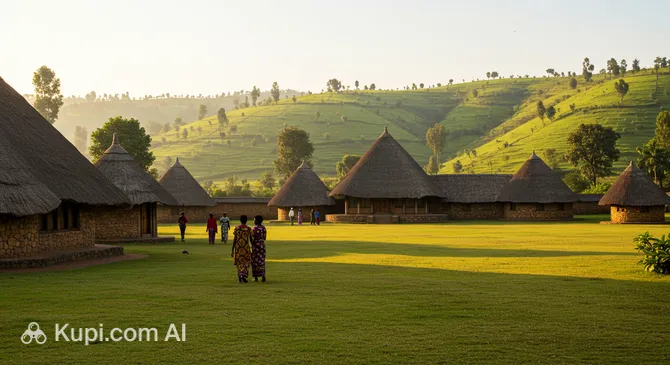
Nyanza (also known as Nyabisindu) is a city with deep cultural resonance located in the heart of Rwanda. As the administrative center of the Southern Province, it represents a harmonious blend of colonial heritage, modern government buildings, and a traditional African way of life. Situated on a high plateau about 53 kilometers southwest of the capital, Kigali, the city serves as an important commercial hub for the region.
Nyanza. Illustration.
Source: Kupi.com AI
From a historical perspective, the city's past is unique: between 1958 and 1962, Nyanza was the capital of the Kingdom of Rwanda. This status has left its mark on the architecture and the city's significance to local residents. Today, it is home to about 55,000 people, while the total population of the district exceeds 365,000, making it a lively yet cozy place.
Travelers are drawn here by the opportunity to touch the roots of Rwandan statehood and get acquainted with traditional art. Visiting this city is an invitation to see the country beyond the popular tourist trails, immerse yourself in the atmosphere of authentic provincial life, and experience the hospitality of the locals.
Weather Overview
The climate in Nyanza can be described as temperate and mild, typical for the highland regions of Rwanda. Thanks to its location at an altitude of about 1500–1700 meters above sea level, there is no exhausting heat typical of many equatorial regions. Expect warm days with temperatures ranging between 24–25°C and cool, refreshing nights when the thermometer can drop to 14–15°C.
The year is divided into two main rainy seasons (from March to May and from October to December) and dry periods. April and November are traditionally considered the wettest months when rainfall can be quite intense. However, even during these times, rain is often followed by hours of sunshine. If you want to know more about what the weather in the city will be like for specific dates, it is worth monitoring current forecasts.
The best time to visit is during the dry months, such as July and August, when the chance of precipitation is minimal and the air is clearest. During this time, humidity decreases, making long walks and sightseeing as comfortable as possible for travelers.
Average monthly temperature
Average monthly precipitation
Interesting Facts
This city holds many surprising details that help in better understanding the culture and traditions of the region.
On the last Saturday of every month, residents participate in Umuganda — a program of mandatory community service. During this time, all shops in the city are closed, and citizens work together on street cleaning or construction.
From 1958 to 1962, Nyanza was officially the capital of the Kingdom of Rwanda, making it one of the country's key historical centers.
The city ranks 10th in the country by population and is one of the five largest centers in the Southern Province.
It is home to one of the few museums in East Africa entirely dedicated to the traditional arts and crafts of the region.
How to Get There
Nyanza is accessible primarily through its well-developed road connections with the nation's capital. Most travelers prefer to start their journey in Kigali, from where the drive to Nyanza takes about 1–1.5 hours. It is best to research how to plan your route in advance to account for local traffic conditions.
The main ways to travel between cities are private taxis or renting a car with a driver — this is the most comfortable and fastest option for a tourist. An alternative is the minibuses (matatus) that run regularly between regional centers. While a matatu ride may take longer due to intermediate stops, it allows for a deeper immersion into the local flavor.
There is currently no rail service in this region, so ground vehicle transport remains the only practical way to reach the city. The road surface on main highways is in good condition, though it is worth allowing extra time for potential delays during the rainy seasons.
Station
Passenger traffic
Distance
Kigoma station
1
280 km
Main Attractions
Despite the city being primarily an administrative center, there are several truly significant sites here. The main jewel of the region is the King's Palace Museum. This site is a reconstruction of the traditional residence of Rwanda's monarchs, where you can learn about the kings' way of life and see the impressive long-horned "Inyambo" cows, which were traditionally considered a symbol of power and wealth.
Another important cultural site is the Rwanda Art Museum. It houses rich collections of traditional crafts, sculptures, and artifacts that vividly illustrate the country's artistic journey through the centuries. For those interested in history, a visit to this museum is an excellent addition to a walk around the city.
A stroll through the central part of the city is also worth your time. The typical layout of a provincial African center, with its mix of administrative buildings and local marketplaces, allows you to feel the rhythm of everyday life in Nyanza. Although many monuments from the royal era have not survived in their original form, the status of the former capital gives every street in the city a special historical context.
Local Cuisine
The gastronomic scene in Nyanza is the quintessence of traditional Central African flavors. The diet here is based on products grown in the region's fertile lands: cassava, beans, corn, and bananas. You should definitely try ugali (a thick porridge made from maize flour), which serves as a side dish for many meals, as well as matoke — specially prepared green bananas.
Locals most often eat in small eateries and street stalls serving fragrant bean stews and fish caught in nearby waters. This is a great opportunity to try authentic cuisine at very affordable prices. In the city itself, you can also find establishments near administrative buildings where the menu will be more familiar to travelers.
As for drinks, fresh tropical fruit juices and local beer are popular in Nyanza. Travelers are strongly advised to consume only bottled water. The culinary experience in Nyanza is not about haute cuisine, but about simple, hearty, and healthy foods that reflect the spirit and traditions of this land.
Travel Tips
A trip to Nyanza promises to be fascinating, and to make your journey go as smoothly as possible, we have prepared some practical tips.
Clothing and Essentials: Due to the high-altitude location, the climate in the city is temperate. Bring light clothing made of natural fabrics for daytime walks and a light jacket or sweater for cool evenings. Comfortable closed-toe shoes are essential.
Transport: To get around the city, it is best to use a moto-taxi or a regular taxi. If you are planning a trip from Kigali, it is most convenient to rent a car with a driver.
Finances: The main currency is the Rwandan Franc. Cards are accepted very rarely, only in large establishments, so always carry a supply of cash.
Health and Safety: The city is generally safe, but observe standard precautions: do not walk alone after dark. Drink only bottled water.
Communication: The local population speaks Kinyarwanda; French and English are less common. Learn a few basic phrases in the local language — it really helps win people over.
Local Etiquette: Rwandans are polite and reserved people. Greet people when you meet them, be punctual, and show respect for local customs.
What to Avoid: Try not to plan important errands for the morning of the last Saturday of the month due to Umuganda. It is also not recommended to photograph government facilities without special permission.
Additional Tip: Be sure to visit the local markets in the morning — this is the best time to see the city in motion and buy the freshest products.
May your introduction to Nyanza be filled with vivid discoveries and pleasant encounters!
Entertainment & Nightlife
The entertainment industry in Nyanza is mainly geared toward local residents, so Western-style nightlife is virtually non-existent here. Evenings in the city are quiet: small, cozy cafes and bars are the main meeting places. In such establishments, it is customary to have leisurely conversations and discuss the day's news to the sound of local music.
For those looking for vibrant nightclubs or large-scale entertainment centers, the best solution is a trip to Kigali, which can be reached in about an hour. The capital offers a wide choice of restaurants, discos, and cultural events catering to every taste and budget.
In Nyanza itself, cultural life is often linked to community events and holidays. The days of the Umuganda program are of particular importance, as social interaction reaches its peak. Those who want to explore the historical side should spend a day at the King's Palace Museum, which is the main center of attraction for visitors to the city.
Parks & Museums
Unique museums take center stage in the cultural landscape of Nyanza. The main object of interest is the King's Palace Museum, which introduces guests to the structure of the traditional monarchy. A stroll through the palace grounds, surrounded by green lawns, gives an idea of what the royal residence looked like during the city's heyday.
The Rwanda Art Museum is equally important for understanding the regional heritage. Its exhibits are dedicated to folk crafts and contemporary art, making it a must-visit for anyone who appreciates aesthetics and history. The museum actively collaborates with local artisans, preserving unique wood and fabric-working techniques.
While there are few classic city parks in Nyanza, the city itself is nestled in the greenery of private gardens and plantings around administrative buildings. The high-altitude location ensures that nature remains bright and lush throughout the year. The areas around cultural sites, where well-maintained landscapes are harmoniously integrated into the environment, are best suited for outdoor walks.
Getting Around
The transport system in Nyanza is typical for most Rwandan cities and is characterized by a dominant informal sector. The most popular and fastest way to get around the city is by moto-taxi ("moto"). This is a convenient option for short trips; however, you should agree on the price with the driver in advance and always use a helmet.
For trips between districts and to neighboring settlements, locals often use minibuses known as matatus. They do not have a strict schedule and depart as they fill up with passengers. Despite the lack of fixed schedules, matatus run quite frequently during daylight hours, connecting Nyanza with key points in the province.
The payment system on public transport is exclusively cash-based, so tourists should always carry small change. For more comfortable trips, you can order a regular taxi, but their number in the city is limited. Bicycles also remain an important means of transport, and the central streets of the city are well-suited for walking during daylight hours.
Accommodation
The accommodation options in Nyanza mainly consist of small guesthouses and budget hotels catering to locals and business travelers. The tourist infrastructure here is still developing, so luxury five-star hotels should not be expected in the city itself. Most accommodation options are concentrated in the city center, near markets and government offices.
Those planning to visit the King's Palace Museum and other sights are recommended to book accommodation in advance through local contacts or agencies, as the number of comfortable rooms is limited. The level of service here is simpler than in the capital, but this is more than compensated for by affordable prices and the genuine hospitality of the staff.
For longer stays or for those desiring a high level of comfort, many tourists prefer to stay in Kigali or neighboring Huye (Butare), visiting Nyanza as a day trip. Nevertheless, staying overnight in the city itself allows you to experience the unique rhythm of life in the Rwandan province and see the city during the hours when there are no daytime visitors.
Nearby Cities
Thanks to its location on the country's main transport artery, Nyanza serves as an excellent starting point for exploring other interesting corners of Rwanda's Southern Province. The city's surroundings are rich in cultural and educational centers that are easy to visit as part of a day trip.
Just 28 kilometers to the south lies the city of Huye (formerly known as Butare). It is the intellectual capital of the country, home to the National University and one of the best ethnographic museums in Africa. Also worth noting are neighboring Ruhango and Muhanga — bustling commercial centers through which the region's main routes pass. If you find yourself missing the capital's flair, the road to Kigali takes just over an hour.
City
Population
Distance
Ruhango
17 051
13 km
Huye
50 220
28 km
Muhanga
87 613
29 km
Ndora
23 813
30 km
Nyamagabe
16 695
32 km
Exploring nearby cities will allow you to see the diversity of Rwandan landscapes — from endless hills to terraced fields. Each of these destinations complements the overall picture of life in the country, making your journey through the Southern Province rich and unforgettable.
Shopping & Souvenirs
Shopping in Nyanza is primarily about getting acquainted with colorful local markets. The city's central market is its commercial heart, where life bustles from early morning. You can find literally everything here: from the freshest tropical fruits and spices to bright African fabrics with traditional patterns, which local craftsmen can use to sew clothes right before your eyes.
For authentic souvenirs, you should head to the specialized shops at the King's Palace Museum or the Art Museum. They sell handmade products: "agaseke" woven baskets, wood carvings, and ceramics. Such items will be more than just a souvenir; they will be a true symbol of Rwandan craftsmanship and history.
Shops in the city operate on a standard schedule, usually opening at 8-9 AM and closing by evening. It is important to remember that trade stops during Umuganda days. Payment in most outlets is made in cash in the local currency (Rwandan Franc), so tourists are advised to carry small bills for convenience when paying at markets.