Support

Twin Gate

About

Strolling through the ancient streets that Pula is famous for, it's impossible to miss a majestic monument of antiquity — the Twin Gates. This historical structure was erected at the turn of the 1st and 2nd centuries AD, when Croatia was part of the mighty Roman Empire. The gates served as a ceremonial entrance to the city and led straight to the ancient theater, blending harmoniously into the ring of city walls.
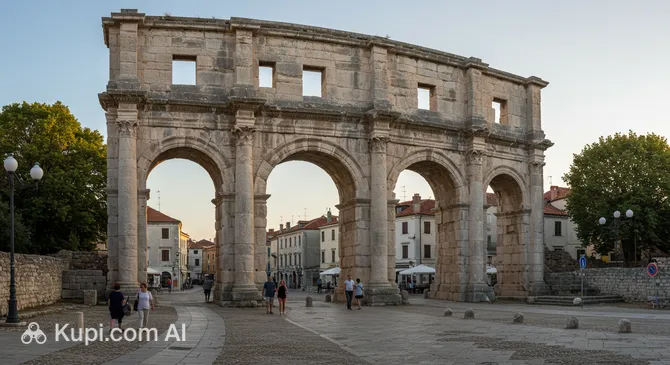
Twin Gates
Twin Gates. Иллюстрация. Источник: Kupi.com AI

The structure is simple yet elegant: two identical arches connected by a shared cornice. An observant traveler will notice special slots in the upper part — massive grates were once lowered through them to protect the city from unwanted guests. Above the arches sits a marble plaque mentioning Lucius Menacius Priscus, whose generous contribution to the city's water supply system was immortalized in stone.

Today, the Twin Gates are considered one of the city's iconic landmarks, highlighting its rich heritage. Perfectly preserved, they serve as a portal between the modern pace of life and the atmosphere of an ancient Roman settlement, attracting thousands of history and architecture enthusiasts.

Contacts

To confirm details before your visit, you can consult the city's official tourism resources.

How to contactContact
AddressCarrarina ul. 8, 52100, Pula, Хорватия
Websitewww.pulainfo.hr

What to Do

It's worth pausing at the Twin Gates to examine the details of ancient Roman engineering. Study the massive arches and find the grooves where protective gates slid centuries ago. Don't forget to look at the ancient inscription on the marble — it's a great opportunity to touch the history of philanthropy during the imperial era.

Photography enthusiasts will love the play of light on the ancient stone, especially in the morning hours. The gates provide a perfect classical backdrop for photos. After exploring the arches, be sure to look at the remains of the octagonal mausoleum discovered nearby — these ruins vividly illustrate the scale of Roman burials located outside the city limits.

Since the gates are just a few steps from the Archaeological Museum of Istria and the Roman Theater, it's best to turn your visit into a walking tour of the "Roman ring." This allows you to see key monuments in one go, including the famous Arch of the Sergii and the Temple of Augustus, fully immersing yourself in the atmosphere of the ancient past.

Getting There

The Twin Gates are located in the heart of the historical center at Carrarina ul. 8. If you are already in the old part of the city, they are easy to reach on foot: a walk from the famous Amphitheater takes only 10–15 minutes heading east. The Roman Theater and the Archaeological Museum, which are in the immediate vicinity, can serve as landmarks.

For those arriving from other cities or the airport, Pula offers a well-developed transport network. From the airport, located 6 km away, you can take a taxi or shuttle to the central bus station, which is just a 5–10 minute walk from the gates. Buses also regularly arrive in the city from Trieste and Rijeka.

If you prefer private transport, there are parking zones around the Kaštel Fortress and in the city center. However, it's worth noting that the historical center is best explored on foot or by bicycle, as many streets are pedestrianized and the architectural monuments are located very compactly.

Ближайший город: Pula

History & Facts

The Twin Gates were built at the turn of the 1st and 2nd centuries AD, likely on the site of an even older entrance. At that time, they served as one of ten ceremonial portals leading into the walled Roman Pula. It was through these arches that citizens made their way to the grand ancient theater, the remains of which can still be seen today.

Of particular value is the preserved marble slab at the top of the gate. The inscription on it states that one Lucius Menacius Priscus donated the impressive sum of 40,000 sestertii to the city for the development of its water supply system. This is a rare piece of evidence of personal philanthropy in the ancient era, which helped make the lives of citizens more comfortable.

Interestingly, during the Roman period, a vast necropolis was located outside the gates. In later times, when the city walls lost their defensive significance, many tombstones were used by locals as building material for houses. During modern excavations right by the gates, archaeologists discovered the foundation of a rare octagonal mausoleum, which is now open to tourists.

Time Needed

For a quick look at the arches themselves and the commemorative inscription, you'll need about 15–30 minutes. This is plenty of time to take beautiful photos and read the information boards explaining the ancient portal's design.

If you plan to combine the visit with a look at the adjacent archaeological finds, including the octagonal mausoleum and the ruins of the Roman Theater, you should budget 45 to 60 minutes for your walk. The Twin Gates are also a standard stop on guided walking tours of the city, which typically last 2–3 hours.

Working Hours

The Twin Gates are part of the city's architectural landscape and are located outdoors, so they are accessible for viewing 24 hours a day. You can visit them any day of the week — from Monday to Sunday — without any time restrictions.

Nevertheless, to get the most up-to-date information on possible changes in access to adjacent museum areas, it is recommended to check the city's official tourism website.

Круглосуточно

Nearby

The location of the Twin Gates makes it easy to create a rich itinerary through the city's ancient and medieval past. Exploring the surroundings will help you better experience the multi-layered history of this region.

NameDistance
Zerostrasse0 km
Roman Theatre of Pula0.1 km
Istrian Olive Oil Museum0.1 km
Pula Fortress0.2 km
Historical and Maritime Museum of Istria0.2 km
Pula Arena0.3 km
Arch of the Sergii0.3 km

Reached the end of the page?

That means the route is fully explored