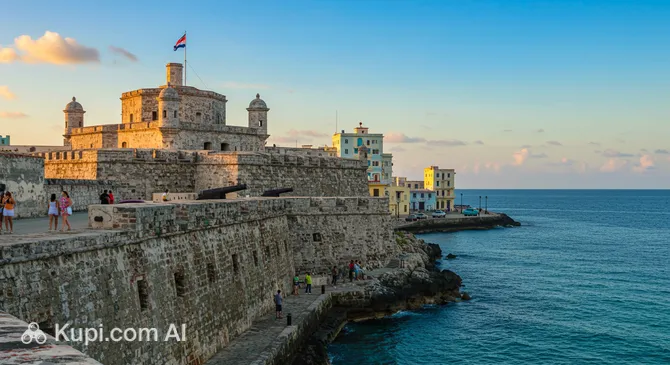
Standing guard at the entrance to a quiet harbor, right where the famous Malecón begins, is Castillo de la Punta. This historic fort, located in Havana, is one of the most important symbols of the colonial past carefully preserved by Cuba.
Built at the end of the 16th century, the San Salvador de la Punta fortress was designed as an impenetrable shield to protect Havana Bay. Designed by Italian master Juan Bautista Antonelli, this bastion became a key element of the city's defense system, capable of repelling attacks by the most daring pirates of the time.
Castillo de la Punta. Illustration.
Source: Kupi.com AI
Traveler photos:
Today, this architectural monument invites guests to peek inside its powerful stone walls. It houses a naval museum featuring rare artifacts, models of old ships, and artillery pieces. Castillo de la Punta is not just a fortification; it is a place where legends of sea battles and the Spanish treasure fleet come to life.
Contacts
To visit this historic fortress, you may find the following contact details useful:
At Castillo de la Punta, everyone will find something to enjoy, whether they are military history buffs or lovers of scenic views. Start your visit at the indoor museum: it houses unique exhibits, including treasures recovered from the seabed and detailed models of the Spanish galleons that protected these shores centuries ago.
Be sure to climb the fortress walls. These platforms offer some of the best panoramic views of Havana Bay and the majestic El Morro castle standing on the opposite shore. It is an ideal spot for photography, especially when the waves crash against the base of the old fortifications.
For those who prefer a quiet rest, the adjacent memorial park will be a pleasant discovery. Here you can examine details of ancient masonry and ship model fragments, and in the evening, enjoy a walk along the Malecón, watching as the setting sun paints the fortress walls in warm crimson tones. If you are traveling with family, children will love seeing the real cannons and imagining themselves as part of a pirate saga adventure.
Getting There
The fortress occupies a strategic position at the very beginning of the famous Malecón promenade, right at the entrance to Havana Bay. If you are walking through the historic center, the easiest way to reach it is on foot: a walk from the Plaza de Armas in Old Havana will take about 15–20 minutes through the picturesque streets leading to the ocean.
For those in other parts of the city, it is convenient to take a taxi—both modern ones and the famous Cuban classic cars. A trip from the Vedado district will take about 10–15 minutes. City buses (guaguas) also run along the waterfront, connecting key tourist areas of the capital.
If you prefer to travel by rental car, parking spaces are available near the fortress. Travelers arriving from the airport should expect a 25–30 minute taxi ride to reach the walls of this majestic outpost.
Nearest city: Havana
History & Facts
The construction of Castillo de la Punta began in 1589 by personal decree of the Spanish King Philip II. The fortification project was entrusted to the talented Italian military engineer Giovanni Bautista Antonelli. The fortress was vital for protecting Havana from constant threats from pirates and enemy European fleets seeking to capture the New World's key port.
One of the most fascinating chapters in the fortress's history was the use of a giant metal chain in 1630. This chain stretched across the entire mouth of the bay from Castillo de la Punta to the opposite shore, where El Morro Castle stood. Every day at sunset, it was raised to physically block the entrance to the harbor and secure the ships stationed there against night raids.
Over the centuries, the fort proved its effectiveness many times, serving not only as a defensive bastion but also as an important warehouse for Spanish artillery. Despite numerous battles, the fortress endured, and in 1997, a large-scale restoration was carried out. This preserved the unique colonial architecture for future generations, making it a symbol of the resilience and engineering skill of the era.
Time Needed
To leisurely explore all corners of the fortress, see the museum exhibits, and take impressive photos against the backdrop of the ocean, you will need approximately 1–2 hours. This is the optimal time for a self-guided exploration of the site.
If you decide to join an organized tour or want to stay longer in the memorial park to admire the view of El Morro, plan to spend up to 3 hours here. Visiting the fortress fits perfectly into a morning or late afternoon city walk.
Working Hours
You can visit Castillo de la Punta any day of the week, as the fortress is open seven days a week. The complex doors are open to tourists from 09:00 to 17:00.
This schedule allows you to easily plan your visit as part of a morning program or during an afternoon stroll along the waterfront. It is recommended to arrive an hour before closing to have time to explore all the museum halls.
9:00 – 17:00
Nearby
The fortress's location in the historic heart of the city makes it easy to combine your visit with other iconic sites. A walk through the surrounding area will reveal colonial-era architectural masterpieces and cozy parks where time seems to stand still.
Exploring nearby attractions will help you dive deeper into the atmosphere of the Cuban capital and see Havana from different perspectives: