Support

José Martí Memorial

About

Towering high above the Vedado district landscape is the José Martí Memorial — the most impressive monument to the national hero known in Cuba. Located on the famous Revolution Square, this architectural complex features a 109-meter star-shaped tower clad in grey granite. At the base of the stele stands a majestic 18-meter statue of the thinker, carved from white marble.
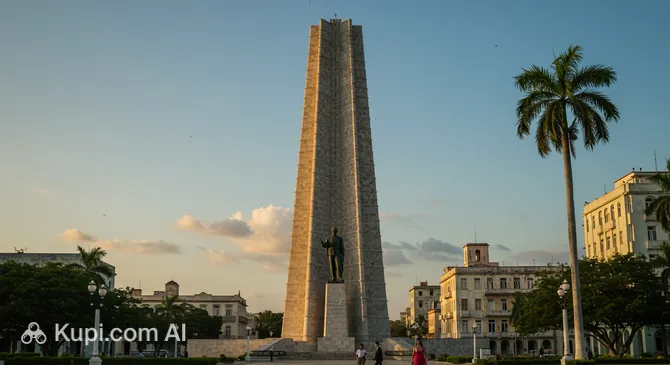
José Martí Memorial
José Martí Memorial. Иллюстрация. Источник: Kupi.com AI

This is not just a monument, but a multifunctional cultural center that houses a memorial museum. Havana is visible from here as if in the palm of your hand, as the memorial tower is officially recognized as the highest point in the city. Inside, five exhibition halls await visitors, telling the story of the life and struggle of the "Apostle of Independence."

The memorial impresses with its combination of monumentality and elegance: from the strict granite lines to the delicate Venetian mosaics in the interiors. It is a place of power where the country's history intertwines with the present, making it a mandatory stop on any traveler's itinerary.

Contacts

For those planning a visit to this monumental structure, it will be useful to save its coordinates in advance. The memorial is located in the heart of the city's administrative district and is easy to find thanks to the tower's impressive height.

Below are the current contact details for communication and navigation:

How to contactContact
AddressCalle Paseo y Ave. Independencia. Plaza de la Revolución. La Habana, 4JF7+38X, Av. Paseo, La Habana, Куба
Phone+53 7 8820906

What to Do

The highlight of visiting the memorial is the ascent by high-speed elevator to the enclosed observation deck. At an altitude of over 120 meters above sea level, you can see the city panorama in all its diversity — from the coastline to distant residential neighborhoods.

In the lower part of the complex, be sure to look into the museum halls. Authentic relics are kept here: Martí's letters, diaries, and personal belongings. Special attention should be paid to the unique wall mural made of Venetian ceramics, where 89 of the philosopher's wise sayings are laid out in gold letters. Temporary exhibitions of contemporary Cuban art are also frequently held in the halls.

If you're lucky, you might catch one of the ceremonial events or concerts in the memorial's fifth hall. After exploring the interior, take a walk along the platform at the base of the statue — it's a great spot for striking photos against the backdrop of Revolution Square and its famous murals.

Getting There

The famous memorial is located on Revolution Square (Plaza de la Revolución) in the Vedado district. To get here from the historical center, such as the Capitolio or Old Havana, it is most convenient to take a taxi — the ride takes about 10–15 minutes. You can also use public transport (local "guagua" buses) that run along Avenida Salvador Allende.

If you prefer the railway, the nearest station is 19 de Noviembre, located at the intersection of Tulipán and Oeste streets. From the station, you will need to walk for about 15 minutes along Hidalgo Street, which will allow you to see a bit of the city's residential neighborhoods. Parking spaces are provided near the square for motorists.

Ближайший город: Havana

History & Facts

The idea of creating a grand monument to José Martí, the "Apostle of Independence," originated in 1926, but the project's implementation only began decades later. Between 1937 and 1943, various competitions were held where different concepts won — ranging from a tower to a seated figure in the style of the Lincoln Memorial. Construction finally began in 1953, timed to coincide with the centenary of the national hero's birth.

The construction of the monument was accompanied by challenges: to clear the space, the Monserrat monastery had to be demolished and local residents relocated. The main works were carried out under the guidance of architect Luis Enrique Varela. Interestingly, the monument was completed in the final days of the Batista administration, but its significance to the people was so great that it became a central symbol of the new era as well.

The memorial is rich in symbolism: six columns at the base represent the six ancient provinces of the island. In 1998, this site gained special spiritual significance when Pope John Paul II conducted a solemn mass for a massive crowd of believers from the platform at the base of the tower.

Time Needed

To explore the museum exhibits at your own pace and enjoy the views from the observation deck, it is recommended to set aside 1.5 to 2 hours for the visit. This is quite enough time for a thoughtful look at the hero's personal belongings and taking photos of the capital from above.

Typically, about 45 minutes are spent touring the museum halls, and another half hour for the ascent and panoramic view of the city. The remaining time is best spent walking around Revolution Square itself and its surrounding gardens to appreciate the scale of this architectural ensemble.

Working Hours

The memorial complex welcomes guests from Monday to Saturday. The museum and observation deck doors are typically open from 09:30 to 16:00. Please note that Sunday is a day off.

The operating schedule may change during public holidays or official ceremonies on the square, so it is recommended to check for current information on official resources or with local guides before your visit.

DayWorking hours
понедельник09:30–16:00
вторник09:30–16:00
среда09:30–16:00
четверг09:30–16:00
пятница09:30–16:00
суббота09:30–16:00
воскресеньеЗакрыто

Nearby

Revolution Square, where the memorial stands, is the starting point for exploring many of the capital's iconic landmarks. A walk through the surrounding area will allow you to better feel the contrast between official architecture and the city's cozy parks.

NameDistance
Revolution Square0.2 km
John Lennon Park1.7 km
Fábrica de Arte Cubano2.4 km
Casa de la Música Miramar2.9 km
Fraternity Park3 km
El Capitolio3.1 km
Great Theatre of Havana3.2 km

Reached the end of the page?

That means the route is fully explored