Support

Djibouti-Ambouli International Airport

About the Airport

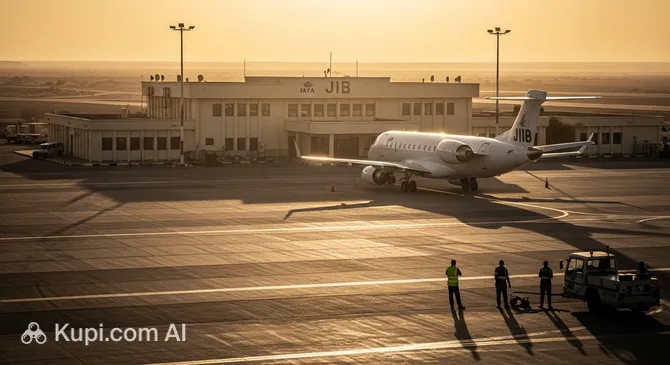
Djibouti-Ambouli International Airport. Source: Kupi.com Binoculars

Djibouti-Ambouli International Airport (JIB) is not merely the main air gateway to the capital and the entire country, but also a vital strategic hub on the Horn of Africa. Located at the crossroads between Africa, the Middle East, and Europe, this airport plays a key role in facilitating both civil aviation and international military and humanitarian missions. Established in 1948, it has evolved over time into a modern transport hub reflecting Djibouti's growing importance on the global stage. Despite its compact size, the airport efficiently serves hundreds of thousands of passengers annually, acting as the starting point for exploring this unique country.

IATA Code JIB
ICAO Code HDAM
City Djibouti City
Distance to Centre approx. 6 km
Status International, joint-use (civil and military)
Passengers per Year approx. 423,000 (based on 2018 data)
Popular Airlines Ethiopian Airlines, Turkish Airlines, Qatar Airways
Schedule Online Flight Board "Djibouti-Ambouli International Airport"

One of the main features of Djibouti-Ambouli Airport is its dual status: it is simultaneously a civilian harbour and an important military base for several foreign nations, which accounts for a significant portion of its traffic. For passengers, there is a single terminal that serves all domestic and international flights. Despite its modest dimensions, it has everything necessary for a comfortable wait before departure: cafes, duty-free shops, currency exchange points, and car rental counters. The airport serves as a hub for major carriers such as Ethiopian Airlines, Turkish Airlines, Qatar Airways, and Air France, providing convenient connections to countries in Africa, the Middle East, and Europe.

Contact Information

For the most up-to-date information regarding flights, services, and airport regulations, we recommend contacting official channels. Below are the main contact details for Djibouti-Ambouli International Airport (JIB).

  • Official Website: www.aeroport-djibouti.com
  • Information Desk Phone: +253 21 34 01 01
  • Address: BP 204, Ambouli, Djibouti, Republic of Djibouti
  • Email: contact@aeroport-djibouti.com
  • Social Media: The airport has an official Facebook page where news and updates are published.
  • Lost Luggage Information: For issues regarding lost or damaged luggage, you should first contact your airline's representative at the airport.
  • Passenger Support Service: for on-site assistance, you may approach the information desk located within the airport terminal.

How to Get to the Airport

Getting to Djibouti-Ambouli International Airport (JIB) from the city centre of Djibouti City is quite simple, as it is located just a few kilometres away. The travel time is usually 15-20 minutes by car, though this may increase during peak hours. Here are the main ways to reach the airport.

Taxi and Transfer

The most convenient and popular way to get to the airport is by taxi. They can be found throughout the city or ordered via your hotel. It is recommended to use official taxis and agree on the fare in advance, as not all drivers use meters. Booking a private transfer is an even more reliable option, guaranteeing a fixed price and timely vehicle arrival, which is particularly convenient for early morning or late-night departures.

Car Rental

If you prefer to drive yourself, several international and local rental agencies operate in Djibouti City. Renting a car gives you complete freedom to travel around Djibouti. Most companies allow you to return the car directly at the airport before departure. Djibouti-Ambouli Airport has a parking area where you can leave a vehicle for both short and long terms, although the number of spaces may be limited.

Public Transport

The public transport system in the capital mainly consists of minibuses (known as "co-lectifs"). This is the most budget-friendly method of travel, but it may not be the most comfortable for tourists with large luggage. They do not have a strict schedule and are often crowded. There may not be a direct route to the terminal, so this option is more suitable for experienced travellers ready for an adventure. There are no trains or metro services to the airport.

Alternative Airports in the Region

Although Djibouti-Ambouli International Airport is the country's main air gateway, other options can be considered for travel in neighbouring regions. For instance, for trips to Ethiopia, Semera Airport (SZE) or Aba Tenna Dejazmach Yilma (DIR) in Dire Dawa might be convenient. For travel to Somaliland, consider Hargeisa Airport (HGA). Also located relatively nearby are Jijiga Airport (JIJ) and Aden International Airport (ADE).

Terminals and Map

Djibouti-Ambouli International Airport (JIB) is distinguished by a simple and clear structure, making it convenient for passengers. The airport consists of one passenger terminal, which serves both domestic and international flights. Thanks to its compact size, navigating through it causes no difficulties even for those visiting for the first time.

The terminal layout is logical: arrival and departure zones are clearly separated. Check-in counters are located in the main hall on the ground floor. After check-in, passengers pass through passport control and security screening to enter the departure zone. The waiting hall is small but has everything necessary: several shops, cafes, and boarding gates. Since all flights are handled in one building, transfers between terminals are not required.

Completing all formalities generally does not take much time. However, during peak hours, especially before the departure of major international flights, queues may form. It is recommended to arrive at the airport 2-3 hours before departure to complete check-in and screening without haste. Signs in the airport are in French, Arabic, and English, which facilitates orientation for international tourists.

Airport History

The history of Djibouti-Ambouli International Airport (JIB) is closely tied to the country's strategic position on the Horn of Africa. Its story began during World War II when the French airbase of Ambouli was established on this site. After the war, the facility began serving civil flights as well, and the official opening of the airport for commercial aviation took place in 1948. From that moment, it became the main air gateway of Djibouti, serving the capital — Djibouti City.

The main stages of the airport's development occurred in the second half of the 20th century. In the 1970s, leading up to and following the country's independence in 1977, significant modernisation was carried out. Specifically, a new passenger terminal was built, and the runway was extended to accommodate larger jet aircraft. These changes transformed Ambouli into a key transport hub of regional importance, capable of handling growing international passenger traffic.

Due to its unique geographical location at the intersection of routes between Africa, the Middle East, and Asia, the airport has always held significant logistical importance. Throughout its history, it has served and continues to serve not only civil purposes but also acts as a base for various international humanitarian and peacekeeping missions. This dual function is one of its main features.

In recent decades, work has been undertaken at the airport to upgrade infrastructure to meet modern safety and comfort standards. While records and loud achievements are not its calling card, Ambouli Airport consistently fulfils its main task — providing reliable air connectivity for the country. An interesting fact: the airport's runway is used jointly by civil airliners and aircraft participating in international operations, making it one of the most multi-functional airfields in the region.

Services and Amenities

Djibouti-Ambouli International Airport (JIB), being the country's main air gateway, offers passengers all necessary services for a comfortable stay while waiting for their flight. Despite its relatively small size, the terminal is designed to satisfy the basic needs of travellers.

Dining and Shopping. At the airport, you will find several cafes and snack bars where you can have a quick bite, drink coffee, or purchase refreshments. For those wishing to buy souvenirs, gifts, or travel essentials, shops are available, including a Duty Free zone. Here, a standard range of perfumes, tobacco products, and local goods is presented.

Lounges and Wi-Fi. For a more comfortable wait, the airport features a VIP lounge. Passengers can use its services for a fee or through airline loyalty programmes. The lounge usually offers beverages, snacks, fresh newspapers, and a quieter atmosphere. Wireless internet (Wi-Fi) is available throughout the terminal, and there are charging stations for mobile devices, allowing you to stay connected before departure.

Financial and Other Services. For passenger convenience, currency exchange points and ATMs function within the airport building where cash can be withdrawn. A medical point is provided in case first aid is needed. For travellers with small children, mother and child rooms are equipped where you can care for your baby in a calm environment.

Additional Amenities. The airport provides services for passengers with reduced mobility, including special assistance during boarding and disembarking, which is recommended to be booked in advance through the airline. Although there are no hotels directly within the terminal grounds, several accommodation options are located in close proximity to the airport, a few minutes away by taxi. There are no specialised conference halls in the airport, but basic business services, such as faxing or document copying, may be provided in the VIP lounge.

Where to Eat

Djibouti-Ambouli International Airport (JIB) offers passengers several basic opportunities for snacks and full meals, although the selection here is not as extensive as in major international hubs. The main establishments are concentrated in the main terminal and are oriented towards satisfying the basic needs of travellers before departure.

In the departure zone, after passing passport control and security (airside), you will find the main cafe where you can order hot dishes as well as light snacks. Sandwiches, pastries, salads, as well as coffee, tea, and soft drinks are usually served here. This is the best place for a full lunch or dinner while waiting for a flight. In the public zone (landside), the choice is generally more modest and may be limited to a small kiosk with drinks and snacks.

If you wish to try something with local flair, pay attention to the offers in the main cafe — sometimes dishes inspired by African and Arab cuisine can be found there. Regarding dietary needs, Halal options are easy to find. Vegetarians generally have access to salads or meat-free pastries. For passengers with stricter restrictions, such as vegans or those requiring gluten-free dishes, it is recommended to clarify ingredients directly with staff, as specialised options may be limited.

For a quick snack, coffee and fresh pastries are ideal, while for a more substantial meal, the hot dish of the day in the main restaurant is suitable. Prices at the airport, as elsewhere, are higher than in the city. Most dining establishments operate in accordance with the flight schedule, ensuring service for passengers on both morning and evening departures.

Travel Tips

Planning a trip through Djibouti-Ambouli International Airport (JIB) becomes easier with our tips. This airport serves the country's capital, Djibouti City, and is the main air gateway of the state of Djibouti. To ensure your journey goes smoothly, familiarise yourself with these useful recommendations.

Arrival Time at the Airport. For international flights, it is recommended to arrive at the airport 2.5–3 hours before departure. For domestic flights, 1.5–2 hours will be sufficient. This will give you enough time to complete all formalities without haste, even if small queues arise.

Check-in and Security Control. Ambouli Airport is relatively small, so navigating it will not be difficult. Keep your passport, visa (if required), and ticket ready. Screening procedures are standard, but sometimes can be more thorough, so pack all liquids and electronic devices in advance so they are easy to remove.

Seat Selection on the Plane. If you love scenic views, especially during takeoff or landing over the Gulf of Tadjoura, choose a window seat. An aisle seat is suitable for those who want the ability to stand up freely and stretch their legs during the flight without disturbing neighbours.

Hand Luggage. It is forbidden to take liquids in containers larger than 100 ml, as well as any sharp or cutting objects, in hand luggage. Be sure to put all important documents, money, necessary medication, a portable charger, and valuables in your bag. A light jacket will also be useful, as it can be cool on the plane.

Passengers with Connections. Clarify at check-in whether your luggage will be transferred automatically to the final destination. Despite the airport's compactness, allow enough time between flights to calmly pass all necessary procedures, especially if you need to go through security control again.

Customs Control. When entering or leaving, be prepared to declare large sums of cash or valuable items. Customs officers may ask standard questions about the purpose of your trip and the contents of your luggage. Remain calm and answer questions clearly.

Saving Time and Money. To save on taxis, consider booking a transfer through your hotel in advance. There are several cafes at the airport, but prices can be high. Take an empty water bottle with you, which can be filled after passing security control.

In Case of Flight Delay. If your flight is delayed, first contact your airline representative for information. Depending on the duration of the delay, you may be provided with drinks, meals, or even hotel accommodation. Since there is little entertainment at the airport, download films or books to your devices in advance to brighten up the wait.

Reached the end of the page?

That means the route is fully explored