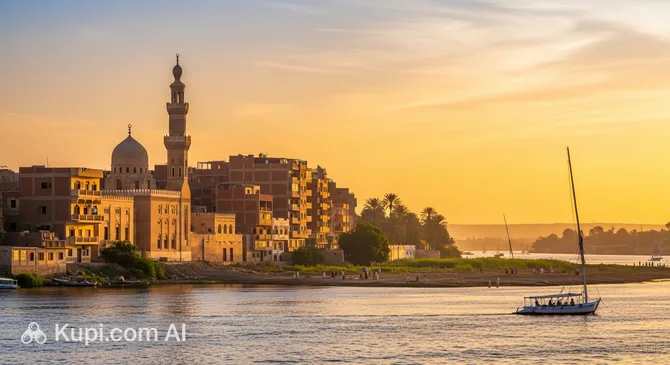
Located on the left bank of the great Nile, Mallawi represents the authentic heart of provincial Egypt. This city in the Minya Governorate is not just an administrative center, but a place where time seems to slow down, allowing travelers to see the real, non-touristy Egypt. With a population of about 148,000, the city lives by the rhythms of agriculture and traditional crafts, preserving the charm of the old Nile Valley.
Mallawi. Illustration.
Source: Kupi.com AI
Geographically, Mallawi is located about 40 kilometers south of El Minya. Its name has deep roots: translated from Coptic, it means "place of fabrics," highlighting the region's rich artisanal heritage. The long history of the city is inextricably linked to weaving, a tradition still carefully preserved by local craftsmen.
While the city itself is an important hub for farmers and traders, for tourists it serves primarily as a convenient "gateway" to the great monuments of Middle Egypt. From here, it is easy to reach the ruins of ancient Hermopolis and mysterious necropolises that hide secrets of millennia. A visit to Mallawi is an invitation to immerse yourself in the atmosphere of a working Egyptian settlement, where sincere hospitality and a traditional way of life are more important than outward glitz.
Weather Overview
The city of Mallawi is located in the typical desert climate zone of Upper Egypt. This means that travelers can expect consistently dry weather with minimal precipitation throughout the year. The proximity to the Nile slightly softens the heat on the coast, but overall the weather in the city is characterized by significant temperature fluctuations between day and night.
The summer months, from June to August, can be a real test: daytime temperatures often exceed +38°C...+40°C. Winter, on the contrary, is very mild and pleasant for walking. In January and February, the air warms up to a comfortable +20°C during the day, but at night it can cool down to +7°C...+8°C. Rain in this region is exceptionally rare, with only a few millimeters of precipitation falling per year.
For a comfortable visit to the region, it is better to choose the period from November to March. Expect a very hot and dry summer, which is replaced by warm sunny days and briskly cool nights in the winter period. Due to the lack of mountainous terrain, sand winds sometimes occur here, bringing dust from the desert, which should be taken into account when planning long open-air excursions.
Average monthly temperature
Average monthly precipitation
Interesting Facts
The name of the city Mallawi goes back to an ancient Coptic word that literally translates as "place of fabrics," recalling the region's centuries-long leadership in textile production.
The city is located just a few kilometers from legendary Hermopolis—the sacred center of the god Thoth, who in antiquity was considered the patron of knowledge, writing, and the moon.
Mallawi ranks second in population in the Minya Governorate, being an important strategic point for the entire Nile Valley in Middle Egypt.
Near the city is the unique necropolis of Tuna el-Gebel, which houses the world's largest burials of mummified ibises and baboons.
The city's telephone code is 86, and the daily life of the region depends almost entirely on the flooding of the Nile and the fertile lands surrounding the settlement.
How to Get There
The transport accessibility of Mallawi is largely determined by its position in the Nile Valley, which connects Cairo with the southern regions of the country. Although the city does not have its own airport, it is integrated into the general logistical network of Egypt, making a journey to Mallawi quite feasible for the prepared tourist.
Most travelers arrive here via Cairo International Airport (CAI). The distance from the capital is about 300 kilometers, which takes from 4 to 6 hours by bus or car. Direct regular buses and shuttle taxis run frequently between Cairo and Mallawi, offering a budget-friendly and colorful way to travel. The road passes along picturesque agricultural lands and desert landscapes.
The railway connection is one of the most reliable ways to reach the region. Although high-speed trains more often stop at larger hubs such as El Minya or Asyut, Mallawi also has its own station on an important main line. Traveling by train allows you to enjoy views of the Nile Valley, but it is better to purchase tickets for popular directions in advance.
Station
Passenger traffic
Distance
El-Marg
4
272 km
El-Marg
4
272 km
Luxor Railway Station
5
288 km
For those who prefer mobility, the best option is to rent a car with a driver or take a taxi from El Minya. The journey along highway No. 60 takes less than an hour. It is worth considering that traffic in the province can be chaotic, and delays are possible at the exits from large cities due to heavy traffic flow.
Main Attractions
The city of Mallawi is not one of the classic tourist centers with an abundance of monuments within the city limits, but its surroundings hide true archaeological treasures. The city streets themselves are interesting for their everyday hustle and bustle and colorful local markets located near the Nile waterfront, where you can observe the life of the modern descendants of the pharaohs.
The main magnet for travelers remains nearby sites such as Hermopolis (El Ashmunein). This was an ancient capital and the center of the cult of the god of wisdom, Thoth. Today, you can see impressive temple remains and huge baboon statues that once guarded the sacred site. Mallawi is ideal as a base for exploring these ruins.
Another important location within driving distance is Tuna el-Gebel. This necropolis is famous for its extensive catacombs, where the mummies of sacred ibises and baboons are buried. Visiting these places allows you to touch the Hellenistic and Roman periods of Egypt's history, which rarely make it onto standard tourist itineraries.
For those ready to drive a bit further, Tell el-Amarna is available—the ruins of the capital of the "sun pharaoh" Akhenaten. The city of Mallawi is an important stop on the way to these unique rock-cut tombs and the remains of ancient palaces, offering travelers a rare opportunity to explore monuments without the crowds of tourists.
Local Cuisine
The culinary traditions of Mallawi are inextricably linked to the fertility of the lands of Upper Egypt. Here you can try the most authentic national dishes made from the freshest products. The basis of the local diet is legumes, rice, and vegetables. Be sure to try kushari—a hearty combination of rice, pasta, and lentils topped with a spicy tomato sauce, which is prepared with special skill in local stalls.
A specialty of the region is poultry dishes, in particular hamam mahshi—pigeon stuffed with spicy rice or freekeh (cracked wheat). This festive treat is often found on the menus of local family restaurants. Also, do not miss the opportunity to try ful medames and fresh ta'ameya (the Egyptian version of falafel), served with fluffy bread straight from the oven for breakfast.
The food culture in Mallawi is centered around street cafes and markets. The city's main market is a place where you can find not only spices and fruits, but also homemade cheeses and pastries. Among drinks, strong black tea with mint and ahwa (traditional coffee) lead the way, and on hot days, freshly squeezed mango or guava juices are popular, which have an incredibly rich taste in the Nile Valley.
Travel Tips
A trip to Mallawi will give you a unique experience of getting to know the true soul of the Nile Valley if you follow these practical tips from experienced travelers.
Clothing and gear: Choose light clothing made of natural fabrics (linen, cotton), as it can be very hot here. Since the region is conservative, it is better to prefer modest outfits that cover shoulders and knees, especially when visiting mosques or markets. Be sure to bring sunscreen and comfortable closed shoes for walking on dusty roads.
Transport: Use taxis or tuk-tuks to get around the city, but always agree on the price before boarding. For trips to other cities, it is better to choose regular buses or the train, tickets for which should be bought at the station box office in advance.
Finances: Only Egyptian pounds (EGP) are in use. Cards are accepted extremely rarely, so always have a supply of cash with you in small denominations for markets and tips. ATMs can be found in the city center, but international cards do not always work reliably.
Health and safety: Drink exclusively bottled water and avoid ice in drinks in street cafes. Pharmacies are frequent, but it's better to bring specific medications with you. Overall, the city is safe, but be mindful of your belongings in crowded places.
Communication: The main language is Arabic. Few people know English, so learn a few basic phrases: "Assalamu alaikum" (hello) and "Shukran" (thank you). This will immediately endear you to the locals.
Local etiquette: Egyptians in the province are very hospitable. If you are invited for tea, don't refuse immediately—it's a gesture of politeness. When entering a private home, be sure to take off your shoes.
What to avoid: You should not photograph government buildings, bridges, and people without their explicit consent. Also, avoid walking alone in the outskirts of the city late at night.
Extra tip: The best time to visit the markets is early morning, when it's not too hot yet and the selection of products and fabrics is at its maximum.
Following these simple rules will help you enjoy the hospitality of Mallawi and make your trip comfortable and safe. Happy exploring!
Entertainment & Nightlife
The entertainment scene in Mallawi reflects its status as a conservative and hardworking city. You won't find noisy nightclubs, bars, or modern concert venues here. The evening life of the locals is centered around the Nile promenade, where it is pleasant to stroll after sunset, and numerous street cafes where men traditionally gather for a cup of tea and a game of dominoes.
Local markets and small squares that come alive in the evening hours serve as the main places for relaxation. The atmosphere here is calm and friendly, and the crowd consists mainly of local families and youth. If you want more active evening leisure, such as cinemas or modern restaurants, it is better to head to El Minya, located a 40-minute drive away.
Safety for walking in Mallawi is at a good level, but keep in mind that life here winds down quite early. For moving around after dark, it is better to use a taxi, the price of which should be negotiated in advance. Daytime entertainment is limited to exploring local crafts and visiting agricultural exhibitions that are occasionally held in the region.
Parks & Museums
Park culture in Mallawi is in the development stage, and the main green zones here are concentrated along the majestic Nile. The shoreline is the main place for townspeople to relax, where you can find small squares and alleys. A walk by the river allows you to enjoy the cool breeze and views of the feluccas gliding smoothly over the water, which is the best natural therapy in the hot desert climate.
There are currently no large museums of its own within the city. However, Mallawi is unofficially considered an "open-air museum" due to its architecture and proximity to great archaeological monuments. The historical heritage of the region is represented in the exhibitions of museums in neighboring El Minya, as well as in small archaeological centers at the necropolises of Tuna el-Gebel and Hermopolis, where finds from local excavations are kept.
The lack of large city parks is compensated for by the endless agricultural fields surrounding the city. These emerald strips of land create a unique contrast with the buildings and are natural zones for "green" recreation. For nature and history lovers, visiting the surroundings of Mallawi will be a great opportunity to see the authentic landscapes of Upper Egypt, preserved in almost their original form.
Getting Around
The transport system of Mallawi is simple and efficient for the needs of the local population. The main type of public transport here are minibuses, which Egyptians call "microbuses." They run along the main city arteries and connect Mallawi with neighboring villages and large cities like El Minya. There are often no fixed stops—just wave your hand for the driver to slow down.
Within the city, taxis and three-wheeled rickshaws (tuk-tuks) are popular and inexpensive means of transportation. The latter are especially convenient for trips through the narrow streets of old quarters and markets. The fare for a tuk-tuk or taxi should be agreed upon in advance, as meters are a great rarity here. The average price for a trip around the city is small, but for foreign guests, it may be slightly higher.
It is most convenient to move around the city during daylight hours. It's worth considering that during peak hours—morning and evening—minibuses can be overcrowded. Fare payment is always made in cash directly to the driver. Bicycles are not common in Mallawi due to the intense sun, so for a tourist, the most comfortable option remains a taxi or a walk along the waterfront.
Accommodation
The hotel infrastructure in Mallawi is quite modestly developed, as the city rarely serves as a place for long-term tourist stays. The majority of offers consist of budget guesthouses and small hotels catering to locals or specialists coming to the city on business. Nevertheless, for transit travelers exploring the monuments of Middle Egypt, there is always a roof over their heads.
Most accommodation options are concentrated in the central part of the city, near the railway station and main shopping streets. This is convenient in terms of transport accessibility, but be prepared for typical city noise. If you are looking for a higher level of comfort and service, it is recommended to consider staying in nearby El Minya, where international hotel chains and resorts on the banks of the Nile are represented.
For those planning to stay in the region for a few days, renting an apartment can be a good alternative to hotels. It is better to book accommodation in Mallawi in advance using international services, although the choice there may be limited. Remember that in provincial Egypt, personal contact and on-site agreements still play a big role, and prices for accommodation here are significantly lower than in Cairo or Luxor.
Nearby Cities
The city of Mallawi serves as an excellent starting point for exploring the less-known but extremely interesting corners of the Nile Valley. The city's location in the center of an agricultural region allows you to reach several distinctive settlements in a short time, each of which keeps its own unique history and atmosphere.
Just 6 kilometers away is Deir el-Bersha, famous for its ancient tombs from the Middle Kingdom. A bit further are Deir Abu Hinnis and Deir Mawas, where you can see the life of a modern Egyptian village and monuments of Coptic heritage. It is also worth paying attention to Beni Hasan al-Shuruq, from where it is convenient to get to the famous rock tombs of the governors of ancient nomes.
City
Population
Distance
Dayr al-Barsha
14 297
6 km
Dayr Abu Hinnis
19 638
8 km
Dayr Mawas
40 640
11 km
Bani Hasan ash Shuruq
18 218
18 km
Abu Qurqas
63 264
22 km
Exploring these surroundings will give you a much deeper understanding of Egypt than standard excursions. The proximity of the cities to each other allows you to plan rich day trips, returning to Mallawi in the evening or continuing your way toward El Minya, which is only 40 kilometers to the north.
Shopping & Souvenirs
Shopping in Mallawi is primarily an immersion into the atmosphere of traditional oriental bazaars. The city, whose name means "place of fabrics," still lives up to its name. In the central markets, you can find high-quality Egyptian cotton, hand-woven fabrics, and traditional clothing—galabeyas. Local textiles are famous for their durability and natural materials, making them an excellent and practical souvenir.
Main shopping activities are concentrated on the streets leading to the Nile and in the central market. Here, stalls are literally bursting with fresh spices, dates, and grain crops grown in the surrounding fields. Grocery shopping turns into a social event: it is customary to greet each other, exchange news, and, of course, politely haggle. This is the best way to feel the rhythm of life in provincial Egypt.
In addition to fabrics and food, you can find products from local craftsmen in ceramics and wood in the shops of Mallawi. There are no modern Western-style shopping centers in the city, so you should go shopping in the first half of the day or after evening prayers when the shops open again. Payment is mainly made in cash in local currency, and bank cards are accepted only in rare state institutions or pharmacies.