Support

Tallinn Airport

About the Airport

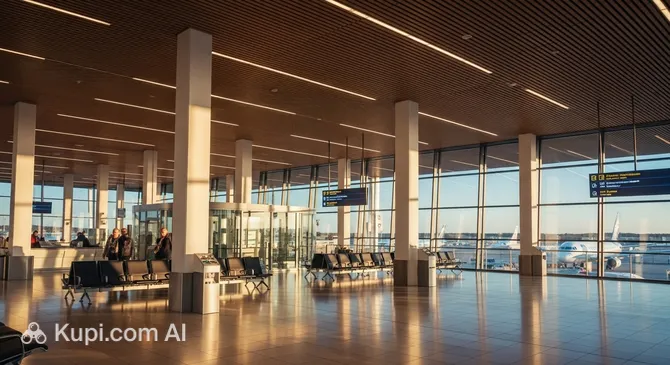
Tallinn Airport. Source: Kupi.com Binoculars
Lennart Meri Airport in Tallinn is often called the coziest airport in the world, and it holds this title for a reason. Here, passengers feel less like they are in a transit hub and more like they are in a living room: soft carpets, armchairs upholstered in local fabrics, and a library create a homely atmosphere. The airport is located surprisingly close to the city centre, allowing you to reach the Old Town in just 15–20 minutes by tram or taxi.
IATA Code TLL
ICAO Code EETN
City Tallinn
Distance to Centre 4 km
Status International
Annual Passengers Approx. 3.5 million (2024)
Schedule Online Flight Board

Tallinn Airport stands out for its attention to traveller comfort and unique interior details. The entire terminal is designed in an Estonian style: waiting areas are styled after various corners of the country, from the sea coast to forest thickets, and playgrounds are equipped for children, including a large area shaped like the house of Lotte — a popular Estonian cartoon character.

One of the most famous features is the library in the departure zone, where anyone can borrow a book for their flight or leave one for other passengers. The airport also offers modern sleeping pods, a sports corner, and a business lounge with an outdoor terrace. Thanks to the terminal's compactness, all procedures, from check-in to boarding, are completed quickly and without hassle.

Contact Information

For your convenience, we have gathered the main contact information for Tallinn Airport. You can contact airport representatives in several ways:

  • Official Website: www.tallinn-airport.ee — here you will find the most up-to-date information on flights, services, and airport rules.
  • Information Service Phone: +372 605 8888 (24 hours).
  • Address: Tartu mnt 101, 10112, Tallinn, Estonia.
  • Email for General Inquiries: info@tll.aero.
  • Lost & Found Service: If you have lost your belongings within the terminal, please contact +372 605 8313 or email lost.found@tll.aero. For luggage lost during a flight, please contact your airline directly.
  • Social Media: Follow airport updates and receive operational notifications on the official pages on Facebook and Instagram.

How to Get to the Airport

Getting to Tallinn Airport (TLL) from the centre of Tallinn is quick and hassle-free, as it is located just 4 kilometres from the heart of the city. Thanks to a well-developed transport network, travellers have several convenient options to choose from, suitable for any budget and preference.

Public Transport is the most economical and popular method. Tram No. 4 runs directly to the passenger terminal. The journey from central stops (for example, Viru or Vabaduse väljak) will take about 15–17 minutes. Additionally, Bus No. 2 connects the airport with the city centre and the seaport. Tickets can be purchased at R-kiosks, from a machine, or from the driver (which will be slightly more expensive). This is an excellent choice for those travelling light.

Taxi or Transfer is the ideal option for those who value comfort, are travelling with large luggage, or are arriving at night. A trip from the city centre takes just 10–15 minutes depending on traffic. In Estonia, ride-hailing apps (such as Bolt) are popular and often more cost-effective than hailing a car on the street. The cost of a trip usually varies between 10–15 Euros. Official taxis await passengers outside the arrivals hall.

If you are moving around in a private or rented car, the route is extremely simple and fast. The airport provides various parking options: a short-term "Kiss & Fly" area right at the terminal entrance for quick passenger drop-off, as well as several long-term car parks with more favourable rates. It is recommended to check the map and prices on the official airport website in advance, especially if you plan to leave your car for several days.

For travellers planning more complex routes, it is worth noting that Tallinn Airport is not the only transport hub in the region. You can quickly reach Helsinki-Vantaa Airport by ferry across the gulf, and regional airports are available within the country, such as Tartu Airport or Kuressaare Airport on the island of Saaremaa.

Terminals and Map

Tallinn Airport, named after Lennart Meri, is distinguished by a well-thought-out and compact structure, making it one of the most convenient in Europe. Orienting yourself here is very simple, as all passenger operations are concentrated in a single terminal that serves both domestic and international flights.

The terminal structure is intuitive and divided into several levels:

  • Ground Floor (Level 0) — This is the arrivals area. Here, passengers go through passport control (if arriving from outside the Schengen zone), collect luggage, and exit into the general hall, where car rental desks, tourist information, and exits to public transport and taxis are located.
  • First Floor (Level 1) — The main level for departing passengers. This houses a spacious check-in hall with airline counters and self-service kiosks, as well as the main security control point.
  • Gallery (Level 2) — After passing security control, passengers enter the departure zone, which partially continues onto the second, gallery level. Boarding gates, shops, cafes, and business lounges are located here.

Navigation in Tallinn Airport is effortless thanks to clear signs in Estonian, English, and Russian. Since there is only one terminal, transitions between zones take minimal time. After security, the departure zone is divided into Schengen and Non-Schengen areas. For flights outside the Schengen zone, you will need to pass an additional passport control located on the way to the relevant gates.

Due to its compactness, completing all pre-flight procedures at Tallinn Airport is usually very quick. On average, check-in and security screening take no more than 20-30 minutes, even during peak hours. Nevertheless, it is standard practice to arrive at the airport 2 hours before an international flight and 1.5 hours before a flight within the Schengen zone. This time will be more than enough to check luggage without rushing, pass control, and enjoy the cozy atmosphere of the airport, which is famous for its original design, free library, and comfortable waiting areas.

Airport History

The history of Tallinn Airport, one of the coziest in Europe, dates back to the 1930s. The official opening of the airfield on the shores of Lake Ülemiste took place on 20 September 1936. The original terminal built at that time was considered quite modern, but it was destroyed during the Second World War, which temporarily halted the development of civil aviation in the region.

The airport received a significant boost for development ahead of the 1980 Olympic Games. Since the Olympic sailing regatta was held in Tallinn, a new passenger terminal was built to welcome guests and athletes. Its Finnish-style architecture was innovative for that time, and this building served as the capital's main air gateway for almost two decades.

After the restoration of Estonia's independence, a new era of modernization began. In 1999, the first large-scale reconstruction of the old terminal was completed. And in 2008, the airport was transformed beyond recognition thanks to the construction of a new, spacious, and modern complex fully meeting the requirements of the Schengen Agreement. In March 2009, the airport was named after the country's second president — Lennart Meri, in recognition of his contribution to the development of the state.

Among the interesting facts from the airport's history is its unwavering reputation. It has repeatedly received awards as one of the most comfortable and passenger-friendly airports in the world. It is often called "home-like" for its thoughtful interior with a library, children's zones, and even a fireplace. And its unique location just 4 kilometres from the city centre makes it one of the most convenient capital city airports on the planet.

Services and Amenities

Lennart Meri Tallinn Airport (TLL) is deservedly considered one of the coziest and most convenient in Europe. Passengers are offered a wide range of services to make waiting for a flight as comfortable as possible. Free and unlimited Wi-Fi is available throughout the terminal, and numerous power outlets and USB ports allow for easy charging of electronic devices.

For those feeling hungry, the airport features various cafes, bistros, and restaurants offering both Estonian cuisine and international favourites. In the shops, including the Duty-Free zone, you can purchase souvenirs, local delicacies, cosmetics, perfumes, and other goods. Financial matters are easily resolved with ATMs and currency exchange points located in the arrival and departure halls.

For passengers preferring elevated comfort, the LHV Business Lounge is open, accessible to everyone for a fee. Here you can relax in a quiet atmosphere and enjoy snacks and beverages. For business travellers, conference rooms are equipped and available for rent for meetings and negotiations.

Tallinn Airport is well-prepared for travellers with children. Play areas are equipped for young passengers, and changing tables are available in the restrooms. Passengers with reduced mobility are provided with all necessary assistance — from escorting through the terminal to boarding the aircraft. To receive this service, it is recommended to notify your airline in advance. If necessary, first aid is available at the airport. For a comfortable rest, hotels are located next to the terminal, reachable on foot in just a few minutes.

Where to Eat

At Tallinn Airport, you certainly won't go hungry — there are options for every taste and budget. Unlike many large airports, an almost home-like atmosphere reigns here, and food outlets offer quality and diverse food. You can quickly grab a coffee with fresh pastries before departure or enjoy a leisurely lunch or dinner while waiting for your flight.

The main part of the cafes and restaurants is located in the departure zone (airside), immediately after passing security control. The choice here is the widest. At your service are several cozy coffee shops where you can order sandwiches, salads, and desserts. For a more substantial meal, local bistros and pubs offering European dishes are perfect. This is also a wonderful opportunity to try famous local beverages and flavours. Some establishments focus on local products, so you have a chance to appreciate classic sprat sandwiches (kiluvõileib) or desserts based on rye bread.

In the public zone before security control (landside), in the arrival and check-in halls, the selection is more modest but sufficient for those meeting passengers and those who arrived too early. There is a cafe and several kiosks where you can buy drinks, snacks, and sandwiches. Regarding special dietary needs, most establishments have vegetarian options. Finding gluten-free or vegan dishes is also possible, especially in cafes specializing in healthy eating — do not hesitate to ask the staff about the ingredients and Halal suitability of the dishes.

Prices at Tallinn Airport, like in most European airports, are slightly higher than in the city but remain at an acceptable level. A cup of coffee will cost approximately 4-5 Euros, and a full lunch — 15-25 Euros. Most establishments open early in the morning and work until the departure of the last evening flights. For a quick snack, coffee shops are ideal, and for a full lunch — restaurants in the clean zone.

Tips for Travellers

Travelling through Tallinn Airport usually goes smoothly and comfortably, as it is rightfully considered one of the coziest in Europe. To avoid unnecessary rushing, we recommend arriving at the airport at least 2 hours before flights within the Schengen zone and 2.5-3 hours for international flights outside of it. This time will be sufficient to complete all formalities without stress.

The best way to save time is to complete online check-in for your flight and print or save the boarding pass on your phone in advance. If you only have hand luggage, you can head straight to security control. By the way, screening at Tallinn Airport is organized very efficiently, and queues here are a rarity. Simply follow standard rules: prepare liquids and electronic devices for inspection in advance.

When packing hand luggage, remember European standards: all liquids must be in containers of no more than 100 ml each, and their total volume must not exceed 1 litre. All bottles must be placed in one transparent resealable bag. Sharp objects, weapons, and other dangerous items are prohibited. Always check your airline's rules, as there may be additional restrictions on weight and dimensions.

When choosing a seat on the plane, consider your preferences. A window seat (A, F) will give you beautiful views during takeoff and landing. An aisle seat (C, D) allows you to stand up freely without disturbing neighbours. If you need more legroom, pay attention to seats at emergency exits, but note that airlines often charge an additional fee for them.

If you have a transfer in Tallinn, you are in luck — the airport is very compact, and moving between gates is easy and quick. There are clear signs everywhere. Passengers flying transit from non-Schengen countries to Schengen countries will have to pass passport control. Customs control is standard for the EU: if you have nothing to declare, feel free to go through the "Green Channel".

To save money, use public transport: tram line No. 4 connects the airport with the city centre; it is fast and inexpensive. Inside the terminal, there are fountains with free drinking water, so you can bring an empty bottle with you. Time savings are also achieved through good preparation for screening — keep liquids and electronics close at hand.

In case of a flight delay, Tallinn Airport will offer you comfortable waiting conditions. There is free Wi-Fi, cozy rest zones, and even a small library. First, contact your airline representative for information on the flight status and your rights (including compensation under EU Regulation 261/2004 for long delays). Keep all receipts for food and drinks if the delay involves reimbursement of expenses.
Reached the end of the page?

That means the route is fully explored