Support

Riga International Airport

About the Airport

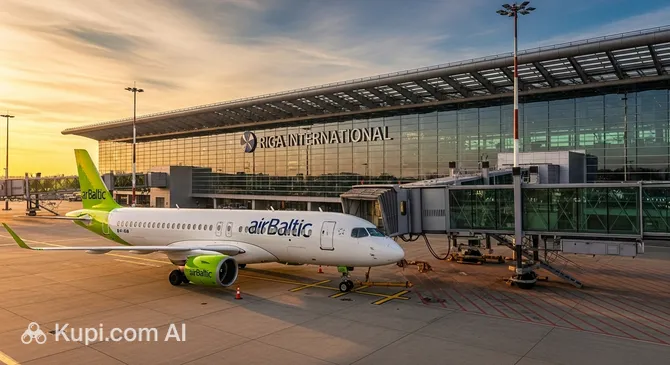
Riga International Airport. Source: Kupi.com Binoculars

Riga International Airport (RIX) is not merely a transport node, but a true gateway to the Baltics, where your introduction to Latvian hospitality begins. This modern and welcoming hub, recognised as one of the fastest-growing in Northern Europe, surprises visitors with its compactness and intuitive navigation. Here, amidst stylish interiors and the aroma of fresh coffee, travellers can feel the rhythm of the city even before exiting the terminal. The airport serves as the main base for the national airline, airBaltic, and connects Riga with a hundred cities worldwide, making it the ideal starting point for any European itinerary.

IATA Code RIX
ICAO Code EVRA
City Riga
Distance to Centre ~10 km
Status International
Annual Passengers ~7.12 million (2024)
Schedule Online flight board on the airport website

Features and Advantages

Riga International Airport is the largest aviation hub in the Baltic states and offers passengers a high level of service while maintaining the cosiness of a smaller airport.

  • Transport Accessibility: The airport is located just 10 kilometres from the city centre. You can reach Old Riga quickly and economically on bus No. 22, which runs every 15–20 minutes, or by taxi in approximately 20 minutes.
  • Terminal Convenience: The entire passenger flow is serviced in a single modern terminal, making transfers fast and convenient. The building is divided into Schengen and non-Schengen zones, yet navigation remains simple and clear.
  • Comfort Services: Business lounges (Primeclass Lounge), Fast Track service for quick security clearance, as well as numerous cafes, Duty Free shops, and car rental points are available for passengers.
  • Base Hub: The airport serves as the main hub for the airline airBaltic, ensuring excellent flight connectivity throughout Europe and beyond.
  • Connectivity: Free and fast Wi-Fi operates throughout the terminal, allowing travellers to stay connected without restrictions.

Contact Information

For your convenience, we have compiled the essential contact information for Riga International Airport (RIX).

  • Official Website: www.riga-airport.com. On the site, you will find the current flight schedule, information about parking, services, and the latest news.
  • Information Service Phone: +371 29311817. You can obtain operational information about flights and airport operations at this number.
  • Airport Address: Lidosta "Rīga", Mārupes novads, LV-1053, Latvija.
  • Email for General Inquiries: welcome@riga-airport.com.
  • Social Media: The airport actively maintains pages on popular social networks such as Facebook, X (formerly Twitter), and Instagram, where important updates are published. You can find them by searching for "Riga Airport".
  • Lost Luggage Information: If you have lost items within the airport terminal, contact the Lost and Found bureau by phone: +371 67207236 or by email lf@riga-airport.com. In case of loss or damage to checked baggage, you should contact your airline's representative directly.
  • Passenger Support Service: For assistance and consultations regarding your travel through Riga Airport, you may use the main information service phone number or email.

How to Get to the Airport

Getting to Riga International Airport (RIX) from the centre of Riga is effortless, as it is located just 10 kilometres from the historic part of the city. The capital of Latvia offers travellers several convenient ways to reach its main aviation hub, varying in cost, speed, and level of comfort.

The most economical and popular option is city bus No. 22. It runs between the city centre (from Abrenes Street) and the airport with intervals of 10-20 minutes, passing by the central station and the Old Town. The journey takes about 30 minutes. Tickets can be purchased at ticket machines at stops, in "Narvesen" kiosks, or from the driver (in the latter case, it will cost slightly more). This is an excellent choice for those travelling light and wishing to save money.

For those who value speed and comfort, the optimal solution is a taxi or ride-hailing service (such as Bolt). A car can be requested via an app or found at one of the numerous stands in the city. The trip from the centre to the airport will take 15-20 minutes depending on traffic conditions and will cost approximately 15–25 Euros. You can also pre-book a private transfer, which is particularly convenient for families with children or large groups with bulky luggage.

If you are travelling by personal or rented car, the route to the airport is quick and clear thanks to good signage. A convenient drop-off zone for passengers is located at the terminal. For those planning to leave their car for the duration of the trip, several parking lots operate on the airport territory: short-term P1 directly by the building and several long-term lots (P2, P3) located slightly further away. It is recommended to book a spot in long-term parking online in advance — this allows for significant savings.

Terminals and Map

The International Airport Riga (RIX) is distinguished by a structure that is well-thought-out and convenient for passengers. The main thing to know is that the airport operates with one passenger terminal, which serves all flights — both Schengen and non-Schengen. This significantly simplifies navigation and reduces time spent moving inside the building.

The terminal structure is logical and intuitive. The building has several levels, but the main navigation for passengers takes place on two floors:

  • First Floor — this is the arrivals area. Located here are baggage claim belts, customs control, tourist information desks, currency exchange points, car rental offices, and exits to the city for taxis and public transport.
  • Second Floor — the departures area. Passengers arrive here to check in for flights (check-in counters are marked with letters A, B, and C) and pass through security control. After screening, access opens to Duty Free shops, cafes, and boarding gates.

After passing security control, passengers enter the general departure zone, which is divided into two main sectors depending on the flight destination. Sectors B and C are intended for flights to Schengen Agreement countries. For flights to countries outside the Schengen zone (for example, the UK, Ireland), as well as for transit passengers travelling to these countries, Sector C is used, separated by border control. Arrival halls are also divided: Sector A serves those arriving from non-Schengen countries, while Sectors B and C serve those from the Schengen area.

Because everything is under one roof, transfers between zones take minimal time. On average, you should allocate about 1.5-2 hours before departure for check-in and security control, although during peak hours or the height of the tourist season, this time may increase. Overall, Riga Airport is renowned for its compactness and efficiency, so getting lost here is practically impossible — simply follow the clear signs in Latvian and English.

History of the Airport

The history of the modern International Airport Riga (RIX) began in 1974, when it was officially opened. This complex was built according to the latest Soviet engineering standards of that time and replaced the outdated Spilve Airport. Initially designed to handle up to 2.5 million passengers per year, it quickly became one of the key hubs for "Aeroflot" in the region.

A new stage in the airport's life began after the restoration of Latvia's independence in 1991. It received the status of the main national airport and began actively integrating into the European and global air transport system. The first large-scale reconstruction and modernisation was completed in 2001, which significantly increased the level of comfort and capacity, bringing it in line with international standards.

A key factor in the airport's rapid growth was the development of the national airline airBaltic, which chose Riga as its main base. This turned RIX into the largest transit hub in the Baltic states. To service the growing passenger flow, new terminals were built: the North Pier in 2006 and the South Pier in 2016. These expansions helped the airport repeatedly break records for the number of passengers served.

One interesting fact is that the architects originally incorporated the possibility of easy expansion into the project, which was successfully realised decades later. Today, Riga Airport is not just a point on the map, but a modern and dynamically developing complex, rightfully considered the main aviation centre of the Baltic region, connecting it with dozens of countries around the world.

Services and Amenities

The International Airport Riga (RIX) offers passengers a wide range of services for a comfortable wait before their flight. Within the terminal, you will find numerous cafes and restaurants where you can have a quick snack with a sandwich and coffee or enjoy a full meal. For shopping enthusiasts, Duty-Free shops operate, offering perfumes, beverages, and confectionery, as well as souvenir shops where you can purchase traditional Latvian goods, such as amber products or the famous Riga Balsam.

For those seeking peace and privacy, the airport features the Primeclass Lounge, where guests are offered snacks, drinks, fresh press, and comfortable workspaces. Free Wi-Fi is available throughout the airport, and numerous sockets and USB ports for charging electronic devices are installed in waiting halls and at boarding gates. Financial matters can be resolved at bank branches or currency exchange points.

The airport cares for all categories of passengers. For those travelling with small children, mother and child rooms with changing tables are equipped, and there is a play area in the Schengen departure zone. Passengers with reduced mobility can pre-order an assistance service through their airline; the terminal is fully equipped with ramps, elevators, and special restrooms. In case of feeling unwell, one can visit the 24-hour medical point.

Additional amenities are provided for business travellers and transit passengers. Several hotels are located directly on the airport territory and within walking distance. Services of conference halls and meeting rooms, equipped with all necessary equipment, are also available, allowing for effective use of time between flights to address work tasks.

Where to Eat

At the International Airport Riga (RIX), travellers will find diverse dining options designed for any taste, budget, and amount of time. Catering establishments are located both in the public area and in the departure zone after passing security control.

In the public area (before security control), located on the 1st and 2nd floors, you will find several cafes where you can drink coffee with fresh pastries or a sandwich. This is a convenient option for those meeting or seeing off passengers, as well as for those who arrived at the airport early. Kiosks, such as Narvesen, usually operate here as well, where you can buy drinks and snacks.

The majority of restaurants and cafes are located in the departure zone, after passing security control. Here, the selection is significantly wider and will satisfy both those looking for a quick snack and those preferring a full lunch or dinner in a quiet atmosphere.

For those wishing to get acquainted with Latvian cuisine, we recommend visiting the self-service restaurant LIDO. This is a popular chain in Latvia offering a large selection of traditional dishes: from cold appetisers and soups to hearty hot meat and fish dishes with various sides. This is an excellent opportunity for a full meal. For a quicker snack, numerous coffee shops, pizzerias, and sushi bars are suitable. In the bars, you can order local beverages or try the famous Riga Black Balsam.

Regarding special dietary needs, vegetarian dishes (salads, vegetable stews, pastries) are available in most establishments. Finding vegan and gluten-free options might be more challenging; it is recommended to study the menu carefully or ask the staff. Information regarding Halal meal options is also available upon request.

Prices at Riga Airport, as in most major airports, are higher than in the city. The cost of a cup of coffee starts from approximately 3-4 Euros, while a full lunch will cost 15-25 Euros per person. Most establishments open early in the morning, around 5:00-6:00, and work until the departure of the last flight late in the evening, providing passengers with food and drinks throughout the day.

Travel Tips

To ensure your journey through Riga International Airport goes smoothly and without unnecessary stress, make use of our tips. This modern and sufficiently compact air terminal is convenient for passengers, but knowing certain nuances will help save time and nerves.

Arrival Time and Check-in. We recommend arriving at the airport at least 2–2.5 hours before flights within the Schengen zone and 3 hours for all other international destinations. During peak seasons (summer, Christmas holidays), it is better to add another half hour. To save time, complete online check-in, which opens 24-48 hours before departure for most airlines. This will allow you to proceed immediately to baggage drop or, if you are travelling light, to the security checkpoint.

Security Control and Hand Luggage. Be prepared for security control in advance: remove all metal items from your pockets, take off outerwear, belts, and watches. Laptops, tablets, and other large gadgets must be taken out of bags. Liquids (in containers up to 100 ml) must be packed in a single transparent bag with a volume of no more than 1 litre. It is forbidden to carry weapons, sharp objects, and flammable substances in hand luggage. Medicines (a prescription may be required), baby food, and Duty Free goods packed in a special sealed bag are permitted.

Tips for Transit Passengers. The airport of Riga is a convenient transit hub, especially for airBaltic flights. If you are flying in transit between Schengen Agreement countries, you do not need to pass passport control again. If your route lies from a non-Schengen country to a Schengen country (or vice versa), be prepared for border control. Transfer time is usually sufficient, but try not to linger in shops until you are sure you have completed all necessary formalities.

Customs Control and Savings. When entering Latvia from non-EU countries, you will have to pass through customs. If you have no goods to declare, confidently go through the "Green Channel". Otherwise, choose the "Red Channel". To save a little, bring an empty water bottle with you — after security screening, you can fill it at drinking fountains. Prices for food and drinks in the "clean zone" are higher, so a light snack can be brought with you.

What to do in case of flight delay? In the event of a flight delay, first contact your airline's counter for information. Depending on the waiting duration, you may be provided with vouchers for food and drinks. Riga is in the EU, so European air passenger rights regulations apply here. Do not hesitate to clarify what compensation you are entitled to. The airport has free Wi-Fi, and numerous cafes and shops to pass the waiting time.

Reached the end of the page?

That means the route is fully explored