Support

Kuressaare Airport

About the Airport

Kuressaare Airport (Kuressaare lennujaam) is not just a transport hub, but a cosy aerial gateway to the largest island of Estonia, Saaremaa. Located just a few kilometres from the city of the same name, it serves as a starting point for exploring the island's unique nature, medieval castles, and spa resorts. For many travellers, this is where a quick and comfortable immersion into the leisurely atmosphere of Saaremaa begins, bypassing the long ferry crossing.
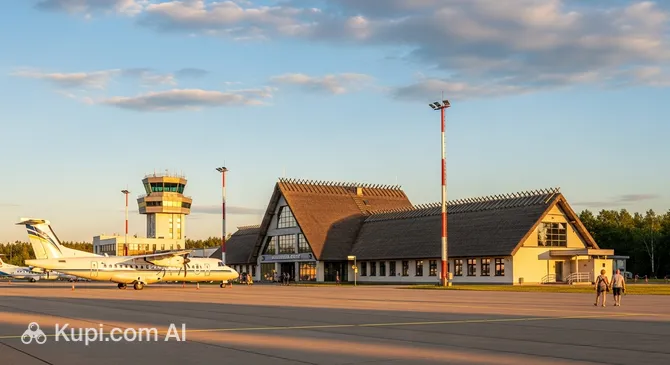
Kuressaare Airport. Source: Kupi.com Binoculars
IATA Code URE
ICAO Code EEKE
City Kuressaare
Distance to centre about 3 km
Status Domestic, with seasonal international flights
Passengers per year about 32,000 (2023)
Popular Airlines NyxAir, charter airlines

The main advantage of Kuressaare Airport is its compactness and efficiency. There are no long queues or the hustle and bustle of large aviation hubs here, allowing you to complete all formalities in a matter of minutes. This is an ideal option for those who value their time and comfort. The main route consists of regular flights to Tallinn, ensuring a reliable connection between the island and the capital throughout the year.

Despite its modest size, the airport offers basic amenities for passengers, including a waiting hall and free Wi-Fi. Its operation is of key importance for the development of tourism and business activity on the island of Saaremaa. For many residents and guests of the island, this is the fastest and most convenient way to reach mainland Estonia, especially during the off-season.

Contact Information

  • Official website: www.kuressaare-airport.ee
  • Information desk phone: +372 453 0313
  • Address: Lennujaama tee 1, 93815, Kuressaare city, Estonia
  • Email: info.kuressaare@tll.aero
  • Social media: Kuressaare Airport does not have its own social media pages. News and updates can be followed on the official channels of Tallinn Airport.
  • Lost luggage information: If your luggage has been lost, please contact your airline representative first. For items left in the terminal building, write to: lostandfound.kuressaare@tll.aero.
  • Passenger support contacts: For consultation and assistance, you can call the information desk or write to the general airport email.

How to Get to the Airport

Kuressaare Airport (URE) is located just 3 kilometres from the city centre of Kuressaare, making the journey there quick and convenient. You can reach the terminal in several ways, and the choice depends on your budget, time, and amount of luggage. A trip around the island of Saaremaa in Estonia often ends right here, so it is worth planning your route in advance.

The most budget-friendly way to get to the airport is by city bus. Route No. 2 runs from the city centre towards the airport. The trip will take about 10-15 minutes, but it is worth checking the schedule in advance, as intervals between buses can be long, especially on weekends. This is a great option for budget-conscious travellers with light luggage. The ticket price usually does not exceed a few euros.

The most comfortable and fastest option is a taxi ride. Due to the short distance, a trip from any point in the centre of Kuressaare to the airport will take just 5-10 minutes. The cost of the trip is usually low, making a taxi an attractive choice for small groups, families with children, or travellers with bulky luggage. You can order a car by phone or use mobile apps. You can also book a transfer in advance so that the driver meets you at the appointed time.

If you explored the island of Saaremaa by car, it is most convenient to return it directly at the airport. Many car rental companies have their desks in the Kuressaare terminal. For those arriving at the airport in their own or rented car to meet or see off passengers, parking is provided. It is located in the immediate vicinity of the terminal building and offers both short-term and long-term parking options.

The unique location of the airport makes it accessible even on foot. If you are travelling light and the weather permits, a walk from the city centre will take about 30-40 minutes. This is a wonderful opportunity to enjoy the calm atmosphere of the resort city once more before departure.

Terminals and Map

Kuressaare Airport (URE) represents a model of a compact and cosy regional air terminal. Its main feature is the presence of just one passenger terminal, which serves all flights. The terminal building, built using local dolomite and wood, is an architectural landmark in itself and creates a pleasant, almost home-like atmosphere.

The airport layout is extremely simple and intuitive. Since there is only one terminal and it is very small, all key zones are within walking distance of each other. It is practically impossible to get lost here. The check-in counters, security screening area, a small waiting hall, and the boarding gate are located in one hall. The departure and arrival zones are effectively parts of the same space, making movement around the airport maximally fast. There are no transfers between terminals as they are unnecessary.

One of the main advantages of Kuressaare Airport is the speed of completing all formalities. Check-in and security screening procedures take a minimum amount of time, usually no more than 10-15 minutes. Thanks to this, there is no need to arrive several hours before departure. As a rule, arriving at the airport 45–60 minutes before the departure of a domestic flight is more than enough.

For navigation, simply follow the few signs. Immediately after entering the building, you will see the check-in counters. After passing check-in and security, you will enter a cosy waiting hall with a view of the airfield, where you can relax before the flight. The simplicity and compactness of the airport are its key virtue, saving travellers from the stress typical of major aviation hubs.

History of the Airport

The history of Kuressaare Airport (URE), located on Estonia's largest island, Saaremaa, officially began on 6 March 1945. On this day, the first regular flight on the Tallinn — Kuressaare route took place. In the post-war years, the infrastructure was very modest, and the runway was unpaved.

The first major stage of development occurred in the late 1950s and early 1960s. In 1958, the runway was paved for the first time, and in 1962, the first terminal building was constructed. Kuressaare's popularity as a resort grew, requiring further expansion. Between 1972 and 1976, a second runway was built, and a new passenger terminal was erected, which, with subsequent modernisations, is still in use today.

In recent history, the airport continued to improve. A key reconstruction of the main runway was carried out in 1999, allowing it to accommodate more modern aircraft. In 2007, the passenger terminal was significantly expanded and renovated, turning into a cosy and functional space often noted by tourists for its "home-like" atmosphere.

Interesting fact: Kuressaare Airport plays a vital role in connecting not only with the mainland but also with the tiny island of Ruhnu, providing its residents with a link to the outside world. Despite its modest size, the airport effectively handles passenger traffic, especially during the summer tourist season, remaining the key aerial gateway to the picturesque island of Saaremaa.

Services and Amenities

Kuressaare Airport (URE) is a small and cosy regional airport serving the island of Saaremaa. Despite its compact size, it provides passengers with the basic amenities necessary for a comfortable wait for their flight.

Dining and shopping. A small café operates in the terminal building, where you can drink coffee or have a snack with sandwiches or pastries before departure. The choice of shops here is limited, so do not count on full-scale shopping, but you can find basic goods and souvenirs.

Waiting halls and internet. A general waiting hall is equipped for passengers. There are no specialised VIP lounges or business lounges at the airport. Free Wi-Fi is available throughout the terminal, and there are also power outlets for charging electronic devices, although their number may be limited during peak hours.

Financial and other services. Please note that there are no bank branches or currency exchange points at Kuressaare Airport. It is recommended to take care of exchanging cash in the city in advance. There is also no full-scale medical point, but airport staff are trained to provide first aid.

Services for passengers with special needs. A mother and child room is provided for passengers with children. The airport is equipped to serve travellers with reduced mobility, however, it is recommended to notify your airline in advance about the need for special assistance.

Accommodation and business services. There are no hotels on the airport territory itself, however, many accommodation options can be found in the city of Kuressaare, which is located just a few kilometres away. Conference halls or business centres are also absent from the terminal building.

Where to Eat

Kuressaare Airport is a small regional airport, so dining options here are compact and correspond to its size. Passengers should not expect a wide variety of restaurants as in major international hubs, but everything necessary for a comfortable wait for the flight is available here.

Dining at the airport is represented by one cosy café, located in the general hall of the terminal. It is accessible to both departing and arriving passengers, as well as those seeing them off. The café is perfect for a light snack or a cup of coffee before the flight. Its opening hours are usually tied to the flight schedule: it opens shortly before the first departure and closes after the last plane leaves.

In the café menu, you will find a standard set of offers:

  • Hot drinks: coffee, tea, cocoa.
  • Soft drinks, juices, and water.
  • Light snacks: sandwiches and fresh pastries.
  • Sweets: chocolate, biscuits, and cakes.

Prices in the café are moderate, but, as in most airports, may be slightly higher than in city establishments. Sometimes you can find products from local producers here, which gives a chance to try something characteristic of Estonia and the island of Saaremaa.

Regarding special dietary needs, the choice for vegetarians, vegans, or passengers with gluten intolerance may be extremely limited. As a rule, you can find a simple salad or fruit, but do not count on specialised dishes. If you have strict dietary restrictions, it is recommended to bring food with you or dine in one of the numerous restaurants in the city of Kuressaare before travelling to the airport.

Travel Tips

To ensure your journey through the airport of Kuressaare city goes as smoothly as possible, use our tips. This is a small and cosy regional airport, so many procedures here are faster than in large hubs, but preparation is never superfluous.

Arrival time at the airport. Despite the compact size of the airport, it is recommended to arrive 1.5-2 hours before departure. This time will be enough to check in luggage without rushing, pass security control, and reach the boarding gate. For domestic flights within Estonia, you can arrive a little later, but it is better to have a buffer of time.

Check-in and security control. To save time, check in for your flight online if your airline provides such an option. Security control at Kuressaare Airport usually goes quickly due to the small flow of passengers, but standard rules remain in force — be ready to present your boarding pass and remove electronic devices and liquids.

Choosing a seat on the plane. Flights to and from the island of Saaremaa offer picturesque views of the Baltic Sea and the archipelago. If you want to enjoy the panorama, choose a window seat. If freedom of movement and the ability to exit the plane first are more important to you, an aisle seat is better suited.

Hand luggage. Standard rules for carrying liquids apply here as well: all containers must be no more than 100 ml in volume and packed in one transparent bag. It is forbidden to carry sharp objects in hand luggage. Always check with your airline's rules, as requirements for the weight and dimensions of hand luggage may differ.

Passengers with transfers. Kuressaare Airport is not a major transit hub. Most flights are direct to Tallinn. If you have a transfer planned in the capital, ensure you have enough time between flights. As a rule, 1.5-2 hours is sufficient for connections at Tallinn Airport.

Customs control. Since most flights are domestic or operated within the Schengen Area, there is no systematic passport and customs control. Procedures may only apply to rare charter flights from countries outside the Schengen Agreement.

Saving time and money. Book flight tickets in advance to get the best prices. Travel light to avoid paying for extra luggage. Use online check-in and save the boarding pass on your phone. Instead of a taxi, you can consider walking to the city centre, as the airport is located very close by.

Flight delay. In case of a flight delay or cancellation, contact your airline's counter first for information. Passengers departing from EU airports are protected by Regulation (EC) No 261/2004, which provides the right to assistance and compensation in certain situations. The small terminal has basic amenities to pass the waiting time.

Reached the end of the page?

That means the route is fully explored