Support

Turku Airport

About the Airport

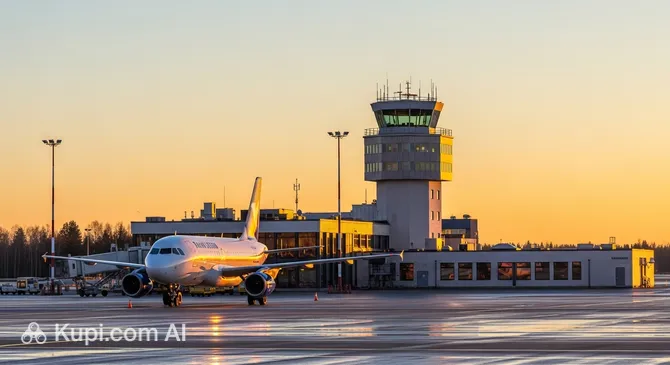
Turku Airport. Source: Kupi.com Binoculars

Turku Airport (TKU) is not just an air hub, but a true historical gateway to Finland. As the country's first civil airport, opened back in 1935, it combines rich history with modern service standards. The current terminal, located 8 km from the centre of Turku, began operations in 1955 and still plays a key role in the transport system of the south-western region. Despite its compact size, it is one of the busiest in the country for both passenger and cargo traffic, serving as a starting point for travel across Europe and into the picturesque Finnish archipelago.

IATA Code TKU
ICAO Code EFTU
City Turku
Distance to centre About 8 km
Status International
Annual Passengers approx. 300,000 (2023)
Popular Airlines Wizz Air, SAS, airBaltic
Schedule online flight board "Turku Airport"

Passengers appreciate Turku Airport for its efficiency and comfort. One of the key advantages is its focus on budget carriers, making it an ideal choice for economical travellers exploring Europe. Free and unlimited Wi-Fi is available throughout the terminal, and for those who need to attend to business in a quiet environment, a special free workspace is equipped in the transit zone. Getting to the city centre or the seaport is very easy: Bus No. 1 runs regularly, and the trip to the Market Square takes only about 20 minutes. The airport's repeated recognition as "Airport of the Year" confirms the high level of service and care for passengers.

Contact Information

  • Official Website: www.finavia.fi/en/airports/turku
  • Information Desk Phone: +358 20 708 000 (general information service of the airport operator Finavia).
  • Airport Address: Lentoasemantie 150, 20360 Turku, Finland.
  • Email: A direct email address is not published. To contact airport representatives, it is recommended to use the feedback form on the official website.
  • Social Media: You can follow news from all Finavia airports, including Turku, on their official pages on Facebook, X (formerly Twitter) and Instagram.
  • Lost Luggage Information: For questions regarding lost checked baggage, please contact your airline directly. Items left within the terminal are handed over to the Lost & Found service. Current contact details for the service are available on the airport website.
  • Passenger Support: For general questions and enquiries, you can use the information desk phone or send a request via the official airport website.

Getting to the Airport

Turku Airport (TKU) is conveniently located just 8 kilometres north of the city centre of Turku, making the journey there quick and simple. The most budget-friendly and popular way to get to the airport is city bus No. 1. The route connects the airport, the central Market Square (Kauppatori), and the seaport, which is particularly convenient for those arriving in the city by ferry. The trip from the city centre takes approximately 20-30 minutes depending on traffic. Buses run at regular intervals throughout the day, and the ticket cost is just a few euros, making this the most economical option.

For those who value comfort and time, a taxi is an ideal option. Taxi ranks are located right outside the terminal exit. The trip to the city centre will take about 15-20 minutes, though the cost will naturally be significantly higher than the bus. You can also pre-book a private or group transfer, which may be advantageous if you are travelling with a large amount of luggage or as a family.

If you plan to actively explore south-western Finland, a good solution would be car rental. Offices of several international and local rental companies are present at Turku Airport. It is recommended to book a car in advance, especially during the peak tourist season. For those arriving in their own vehicle, the airport grounds offer both short-term and long-term parking facilities located within walking distance of the terminal.

When planning your route, it is useful to know about other air hubs in the region. The country's largest airport, Helsinki-Vantaa, is located approximately 150 km away and offers a vast number of international destinations. Other nearby options include Tampere-Pirkkala airport, popular with budget airlines, as well as airports in Pori and Mariehamn.

Terminals and Map

Turku Airport (TKU) is a modern, yet very compact and passenger-friendly aviation hub. Its main feature is a simple and clear structure that allows you to avoid the stress and long queues typical of large airports. In fact, all passenger operations, including departures and arrivals, are handled in one main terminal. The previously existing Terminal 2, which was used for budget airlines, has been closed, and now all flights are consolidated under one roof.

The airport layout is extremely simple. The terminal building is divided into two main zones: departures and arrivals. Upon entering the terminal, you immediately find yourself in the public area where the check-in counters and baggage drop-off points are located. After check-in, passengers proceed to the security screening area, beyond which lies a small but cosy departure lounge with several boarding gates. The arrivals area is located in another part of the building and includes baggage reclaim belts and customs control. Thanks to the small size, it is practically impossible to get lost here, and all movements take just a few minutes.

One of the main advantages of Turku Airport is the swift completion of all procedures. Flight check-in and security screening usually take much less time than in large airports. Nevertheless, it is recommended to arrive at the airport approximately 1.5-2 hours before international flights and 1-1.5 hours before domestic flights within Finland to calmly check in luggage and pass through controls. There are no transfers between zones as such, since everything is located in one building on one level, making navigation intuitively clear.

To navigate the terminal, simply follow the few but clear signs in Finnish, Swedish, and English. An information desk is located in the public zone, where staff are always ready to assist and answer your questions. The compactness of the airport is your main ally: from the building entrance to the boarding gate is only a few dozen metres, making travel through Turku maximally comfortable.

Airport History

The history of Turku Airport (TKU) begins in 1935, when the first civil airport in Finland was opened in the Artukainen district. This airfield was an important step in the development of air travel in the country. During the Second World War, it was also used for military purposes, highlighting its strategic importance in those years.

Post-war development required more modern infrastructure. In 1955, the airport was moved to its current location in the municipality of Rusko, approximately 8 kilometres north of the centre of Turku. Along with a new runway, a new terminal building was opened. This move marked the beginning of a new era for the city's air gateway, allowing it to accommodate the larger and more modern aircraft of that time.

Over the following decades, the airport was continuously modernised. In the 1970s, the runway was extended to accommodate jet aircraft, opening up opportunities for international flights. Major reconstructions and terminal expansions were carried out in the 1990s and 2000s to handle growing passenger traffic and meet modern service standards.

One of the significant events in the airport's recent history was the opening of Terminal 2 in 2008. It was specifically designed to serve low-cost airlines, making travel from Turku even more accessible. This decision reflected global trends in the aviation industry and strengthened the airport's position in the market.

A major achievement in recent years was receiving the status of Finland's first carbon-neutral airport in 2019. This was the result of many years of work to reduce environmental impact and implement energy-efficient technologies. Today, Turku Airport is not just an important transport hub, but also an example of sustainable development in the aviation industry.

Services and Amenities

Turku Airport (TKU) offers passengers all necessary services for a comfortable wait before their flight. Despite its compact size, this air hub in south-western Finland is well-equipped. Before departure, you can have a snack in a café or drink a coffee, as well as visit a shop selling souvenirs, press, and travel goods. The selection here is not as vast as in metropolises, but you will find all the essentials.

For those wishing to spend time in a quieter environment, the Turku Lounge is available at the airport. Here you can relax in comfortable chairs, use workstations, and enjoy snacks and beverages. Free Wi-Fi is available throughout the terminal, and special stations and sockets are provided in waiting areas for charging gadgets.

ATMs for cash withdrawal are installed in the airport building. A currency exchange point may not be present or its opening hours may be limited, so it is recommended to arrange currency exchange in advance. In case of need, passengers can request first aid from airport staff, who will call for specialists.

Travellers with children will appreciate the presence of nursing rooms with changing tables. A barrier-free environment has been created for passengers with reduced mobility: there are ramps, lifts, and specially equipped toilets. You can also book an assistance service through your airline in advance.

There are no hotels directly on the grounds of Turku Airport, however, many accommodation options can be found in the city itself, which is easily accessible by bus or taxi. Specialised conference halls are not provided in the terminal, but for business travellers who need to work in silence, the aforementioned VIP lounge will be an excellent solution.

Dining

Turku Airport (TKU) is a compact and convenient air hub which, despite its size, offers passengers everything needed for a comfortable wait, including the opportunity to have a snack or a full lunch. The main dining points are concentrated in the main terminal and serve both departing and arriving travellers.

The central establishment at the airport is the Turku Cafe. It is located both in the public area before security control (landside) and in the departure zone after it (airside). This allows both well-wishers and passengers themselves to grab a bite. The café offers a wide range of beverages, including freshly brewed coffee, tea, juices, as well as light snacks: sandwiches, fresh pastries, salads, and desserts.

For those looking for a more substantial option, the menu usually includes hot dishes, for example, the soup of the day or a simple main course. Although the airport does not specialise in haute cuisine, you can try snacks with local flair here, such as sandwiches on rye bread, which is characteristic of Finland. Vegetarians generally have access to meat-free salads and sandwiches. Information regarding the availability of vegan, gluten-free, or Halal options should be checked directly with staff, as their availability may be limited.

The café's opening hours are directly linked to the flight schedule — it is open to serve passengers of most departing flights but may close during quiet periods. Prices correspond to the average level for Finnish airports. For a quick snack, a coffee and a cinnamon bun (korvapuusti) are perfect, while for a full lunch, a sandwich or the hot dish of the day is suitable. Thanks to the convenient location, you can refresh yourself without haste right before boarding your flight.

Travel Tips

To ensure your journey through Turku Airport goes smoothly and without unnecessary worry, take advantage of our tips. The airport is small and convenient, making it a pleasant starting point for your trip.

Arrival time at the airport. Turku Airport (TKU) is compact, and long queues are rare here. We recommend arriving 2 hours before international flights and 1.5 hours before domestic flights within Finland. This time will be sufficient to complete all pre-flight formalities without haste.

Check-in and security control. To save time, use online check-in, which is offered by most airlines. If checking in at the airport, counters usually open 2 hours before departure. The screening procedure is standard, but thanks to the terminal's small size, it proceeds quickly. Do not forget to pack liquids (in containers up to 100 ml) in a transparent bag in advance and be ready to remove laptops and other large electronics from your hand luggage.

Choosing a seat on the plane. Want to enjoy the views during take-off and landing? Choose a window seat. If freedom of movement and a quick exit after landing are more important to you, an aisle seat is better. To study your aircraft's cabin layout in detail, you can use specialised online services.

What is allowed and prohibited in hand luggage. It is prohibited to take liquids in containers larger than 100 ml, sharp objects, weapons, and flammable substances in hand luggage. All liquids must be collected in one transparent bag with a volume of no more than 1 litre. Always check your airline's rules, as there may be additional restrictions on the weight and dimensions of hand luggage.

Recommendations for transfer passengers. Turku rarely acts as a major transit hub, but if you have a connection here, navigation will not cause difficulties. The airport is very compact, and moving between gates will take just a few minutes. At check-in, clarify whether your luggage will be automatically transferred to the next flight or if you need to collect and re-check it.

Customs control features. For flights within the Schengen area, there is no passport control. If your flight is heading outside Schengen, you will undergo a standard document check procedure by the border service. Please be aware of EU customs limits on the import and export of restricted goods, tobacco products, and cash.

Tips for saving time and money. To save time, check in for your flight online and travel with hand luggage only if possible. To reduce expenses, bring an empty water bottle and fill it at a drinking fountain after passing security. Prices for food and beverages at the airport can be high.

What to do in case of flight delay. In the event of a delay, follow the information on the departure boards and in your airline's app. For significant delays or flight cancellations due to the carrier's fault, under EU Regulation No 261/2004, you are entitled to assistance (beverages, meals, and if necessary — accommodation). Contact your airline representative for further instructions.
Reached the end of the page?

That means the route is fully explored