Support

Addis Ababa Bole International Airport

About the Airport

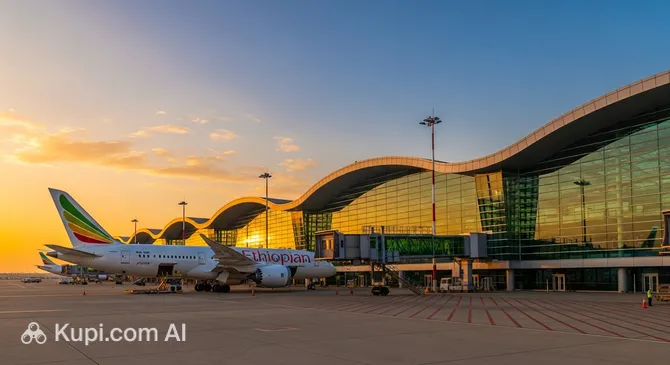
Addis Ababa Bole International Airport. Source: Kupi.com Binoculars

Addis Ababa Bole International Airport (ADD) is not merely the air gateway to Ethiopia, but one of the busiest and most strategically important aviation hubs on the entire African continent. Serving as the main base for the national carrier Ethiopian Airlines, the airport connects Africa with dozens of cities in Asia, Europe, North and South America. Recent expansions and modernization have transformed Bole into a modern complex ready to offer travellers a high level of comfort and service. This airport is a true intersection of cultures and routes, where unforgettable journeys through Ethiopia and the world begin.

IATA Code ADD
ICAO Code HAAB
City Addis Ababa
Distance to Centre 6 km
Status International
Annual Passengers Over 12 million
Popular Airlines Ethiopian Airlines, Emirates, Turkish Airlines
Schedule Online Board "Addis Ababa Bole International Airport"

Features and Advantages

Bole Airport consists of two main terminals. Terminal 1 primarily serves domestic and regional flights, while the modern and spacious Terminal 2 is dedicated to all international destinations. A free shuttle operates between the terminals for passenger convenience. Thanks to recent large-scale reconstruction, the airport's capacity has reached 22 million people per year, allowing it to cope with constantly growing traffic.

Everything here is designed to ensure a comfortable wait for travellers. Passengers have access to numerous shops, including Duty Free, restaurants and cafes offering both local and international cuisine, as well as bank branches and currency exchange points. Free Wi-Fi is available throughout the airport, and several comfortable lounges are open to business class passengers and loyalty programme members. Additionally, for long layovers (from 8 to 24 hours), Ethiopian Airlines may provide transit passengers with complimentary hotel accommodation.

Contact Information

For your convenience, we have compiled the main contact information for Addis Ababa Bole International Airport (ADD).

  • Official Website: On the official Ethiopian Airports portal, you will find the most up-to-date information on flights, services, and airport regulations. We recommend visiting www.ethiopianairports.com before your trip.
  • Help Desk Phone: For immediate information, you can call: +251 11 665 6666.
  • Airport Address: Bole International Airport, Ring Road, Addis Ababa, Ethiopia.
  • Email: For official inquiries, it is recommended to use the contact forms available on the airport website, as this ensures faster and more accurate processing of your request.
  • Social Media: Follow news and updates on the airport's official social media pages. They can usually be found by searching for "Ethiopian Airports" on platforms like Facebook and Twitter.
  • Lost Luggage Information: If your luggage has been lost, you should first contact your airline's representative office. For items left within the airport terminal, you can contact the Lost Property office at: +251 11 517 8305.
  • Passenger Support Contacts: Information desks are located in the departure and arrival halls. Staff are always ready to assist with terminal navigation and answer your questions. The inquiry phone number is listed above.

How to Get to the Airport

You can get to Addis Ababa Bole International Airport from the city centre of Addis Ababa in several ways, each having its own advantages depending on your budget, time, and comfort preferences. When planning your trip, be sure to consider traffic density, especially during peak hours.

Taxi and Private Transfer. This is the most popular and convenient way to reach the airport. The city has official yellow or green taxis operating by meter or fixed tariff, as well as older blue-and-white "Ladas," where you need to negotiate the price with the driver in advance. It is strongly recommended to agree on the trip cost before starting. Ride-hailing apps (such as RIDE) are also popular in Addis Ababa, making the process more predictable. A trip from the city centre usually takes 30 to 60 minutes depending on traffic conditions.

Public Transport. For the most budget-conscious travellers, there are "Anbessa" city buses. This is a very cheap option, but it can be inconvenient if you have a lot of luggage, and the buses themselves are often overcrowded. Routes can be confusing for those visiting the city for the first time. Light rail transport (Metro) is also part of the city's transport system, but its lines may not pass in the immediate vicinity of your hotel, requiring an additional transfer.

Car Rental and Parking. If you prefer independence in movement, you can rent a car. Many international and local rental companies have offices in the city and at the airport itself. Driving in the capital of Ethiopia can be quite chaotic, so this option is suitable for confident drivers. Bole Airport provides both short-term and long-term parking for private vehicles.

If Addis Ababa is just the starting point of your journey through the country, it is convenient to fly to other regions from here. Nearby airports are located in cities such as Hawassa, Dessie, and Jimma, which significantly expands the possibilities for exploring this amazing country.

Terminals and Map

Addis Ababa Bole International Airport (ADD) consists of two main passenger terminals serving domestic and international flights. Understanding their structure will help you orient yourself easily upon arrival or before departure.

Terminal 1 (T1) is the older airport building, which is used today primarily for domestic flights within Ethiopia, as well as for some flights to neighbouring countries. It is smaller and simpler in structure than Terminal 2 but is fully functional for its tasks.

Terminal 2 (T2) is a modern and significantly larger terminal serving the vast majority of international flights. It is the main hub for Ethiopian Airlines. Numerous Duty-Free shops, restaurants, cafes, and business lounges are located here. It is in this terminal that passengers arriving from abroad or flying out of the country undergo customs and passport control.

Both terminals are located in close proximity to each other and are connected by a walkway, allowing passengers to move between them on foot. This is especially convenient for transfers from an international flight to a domestic one and vice versa. Navigation in the airport is quite simple, with signs in Amharic and English. Arrival zones are usually located on the lower floors, while departure and check-in zones are on the upper floors.

It is recommended to allocate sufficient time for check-in, passport control, and security screening, especially in Terminal 2. During peak hours, queues can be long, so for international flights, it is better to arrive at the airport at least 3 hours before departure. For domestic flights, 1.5-2 hours is usually sufficient.

Airport History

The history of Addis Ababa Bole International Airport (ADD) is a clear example of the rapid development of aviation infrastructure in Africa. The airport was founded in 1961 by decree of Emperor Haile Selassie I and originally bore his name. From the very beginning, it became the main base for the national carrier Ethiopian Airlines, whose success story is closely intertwined with the modernization of this transport hub.

After political changes in the country in 1974, the airport was renamed Bole — after the district of Addis Ababa where it is located. In its first decades of operation, it played an important but relatively modest role. However, in the mid-1980s, the airport became a vital centre for coordinating and delivering international humanitarian aid during the devastating famine, highlighting its strategic importance for the entire country.

A key stage in the airport's history occurred in 2003, when a large-scale modernization was completed. The works included the construction of a new international terminal, a modern control tower, and a new 3,800-metre runway. This allowed for the reception of all types of modern aircraft and laid the foundation for transforming Bole into a major international hub.

The recent history of the airport was marked by an even more ambitious expansion project, which was completed in 2019-2020. Thanks to this, the airport's capacity grew from 6 to 22 million passengers per year, making it one of the busiest in Africa. Today, Bole often surpasses other major airports on the continent in transit passenger traffic, being a key point for travel across Africa.

Among interesting facts, its location is worth noting: the airport is situated at an altitude of 2,334 metres above sea level, making it one of the highest international airports in the world. This factor requires aircraft to use more power during takeoff. Thus, over its history, Bole Airport has travelled an impressive path from a small airfield to an ultra-modern complex playing a central role in air travel across the African continent.

Services and Amenities

Addis Ababa Bole International Airport (ADD) offers passengers a full range of services and amenities to make waiting for a flight as comfortable and productive as possible. In the terminals, you will find many restaurants and cafes where you can enjoy both traditional Ethiopian cuisine and familiar international snacks. For shopping enthusiasts, numerous shops are open, including a large Duty Free zone featuring a wide range of goods — from famous Ethiopian coffee and handmade souvenirs to perfumes and electronics from world brands.

For those who value enhanced comfort, several business lounges operate at the airport. Most famous are the Ethiopian Airlines lounges, such as Cloud Nine Lounge and ShebaMiles Lounge. Here, guests can relax in silence, use shower facilities, and enjoy complimentary beverages and snacks. Free Wi-Fi is available throughout the airport, and numerous gadget charging stations ensure you stay connected. For business travellers, basic business services and conference rooms for meetings are provided.

Financial matters can be easily resolved within the airport terminals. At your service are bank branches, 24-hour currency exchange points, and ATMs. In case of necessity, passengers can visit the medical centre, which operates around the clock and is ready to provide first aid.

Bole Airport is well-equipped for travellers with special needs. Mother and child rooms are provided for families with small children. Passengers with reduced mobility are provided with necessary assistance, including escort and wheelchair provision. It is recommended to notify your airline in advance about the need for such services.

If you have a long layover or an early flight, you can stay at one of the hotels located in the immediate vicinity of the terminals. The most popular option is the five-star Ethiopian Skylight Hotel, which is just a few minutes' drive away and offers guests a free shuttle service.

Where to Eat

Addis Ababa Bole International Airport offers passengers a decent selection of establishments where you can grab a bite before departure or have a full meal. Here you will find both outlets with familiar international food and cafes where you can discover authentic Ethiopian cuisine. Most restaurants and cafes are concentrated in Terminal 2, serving international flights.

The majority of establishments are located in the departure area (airside), after passing passport control and security screening. Here you will find both à la carte restaurants and food courts with a more casual atmosphere. You can find pizzerias, burger joints, and coffee shops offering sandwiches and pastries. For those looking for a full lunch, there are restaurants serving European and Asian cuisine.

The main highlight of Bole Airport is the opportunity to try local cuisine. Do not miss the chance to order a traditional Ethiopian dish, for example, `Injera` (a large porous pancake made from teff flour) with various sauces and stewed meat, such as `Doro Wat` (chicken in spicy sauce). Ethiopian cuisine also offers many vegetarian and vegan options, known as "yetsom megeb" (fasting food), making it an excellent choice for passengers with specific dietary preferences.

If you are short on time, pay attention to the numerous coffee shops. Ethiopia is the birthplace of coffee, and trying a cup of freshly brewed `Arabica` here is mandatory. Besides coffee, cafeterias offer quick snacks, pastries, and refreshing drinks. This is an ideal option for a short layover. Some establishments operate 24/7, which is especially convenient for passengers on night flights.

The price range at the airport varies but generally corresponds to average prices in major international hubs — be prepared to pay more than in the city. Regarding special dietary requests, besides vegetarian dishes, you can find Halal options. For gluten-free dishes, it is better to clarify information with restaurant staff in advance. In Terminal 1 (domestic flights), the choice of establishments is more modest but sufficient for a comfortable wait.

Traveller Tips

Travelling through Bole International Airport in Addis Ababa, one of Africa's busiest transit hubs, can go smoothly if you know a few nuances. Here are some tips to help you orient yourself and make your trip more comfortable.

Arrival Time and Check-in. For international flights, it is recommended to arrive at the airport at least 3-4 hours before departure. Queues for check-in, security screening, and passport control can be long, especially during peak hours. If possible, complete online check-in, but note that you will still have to queue to drop off luggage. Keep your passport, visa, and boarding pass handy, as they may be checked several times at different stages.

Hand Luggage and Seat Selection. Rules for carrying liquids are standard: containers no larger than 100 ml, packed in a transparent bag. Always take all valuables, electronics, and portable chargers (power banks) in your hand luggage. When choosing a seat on the plane, remember: a window seat will offer beautiful views during takeoff and landing over the expanses of Ethiopia, while an aisle seat ensures more legroom and freedom of movement around the cabin.

Tips for Transit Passengers. Bole Airport is a major hub, so there are many transit passengers here. Carefully follow signs marked "Transit" or "Connections". You will likely have to undergo a repeat security screening, so be prepared for this. If you have a long layover, the airport has several business lounges (paid access), hotels, as well as many cafes and Duty Free shops.

Customs Control and Saving Money. When entering the country, be prepared to present your passport with a visa and, if necessary, a Yellow Fever vaccination certificate. To save money, bring an empty reusable water bottle — after security screening, it can be filled at drinking fountains. Prices for food and drinks at the airport are quite high. Order taxis only at official counters or use verified ride-hailing apps to avoid inflated prices.

What to Do in Case of Flight Delay? In the event of a delay or cancellation, first contact your airline's counter. Depending on the waiting time, you may be provided with vouchers for meals or even hotel accommodation. Having travel insurance covering such cases will significantly ease the situation. Stay calm, explore the airport's possibilities — perhaps this is a chance to leisurely buy souvenirs or drink a cup of famous Ethiopian coffee.

Reached the end of the page?

That means the route is fully explored