Support

Abbaye aux Dames de Caen

About

Imagine a place where the history of great duchesses and queens comes to life: the Abbaye aux Dames (Women's Abbey) is a grand architectural ensemble that is rightfully considered one of the main symbols gracing Caen. Founded in the 11th century by Matilda of Flanders, this nunnery represents a unique combination of austere Romanesque architecture and the elegance of later reconstructions.
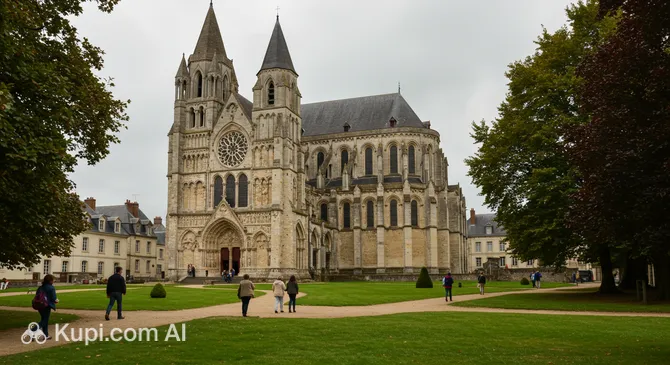
Abbey of the Ladies of Caen
Abbey of the Ladies of Caen. Иллюстрация. Источник: Kupi.com AI

Today, this complex in France is not just a monument to the past, but a living cultural space. Its heart is the majestic Church of the Holy Trinity (Église de la Trinité), whose silhouette dominates the cityscape. Surrounded by a classic French garden, the abbey impresses with the harmony of its proportions and the tranquility of its monastery walls.

This place is worth visiting not only for its architectural delights but also to touch upon the lives of great historical figures. Having survived the Hundred Years' War and revolutionary upheavals, the complex has maintained its status as one of the most significant religious and historical monuments in Normandy, attracting travelers with its unique atmosphere and centuries-old secrets.

Contacts

To plan your visit to this architectural complex, you can use the official contact details. The site administration provides information about visiting rules and available guided tours by phone or via the official web resource.

How to contactContact
AddressPl. Reine Mathilde, 14000 Caen, France
Phone+33 2 31 06 98 98
Websitewww.abbayes-normandes.com

What to Do

Start your discovery of the complex with a visit to the Church of the Holy Trinity. This is a true masterpiece of Norman Romanesque style: you can appreciate the scale of the nine-bay nave and the elegance of the two-story arches. Inside the church, be sure to notice the stained glass windows, which create a wonderful play of light, highlighting the monumentality of the stone walls.

A special place in the church is held by the tomb of Queen Matilda. The black marble slab marks the burial place of the abbey's foundress and is a site of pilgrimage for many history enthusiasts. After exploring the upper part of the church, be sure to descend into the ancient crypt. Its closely set columns and fragments of decor depicting scenes of the Last Judgment create a mystical and solemn atmosphere.

Continue your walk through the monastery courtyards — the cloisters. The architecture of these covered galleries and the wide, grand 18th-century double-flight staircase will provide an excellent backdrop for photos. The abbey's arcaded courtyard is the perfect place to pause for a moment and experience the silence of this historical site in the heart of the bustling city.

Getting There

Reaching this majestic historical monument is easy, as it is located in the central part of the city at Pl. Reine Mathilde. A picturesque street, rue de Chanoines, leads to the building from the east of the city's historical core.

If you are already exploring other landmarks, such as the castle or the Church of Saint-Pierre, you can easily reach the Women's Abbey on foot in about 10–15 minutes. This is a great way to enjoy the atmosphere of the old quarters and admire the details of Norman architecture.

For those who prefer public transport, the city has a well-developed network of buses and trams that stop in the immediate vicinity of Queen Matilda Square. You can also always take a local taxi directly from the city center — the trip will only take a few minutes.

Travelers using a private or rental car are recommended to leave their vehicle at one of the municipal parking lots in the city center, as the streets directly around the abbey can be quite narrow and have parking restrictions.

Ближайший город: Caen

History & Facts

The history of this site began in 1062 when Queen Matilda of Flanders, wife of the famous William the Conqueror, founded the abbey. According to legend, the construction of the monastery was an act of penance: the couple hoped to receive the Pope's forgiveness for their marriage, which was initially not approved by the church due to their kinship.

For centuries, the abbey served as an important religious center for women from noble families. The central element of the complex was the Church of the Holy Trinity, built in the Romanesque style. It is considered one of the most significant and purest examples of Norman architecture of that era, preserving its austere beauty to this day.

The monastery's fate was complex: it survived the destructive events of the Hundred Years' War and the turbulent years of the French Revolution. In the 18th century, the main buildings were reconstructed, and later the complex served many roles — from military barracks and a hospital to an almshouse. Despite all the changes, the architectural integrity of the ensemble has been preserved.

Interestingly, it is here that the foundress herself, Queen Matilda, found her final resting place. After a large-scale restoration in the 1990s, the complex regained its current grand appearance and today serves not only as a historical monument but also as the seat of regional authorities, continuing to play an active role in the life of the region.

Time Needed

To leisurely explore the main sites of the complex, including the Church of the Holy Trinity, descend into the crypt, and stroll through the courtyards, most visitors need between 1 and 2 hours. This is quite enough time to appreciate the architecture and feel the ancient atmosphere.

If you plan to study Queen Matilda's tomb in detail, linger by the stained glass windows, or have a photo session in the classic French garden, it is worth setting aside a bit more time — about half a day. This will allow you to enjoy your walk without rushing and perhaps discover the quietest corners of the abbey.

Working Hours

The abbey is open to visitors daily, though the schedule varies depending on the day of the week. There is a short lunch break on weekdays, which should be taken into account when planning your city route.

Current schedule:

  • Monday – Friday: 08:00 – 12:30 and 13:30 – 18:00
  • Saturday and Sunday: 14:00 – 18:00
On weekends, visits are only possible in the afternoon, so it is better to dedicate your morning to other city sites.

DayWorking hours
Понедельник8:00 – 12:30, 1:30 – 18:00
Вторник8:00 – 12:30, 1:30 – 18:00
Среда8:00 – 12:30, 1:30 – 18:00
Четверг8:00 – 12:30, 1:30 – 18:00
Пятница8:00 – 12:30, 1:30 – 18:00
Суббота2:00 – 18:00
Воскресенье2:00 – 18:00

Nearby

Exploring the surroundings of the Women's Abbey will allow you to dive deeper into the region's rich history and see how the city has evolved over the centuries. Key defensive and religious structures of Normandy are within walking distance.

Many of these sites are located so close that they can be combined into one pleasant walking tour, starting with the ancient castle walls and ending in the city's cozy squares.

NameDistance
Michel d'Ornano Park0.1 km
Jolly Roger0.4 km
Museum of Fine Arts of Caen0.6 km
Bœuf & Cow0.6 km
St Peter's Church0.6 km
Caen Castle0.7 km
Saint John Church0.7 km

Reached the end of the page?

That means the route is fully explored