Support

Abbaye-aux-Hommes

About

Among the architectural treasures of which France is proud, the Abbaye aux Hommes (Men's Abbey) holds a special place. Located in the heart of Caen, this monumental complex is a magnificent example of Romanesque and Gothic architecture, serving as an unofficial symbol of the Normandy region.
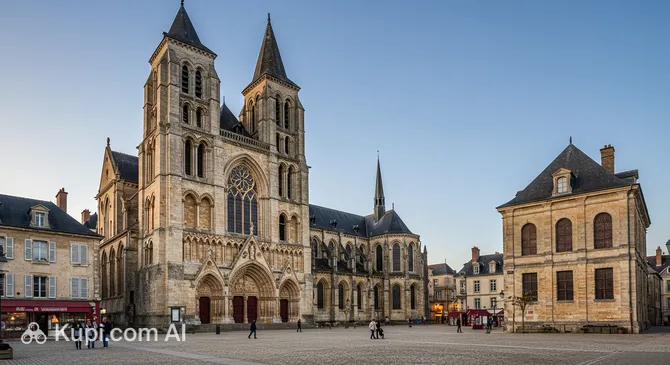
Men
Men's Abbey. Иллюстрация. Источник: Kupi.com AI

Founded in 1059 by the famous William the Conqueror, the abbey originally served as a Benedictine monastery. Today, it is not just a historical monument but a living space where the active Saint-Étienne Church and the administrative halls of the local City Hall (Mairie) harmoniously coexist.

Travelers are drawn here by the austere beauty of the façades, the soaring spires of the cathedral, and the tranquility of the cloister courtyards. It is a place of power where the grandeur of the Middle Ages and the history of one of Europe's most influential rulers shine through the stone.

Contacts

To clarify visit details or book a tour, you can use the official contact information for the institution.

How to contactContact
AddressEsp. Jean-Marie Louvel, 14000 Caen, France
Phone+33 2 31 30 42 81
Websitecaen.fr

What to Do

Begin your exploration of the complex with a visit to the grand Saint-Étienne Church. Inside, you can see the abbey's main shrine — the tomb of William the Conqueror. While admiring the interiors, note the contrast between the powerful Romanesque naves and the elegant Gothic elements added in later periods.

Of particular interest is the Ducal Palace, whose rooms now house the city's Town Hall. During a walk through the halls open to the public, you can see unique models recreating the complex's appearance in different centuries. The abbey's cloister courtyards and passages are perfect for feeling the peaceful atmosphere of the ancient monastery.

If you're lucky with the schedule, be sure to attend an organ music concert — the cathedral's acoustics give the instrument's sound incredible depth. Temporary art exhibitions are also regularly held on-site, seamlessly integrated into the historical interiors.

Getting There

Getting to this historical complex is easy, as it is located in the very city center. If you arrive at the train station, a pleasant walk to the abbey will take about 20–25 minutes, allowing you to enjoy the atmosphere of the old streets along the way.

For those who prefer public transport, city bus stops are located within walking distance of the site. You can also use taxi services — a trip from any central point in the city will be quick and comfortable.

Travelers in private cars should look for nearby city parking, though available spots may be limited during the peak tourist season.

Ближайший город: Caen

History & Facts

The founding of the abbey in 1059 is linked to the dramatic personal story of William the Conqueror and his wife, Matilda of Flanders. The marriage was concluded despite a church ban, and the construction of two abbeys (the Men's and the Women's) became an act of penance that allowed the couple to receive the Pope's blessing. In 1087, the great monarch found his final resting place right here, within the walls of Saint-Étienne Church.

The complex's architectural history spans several centuries. The construction of the main cathedral was completed in 1083, showcasing the power of the Romanesque style. Later, in the 14th century, the ensemble was complemented by the elegant Ducal Palace, while subsequent renovations introduced Gothic and Classicist elements, turning the abbey into a textbook on architectural history.

The buildings' fate changed drastically during the French Revolution. The monastery was closed, and its premises were transferred to the city authorities. Since the beginning of the 19th century, the church has reopened its doors to parishioners, while the other buildings were gradually adapted for civil needs. Today, spiritual heritage and modern administrative life coexist harmoniously here.

Time Needed

To explore every corner of this majestic complex without rushing, it is recommended to set aside 1.5 to 3 hours in your itinerary. This is the optimal time to see both the cathedral's interior and the external architecture of the monastic buildings.

If you plan to visit temporary exhibitions or join a guided tour of the current City Hall rooms, you should aim for the upper end of this range. Photography enthusiasts may also need extra time to capture the play of light in the Gothic vaults.

Working Hours

The abbey is open to visitors daily, though the schedule varies depending on the day of the week. On weekdays, the complex opens early in the morning: from Monday to Thursday, visits are possible from 8:00 AM to 6:00 PM, and on Fridays until 5:00 PM.

There is a break on weekends: on Saturdays and Sundays, the site is open from 9:30 AM to 1:00 PM and then from 2:00 PM to 6:00 PM. Please note that access to some rooms may be temporarily restricted during official events at the City Hall or church services.

DayWorking hours
Понедельник8:00 – 18:00
Вторник8:00 – 18:00
Среда8:00 – 18:00
Четверг8:00 – 18:00
Пятница8:00 – 17:00
Суббота9:30 – 13:00, 2:00 – 18:00
Воскресенье9:30 – 13:00, 2:00 – 18:00

Nearby

Visiting the abbey is just one part of exploring the region's rich heritage. Exploring the surroundings will allow you to dive deeper into the medieval atmosphere and discover new facets of local culture.

In the immediate vicinity, you'll find both defensive structures and exquisite palaces, each holding its own unique story. Here is a list of interesting sites located nearby:

NameDistance
St. Stephen's Church0 km
Balthazar0.5 km
Museum of Normandy0.8 km
Caen Botanical Garden0.8 km
Caen Castle0.9 km
Fleur de Sushi0.9 km
Museum of Fine Arts of Caen0.9 km

Reached the end of the page?

That means the route is fully explored