Support

Düsseldorf Arena

About

The Düsseldorf Arena, officially known as the Merkur Spiel-Arena, is one of the most modern multi-purpose venues in the city of Düsseldorf, Germany. It was previously known as the ESPRIT arena and LTU Arena, and was specially renamed "Düsseldorf Arena" for the Eurovision Song Contest 2011. This arena is a prime example of combining advanced technology with a vibrant sporting atmosphere.
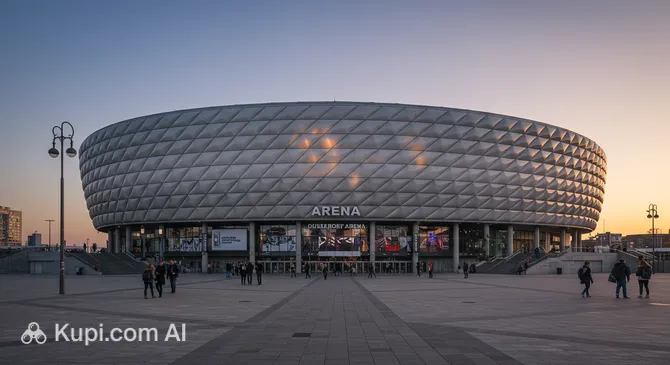
Düsseldorf Arena. Illustration.
Source: Kupi.com AI

Traveler photos:

The stadium was built in 2004 on the site of the historic Rheinstadion. The main pride of the arena is its unique design. The structure features a retractable roof that can close completely, as well as a modern heating system. This allows events to be held here in any weather, creating comfortable conditions for both athletes and spectators.

The arena serves as the home stadium for the local football club Fortuna Düsseldorf, regularly drawing dedicated fans to its stands. The stadium's capacity is over 45,000 spectators, allowing it to host world-class events. The arena was one of the venues for UEFA EURO 2024 matches, once again confirming its high status on the international sports scene.

Contacts

For the latest information on upcoming events, ticket purchases, or other organizational matters, you can contact the representatives of the Düsseldorf Arena. All details are available on the official website, or you can use the contact phone number.

How to contactContact
AddressArena-Straße 1, 40474 Düsseldorf, Germany
Phone number+49 211 15981200
Websitewww.merkur-spiel-arena.de

What to Do

The main activity for visitors to the Düsseldorf Arena is, of course, attending sporting events. Primarily, you can immerse yourself in the atmosphere of real German football at the home matches of Fortuna Düsseldorf, which competes in the 2. Bundesliga. Thousands of fans create an unforgettable show in the stands, and thanks to the stadium's excellent acoustics and design, every spectator feels like they're at the center of the action. In addition to club games, the arena regularly hosts international football matches, as it did during the 2024 European Championship.

Thanks to its versatility, the arena is a hub for both sporting and cultural life. It hosts grand concerts by world stars and music festivals that attract tens of thousands of spectators. Excellent acoustics and the retractable roof make it possible to host events of any format—from rock concerts to large-scale shows. In the past, the stadium also served as the home field for the American football team Rhein Fire, adding another chapter to its rich history.

For those who want to go behind the scenes of sports life, the Düsseldorf Arena offers guided tours. During such a tour, you can visit the players' locker rooms, VIP boxes, and other areas usually hidden from fans' eyes. This is a great opportunity to learn more about how a modern stadium works and feel its scale from the inside. Additionally, there is a hotel on-site, making attending events even more convenient for visitors to the city.

Getting There

Getting to the Düsseldorf Arena is very convenient, especially if you use public transport. This is one of the most efficient ways to attend events, helping you avoid traffic jams and parking issues. The stadium even has its own railway station located right under one of the stands, providing direct access to the arena and making the journey as fast as possible for fans and visitors.

For those who prefer the metro (U-Bahn), there is a dedicated route. Line U78 runs directly to the "Merkur Spiel-Arena/Messe Nord" stop, which is just a few minutes' walk from the entrance. The journey from Düsseldorf Main Station (Düsseldorf Hbf) takes about 18 minutes. On match or concert days, trains run at 5–10 minute intervals, making this a particularly reliable option. It is worth noting that for many events, your ticket may also serve as a public transport pass—be sure to check this information in advance.

The stadium is located next to the Düsseldorf Exhibition Center and about two kilometers from the Rhine River, making it accessible by car as well. The A44 motorway passes nearby, and parking is provided for visitors. However, on major event days, it is recommended to leave early due to potential traffic congestion. Alternatively, you can take a taxi or one of the bus routes that stop nearby.

Nearest city: Dusseldorf

History & Facts

The history of the modern Düsseldorf Arena is inextricably linked with its predecessor—the legendary Rheinstadion. Built back in 1925, the old stadium witnessed great football battles, including matches of the 1974 World Cup and the 1988 European Championship. However, time moved on, and in 2002, the decision was made to demolish the historic arena to build an ultra-modern multi-purpose complex in its place. Construction of the new arena, located near the Rhine River, lasted from 2002 to 2004.

The stadium, originally named the "LTU Arena," opened its doors to football even before all the work was officially completed. The first match took place on September 10, 2004, with local club Fortuna hosting Union Berlin and winning 2:0. However, the official and ceremonial opening didn't happen until January 18, 2005. That day, Fortuna faced Bayern Munich, and to the disappointment of local fans, the match ended in a crushing 1:5 defeat for the hosts.

The construction of the arena cost an impressive sum—between 218 and 240 million euros. The authorities of the city of Düsseldorf had high hopes that the new modern stadium would help the city become one of the venues for the 2006 FIFA World Cup held in Germany. However, despite all efforts and investments, the city's bid was rejected, and the arena was only given reserve status. This fact became one of the most notable in the early history of the stadium, which nevertheless eventually became one of the country's most important sporting and cultural venues.

Time Needed

The amount of time you should set aside for a visit to the Düsseldorf Arena depends entirely on the purpose of your visit. If you plan to attend an event, whether it's a football match or a concert, be prepared to spend a significant part of the day or evening. Attending a football match involving the local team Fortuna, including entering the stadium, the game itself (90 minutes plus halftime), and exiting, will take about 2.5–3 hours. If your goal is a concert by a world star, such an event can last 3–4 hours or more, especially considering the opening acts.

For those who want to see the arena without attending a specific event, there are other options. Typically, such stadiums host guided tours that allow you to take a look behind the scenes. Such a tour usually lasts about 1–1.5 hours and includes a visit to the locker rooms, VIP areas, and the pitch. If you simply want to see this grand structure from the outside and take a few souvenir photos, 20–30 minutes will be enough. Thus, your visit to the arena can be either short or quite lengthy.

Working Hours

The Düsseldorf Arena does not have standard opening hours like a museum or a park. The stadium opens its doors to visitors on event days: football matches, concerts, or major shows. The start time in such cases depends entirely on the schedule of the specific event, which can be found on the arena's official website. Given the high demand, it is strongly recommended to purchase tickets for any event in advance, especially for local Fortuna team matches or performances by world stars.

If you want to visit the stadium on non-event days, you can do so as part of an organized guided tour. Public tours that let you see behind the scenes are usually held on Sundays when there are no events. However, the schedule is not fixed and depends on the arena's availability, so you must check the official website's "Arena Tours" section for dates and times. Advance registration is mandatory for tours as group sizes are limited. Thanks to its retractable roof and heating system, the arena operates year-round, hosting guests and events in any season.

Nearby

Visiting the Düsseldorf Arena is a highlight in itself, but exploring its surroundings can make your trip even more rewarding. Located in the Stockum district, the arena is surrounded by green spaces and interesting cultural sites that are definitely worth your time. By setting aside a little time for a stroll, you can turn a stadium visit into a full tour of one of the most picturesque parts of Düsseldorf.

Just a few minutes' walk from the stadium is the vast Nordpark—one of the city's most popular parks where you can escape the hustle and bustle. This is where you'll find gems like the famous Japanese Garden and the educational Aquazoo Löbbecke Museum. Below is a list of nearby attractions with their distance from the arena to help you plan your route.

NameDistance
Aquazoo Löbbecke Museum1.3 km
Jump Galaxy Trampoline Park2.5 km
Museum Kunstpalast4.1 km
Kaiserswerth Imperial Palace4.2 km
Stadterhebungs Monument4.6 km
Kunstsammlung Nordrhein-Westfalen4.7 km
Düsseldorf Memorial4.7 km

Have you reached the end of the page?

So the route has been studied inside and out