Support

Royal Belgian Institute of Natural Sciences

About

The Royal Belgian Institute of Natural Sciences (RBINS) is not just a museum but a major scientific research center located in vibrant Brussels, the capital of Belgium. This institution is one of the country's leading scientific institutes, harmoniously combining serious research with engaging public exhibitions, making it interesting for visitors of all ages.
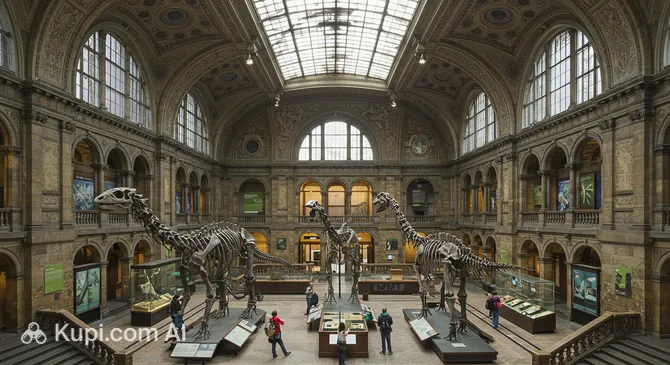
Royal Belgian Institute of Natural Sciences. Illustration.
Source: Kupi.com AI

Traveler photos:

The institute's main pride is its natural history museum, which boasts a truly impressive collection. Just imagine: about 37 million specimens! This makes its collection the third largest in Europe, surpassed only by the famous museums in London and Paris. The permanent exhibitions cover an area of 16,000 square meters, complemented by two halls for temporary exhibitions where there is always something new to discover.

A special place in the hearts of visitors, especially young ones, is held by the Dinosaur Gallery. It is rightfully considered the largest in Europe and offers a fascinating journey through time, introducing the giants that once inhabited our planet. Encountering the iguanodons found in Belgium and other prehistoric creatures leaves an unforgettable impression.

A visit to the Royal Belgian Institute of Natural Sciences is a unique opportunity to touch the mysteries of nature, learn about the latest scientific discoveries, and simply have an exciting time. It is a place where science comes to life and becomes accessible to everyone who seeks to broaden their horizons and experience vivid emotions.

Contacts

To find the most up-to-date information regarding opening hours, ticket prices, and potential special events at the Royal Belgian Institute of Natural Sciences, we recommend visiting the museum's official website. You can also find more details at tourist information centers in Brussels or on-site before your visit.

How to contactContact
AddressRue Vautier 29, 1000 Bruxelles, Belgium
Phone number+32 2 627 42 11
Websitewww.naturalsciences.be

What to Do

At the Royal Belgian Institute of Natural Sciences, visitors can expect a true immersion into the world of nature and science. Of course, one of the main magnets is the famous Dinosaur Gallery—the largest in Europe. Here you can see firsthand the impressive skeletons of prehistoric giants, including the unique iguanodons from Bernissart, and imagine what life on Earth was like millions of years ago. The scale of the exhibition and the realism of the reconstructions make an indelible impression on both children and adults.

Besides meeting the dinosaurs, the institute offers many other fascinating exhibitions. Be sure to visit the "Living Planet" gallery, which is dedicated to the current and important topic of our planet's biodiversity and the challenges of its preservation. This exhibition makes you think about the fragility of the world around us and the human role in its protection, presenting information in an accessible and visual form.

The Royal Belgian Institute of Natural Sciences is not a static collection of exhibits. Temporary exhibitions on a variety of scientific topics are held here regularly, so every visit can bring new discoveries. Additionally, for those who want to deepen their knowledge, the institute organizes educational programs, lectures, and workshops. This is a wonderful opportunity not just to view the exhibitions but to actively participate in the learning process, ask specialists questions, and learn something new firsthand.

Getting There

Getting to the Royal Belgian Institute of Natural Sciences in Brussels is quite simple, as it is conveniently located and well-connected to the city's transport network. The museum is situated in the picturesque Leopold Park, near the European Quarter, making it accessible from various parts of the capital of Belgium.

The most convenient way to reach the institute is by public transport. The nearest metro stations are typically Trône/Troon (lines 2 and 6) or Maelbeek/Maalbeek (lines 1 and 5), both of which are just a few minutes' walk from the museum. Numerous bus routes also stop near Leopold Park. If you are arriving in Brussels by train, the Brussels-Luxembourg railway station (Gare de Bruxelles-Luxembourg/Station Brussel-Luxemburg) is located right next to the museum, which is very convenient.

Of course, you can always take a taxi or use ridesharing services to get to the Royal Belgian Institute of Natural Sciences directly from your hotel or any other point in the city. A taxi ride from central Brussels usually doesn't take long, depending on traffic. If you're staying nearby and the weather is pleasant, a walk through the city or Leopold Park can also be a wonderful addition to your visit.

Nearest city: Brussels

History & Facts

The history of the Royal Belgian Institute of Natural Sciences dates back to the mid-19th century. Its official founding date is **March 31, 1846**, when it was established as the Royal Museum of Natural History. Interestingly, there are several versions of its origin: according to one, the collection was based on the Cabinet of Physics and Natural History of the Royal Library; according to another, it succeeded the so-called Musée de Bruxelles, inheriting the collection of Prince Charles Alexander. It is also mentioned that the naturalist Balthazar-Eugène was the initiator of its creation. This multifaceted origin underscores the rich history of one of the leading scientific centers in Belgium.

A significant stage in the institute's development occurred in the 1930s when a large-scale expansion began under the leadership of director Victor van Straelen. The project was entrusted to architect Lucien de Vestel, but ambitious plans faced harsh realities: World War II and a lack of state funding delayed construction for *twenty years*, until 1955. The institute's tower, which became its recognizable symbol, was only completed in the 1980s. Notably, during the reconstruction, the old monastery building where the institute is located was carefully preserved in its historical form.

One of the most brilliant chapters in the history of the institute (then the Royal Belgian Museum of Natural History) began on **April 12, 1878**. On that day, news reached the museum of a sensational discovery of iguanodons in the Bernissart coal mines. These unique dinosaur skeletons later became the jewel of the collection and brought the museum worldwide fame, forming the basis of the famous Dinosaur Gallery. Later, in 2002, another important event occurred: the Belgian Geological Survey became part of the Royal Institute, further strengthening its scientific potential.

Time Needed

When planning a visit to the Royal Belgian Institute of Natural Sciences, you should expect to spend at least 2-3 hours exploring it. This time is enough to get a general overview of the main exhibitions, including the famous Dinosaur Gallery. However, if you are a passionate fan of paleontology, mineralogy, or zoology, or are traveling with children who will surely want to linger at every interactive display, feel free to set aside half a day for your visit.

The institute's extensive collections and variety of themed halls allow for much more time to be spent here. For example, a detailed study of the Dinosaur Gallery, which is one of the largest in Europe, can take more than an hour on its own. Add to this the exhibitions dedicated to human evolution, biodiversity, the insect world, and minerals, as well as the regularly updated temporary exhibitions, and you will find that time flies by here.

Ultimately, the length of your visit will depend on your interests and pace. Some may prefer a quick look at the most iconic exhibits, while others will want to thoughtfully examine every display case and read every information plaque. In any case, the Royal Belgian Institute of Natural Sciences offers a rich and fascinating experience for visitors of all ages, capable of occupying you for several hours or even most of the day.

Working Hours

The Royal Belgian Institute of Natural Sciences is usually happy to welcome visitors year-round; however, exact opening hours may change depending on the season, day of the week, or due to holidays. To plan your visit in the best way possible, we strongly recommend checking the current schedule on the institute's official website or contacting them directly before your trip. This will help avoid surprises and ensure the museum is open at a time convenient for you.

As for booking tickets, for a popular place like the Royal Belgian Institute of Natural Sciences, it is often a good idea, especially if you plan to visit during the peak tourist season, on weekends, or during special exhibitions. Purchasing tickets online in advance, if available, can not only guarantee entry but also save time by avoiding queues. Information regarding the need for booking and ways to purchase tickets is also best checked on the museum's official resources.

DayOpening hours
MondayClosed
Tuesday9:30 – 17:00
Wednesday9:30 – 17:00
Thursday9:30 – 17:00
Friday9:30 – 17:00
Saturday10:00 – 18:00
Sunday10:00 – 18:00

Nearby

A visit to the Royal Belgian Institute of Natural Sciences will undoubtedly be a highlight of your trip to Brussels. However, to make your journey even more fulfilling and full of impressions, it is worth paying attention to the attractions located nearby. Exploring the surrounding area will allow you to dive deeper into the atmosphere of this amazing city and discover new interesting places, conveniently complementing your main visit.

Thanks to the institute's prime location, several noteworthy sites are within walking distance or a short public transport ride away. This is a great opportunity to combine educational recreation with pleasant walks and an introduction to other facets of Brussels.

NameDistance
Parlamentarium0.4 km
House of European History0.4 km
Royal Palace of Brussels1.2 km
Autoworld1.2 km
Royal Museums of Fine Arts of Belgium1.4 km
Escape Hunt Brussels1.5 km
Church of Our Lady of the Sablon1.5 km

Have you reached the end of the page?

So the route has been studied inside and out