Support

Luxembourg Gardens

About

The Jardin du Luxembourg (Luxembourg Garden) is a magnificent palace and park ensemble spread across the heart of Paris in the famous Latin Quarter. This former royal, and now state-owned park, covers an impressive area of 26 hectares and is one of the most famous and beloved attractions in the capital of France. The garden is a unique combination of strict French classicism and picturesque English style, offering visitors both perfectly manicured flowerbeds and terraces as well as secluded green corners.

The centerpiece of the ensemble is the majestic Luxembourg Palace, which today serves as the meeting place for the Senate—the second chamber of the French Parliament. Nearby are other important buildings: the "Petit Luxembourg," which is the official residence of the President of the Senate, as well as the Luxembourg Museum and an old orangery that houses over 400 species of orchids. The Medici Fountain, built in 1630, also deserves special attention as one of the most romantic spots in the garden.

The Jardin du Luxembourg is not just a park, but a true oasis of peace and culture. Here, you can not only enjoy the beauty of nature and architecture but also find activities for every taste: from sailing model boats on the central pond to playing tennis or chess. For younger visitors, there is a vintage carousel and a puppet theater. It is a favorite relaxation spot for both Parisians and tourists who come here to escape the city bustle, read a book on one of the many chairs, or simply watch the slow pace of city life.
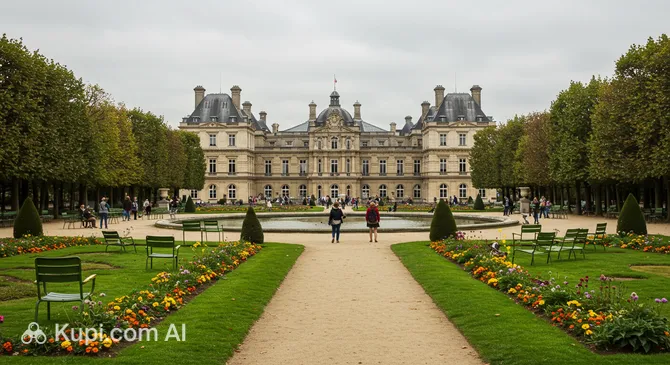
Luxembourg Gardens. Illustration.
Source: Kupi.com AI

Traveler photos:

Contacts

Since the Jardin du Luxembourg is a public park, the most reliable way to find up-to-date information on opening hours, which change seasonally, as well as current events, is to visit the official website. Below is the key information to help you plan your visit.

How to contactContact
Address75006 Paris, France
Phone number+33 1 42 34 20 00
Websitejardin.senat.fr

What to Do

A variety of relaxation and cultural leisure options await visitors in the Jardin du Luxembourg. The park is roughly divided into two main parts, each with its own unique style. Flowerbeds and terraces created back in the 17th century spread around the Luxembourg Palace. These are designed in a strict French style with classic geometry and order. In the eastern and southeastern parts of the garden, there is a later park area designed in a picturesque English style, featuring more natural and free-form landscape solutions.

One of the most romantic areas is the part of the garden adjacent to Rue Guynemer. Here, the English park blends harmoniously with bright flower gardens and statues dedicated to poets. This is an ideal place for leisurely strolls, where you can enjoy the play of light and shadow, rest on a bench in a secluded spot, or simply admire nature. In addition to walking, the garden offers courts for tennis and basketball, while carousels and a puppet theater are available for children. Over a hundred statues are scattered throughout the park, including an original model of the Statue of Liberty and figures of French queens.

The Jardin du Luxembourg is beautiful at any time of year, offering visitors a unique opportunity to immerse themselves in the atmosphere of the past and feel the unmistakable lightness of Parisian life. A walk along its historic paths, celebrated in poems and songs, allows you to escape the city noise and touch the cultural heritage of Paris. This is a place where you can sit for hours by the pond, watching the sailing boats, or find inspiration, just as Baudelaire, Hugo, and Hemingway once did.

Getting There

Getting to the Jardin du Luxembourg is quite easy, as it is located in the heart of Paris, in the vibrant Latin Quarter. Thanks to its central location and excellent transport accessibility, you can easily reach it from anywhere in the city using the metro, RER trains, buses, or simply by taking a walk.

The most convenient and fastest way is to use the RER Line B suburban trains. The Luxembourg station is located right at the north entrance to the park, making this the most direct option. The garden is also served by several metro lines. The nearest station is Odéon, served by lines 4 and 10, which is just a few minutes' pleasant walk from the park entrance. Additionally, you can reach the Saint-Sulpice (line 4) or Notre-Dame-des-Champs (line 12) stations, both of which are within walking distance.

For those who prefer surface transport to enjoy city views along the way, many bus routes stop near the Jardin du Luxembourg. The Sénat and Musée du Luxembourg stops are served by buses No. 58, 84, and 89, while the Luxembourg stop is served by route No. 38. Of course, you can always use a taxi or ride-sharing services, which is particularly convenient for small groups, though you should consider potential traffic in the city center. If you are already exploring the Latin Quarter or the Saint-Germain-des-Prés district, walking to the garden would be a wonderful addition to your itinerary.

Nearest city: Paris

History & Facts

The history of the Jardin du Luxembourg is a story of royal nostalgia. Its creation began in 1611–1612 by order of Queen Marie de' Medici of France, the widow of Henry IV. Missing the picturesque landscapes of her native Tuscany, the Queen wanted to recreate a corner of Italy in the heart of Paris. To do this, she purchased the estate of the Duke of Luxembourg, from which the famous name originated. Thus, around the country chateau being built, a garden appeared that was destined to become one of the city's most beloved relaxation spots.

The central element of this magnificent ensemble was the Luxembourg Palace. Its construction began in 1615 under the direction of architect Salomon de Brosse and was completed by Jacques Lemercier. At that time, Marie de' Medici was regent for her young son, the future King Louis XIII, and personally supervised the project. The architecture of the palace and garden was inspired by the luxurious residences of her native Florence, particularly the famous Palazzo Pitti, where she spent her childhood.

Marie de' Medici's vision was to create a true "Italian paradise" on French soil. The initial design of the park reflected this idea: it featured richly decorated fountains, neatly sculpted hedges, and well-maintained lawns in a strict geometric style. A special aqueduct was even built to supply the fountains with water. Although the garden has undergone changes over the centuries, it still retains the spirit of the Italian Renaissance that the Queen so sought to bring to her new life in Paris.

Time Needed

The time needed to visit the Jardin du Luxembourg largely depends on your interests and pace. For a general overview, a quick walk, and a few photos at the Luxembourg Palace and Medici Fountain, 1–2 hours is quite enough. During this time, you can walk along the main alleys, feel the park's atmosphere, and watch the leisurely life of Parisians relaxing on the famous green chairs.

However, to truly enjoy this place, explore its hidden corners, and fully experience its charm, you should plan for at least half a day. This will give you the opportunity to leisurely stroll through the French and English parts of the garden, find numerous statues, watch a game of tennis or petanque, or perhaps even visit an exhibition at the Luxembourg Museum. The recommended time for a more thorough visit is 2-3 hours, allowing you to take a break from the city bustle and fully immerse yourself in the garden's calm and inspiring atmosphere.

Working Hours

The Jardin du Luxembourg is open to visitors year-round, and what is especially pleasant for travelers is that entry to this beautiful Parisian park is completely free. You won't need to book tickets or make an appointment in advance to stroll through its picturesque alleys. However, there is an important detail to keep in mind: the garden does not have a fixed schedule. Its opening and closing hours depend directly on the season and the length of daylight hours.

Approximately, during the warm season (from April to October), the garden opens at 7:30–8:00 AM and stays open until late evening, closing around 8:00–9:30 PM. In winter (from November to March), the hours are shorter: the gates open around 8:00–8:15 AM and close as early as 4:30–5:00 PM. Since the exact times can change even within a single month, it is strongly recommended to check the current opening hours on the park's official website before your visit to plan your day and avoid any unpleasant surprises.

Nearby

A visit to the Jardin du Luxembourg is just the beginning of exploring the attraction-rich Latin Quarter of Paris. To get a full sense of this historic district, it is worth exploring the surrounding area. A walk through the neighboring streets will allow you to dive deeper into the atmosphere of the capital of France, discovering new iconic landmarks, cozy corners, and cultural treasures located literally steps away from the park.

Many of the city's key attractions are within walking distance, making the Jardin du Luxembourg an ideal starting point for an exciting itinerary. From grand cathedrals and world-famous museums to legendary nightclubs, the park's surroundings offer an impressive variety of places, each with its own unique history and character.

NameDistance
Le Caveau de la Huchette1 km
Louvre Museum1.6 km
Musée d'Orsay1.6 km
Les Invalides2 km
Napoleon's Tomb2 km
Galerie Vivienne2.2 km
Hôtel de Crillon2.5 km

Have you reached the end of the page?

So the route has been studied inside and out