Support

Louvre Museum

About

The Louvre is one of the largest and most famous museums in the world, located in the center of Paris on the right bank of the Seine. It is not just an attraction, but a true symbol of France that every traveler strives to see.

The history of this place goes back centuries: it was originally a defensive fortress built in 1190, later a residence for French kings, and only then did the building become a museum of world significance. The majestic palace complex consists of several parts: the Sully Wing with the Cour Carrée (Square Court), which is the oldest part, as well as the Richelieu and Denon Wings surrounding the Cour Napoléon.

One of the most recognizable features of the modern Louvre is the famous glass pyramid, built between 1985 and 1989 based on the design of architect I.M. Pei. It serves as the main entrance to the museum and, along with its surrounding fountains and smaller pyramids, forms an unforgettable architectural ensemble that has become a symbol of Paris.
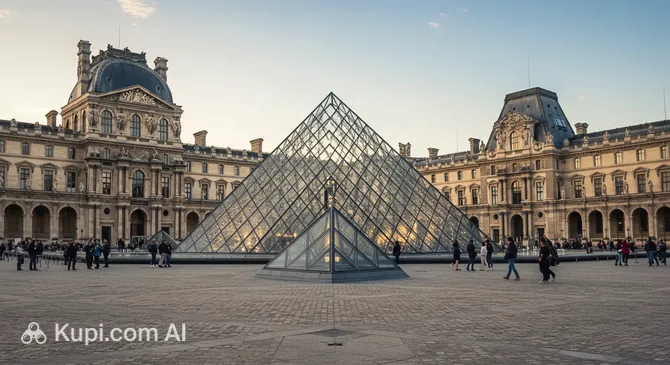
Louvre Museum. Illustration.
Source: Kupi.com AI

Traveler photos:

Contacts

To plan your visit and check current information on exhibitions and opening hours, it is recommended to use the museum's official contact details. All necessary information is available on the Louvre website, or you can contact representatives by phone.

How to contactContact
Address75001 Paris, France
Phone number+33 1 40 20 53 17
Websitewww.louvre.fr

What to Do

A visit to the Louvre is an immersion into the world of art, spanning millennia of history and diverse civilizations. Its countless galleries house rich collections, from Ancient Egypt and Classical Greece to masterpieces of European painting. Naturally, the main magnets for millions of tourists are world-famous exhibits such as Leonardo da Vinci's "Mona Lisa" and the ancient statues of the Venus de Milo and the Winged Victory of Samothrace. To avoid getting lost in this variety, it is recommended to plan your visit in advance: choose a few halls or works you want to see first and map out a convenient route.

But the Louvre is not just its collections. The museum building itself is an outstanding historical monument. Take a walk around the grounds of the former royal palace and admire its architecture, which has evolved over nearly a thousand years and combines various styles. The famous glass pyramid in the Cour Napoléon is particularly striking. This modern structure, which has become a symbol of Paris, creates a stunning contrast with the historical facades of the palace, harmoniously blending the classic and the contemporary.

In addition to self-guided exploration, you can use the services of local guides in the Louvre. A professional tour will help you not to miss the most important things and learn fascinating stories about legendary exhibits. This is a great way to make your visit more structured and informative, especially if you have limited time. Walking through the halls where the kings of France once lived will leave an unforgettable impression.

Getting There

The Louvre is located in the very heart of Paris, on the right bank of the Seine, making it easily accessible from anywhere in the city. The fastest and most convenient way to reach the museum is the Paris Metro. You need the Palais-Royal — Musée du Louvre station, served by lines 1 and 7. A major advantage is that the station has a direct exit leading to the Carrousel du Louvre shopping gallery and further to the main entrance under the glass pyramid. Additionally, the museum can be reached by numerous buses, with stops located right across from the entrance.

If you prefer walking and want to enjoy the city views, the Louvre is an easy walk from many key attractions. For instance, a leisurely stroll from Notre-Dame Cathedral or Place de la Concorde will take no more than 15–20 minutes. There is also a more scenic way to reach the museum — the Batobus river shuttle that cruises along the Seine. Its stop is located on the Quai François-Mitterrand, very close to the Louvre, allowing you to combine your journey with a short river tour.

Nearest city: Paris

History & Facts

The history of the Paris Louvre is inseparable from the history of France itself and spans more than eight centuries. It all began in 1190, when a mighty fortress with a large watchtower was built by order of King Philip Augustus. Its main task was to protect the lower reaches of the Seine from possible invasions. Thus, the site that today houses priceless works of art originally served purely defensive purposes.

Nearly two centuries later, in the 14th century, King Charles V transformed the austere fortress into one of his residences, housing the royal library and treasury. However, the true turning point for the building occurred during the Renaissance. In the mid-16th century, based on the designs of architect Pierre Lescot and sculptor Jean Goujon, the transformation of the medieval castle into an exquisite Renaissance palace began. The construction of the palace complex stretched over several centuries, until the 1880s, with each monarch contributing to its appearance.

The Louvre finally acquired its modern look after the fire at the Tuileries Palace during the Paris Commune, which destroyed the section connecting it to the Louvre. But the story did not end there. In 1983, at the initiative of President François Mitterrand, a large-scale modernization of the museum began. The culmination of this project was the 1989 construction of the famous glass pyramid, designed by architect I.M. Pei, which today serves as the main entrance and is one of the most recognizable symbols of not only the Louvre but all of Paris.

Time Needed

When planning a visit to the Louvre, it is important to understand the scale of this grand museum. It could take several days to fully explore all its treasures and collections. However, if your goal is to see the main masterpieces and feel the atmosphere of the former royal palace, you should set aside at least 3–4 hours for the visit. This will be enough time to see world icons like the "Mona Lisa", the Venus de Milo, and the Winged Victory of Samothrace, as well as get a general impression of the key halls.

If you want to dive deeper into a specific era or collection, such as Ancient Egyptian art or Northern European painting, it's better to plan for half a day or even a full day. Many experienced travelers advise against trying to cover everything in one go to avoid information fatigue. A good strategy is to split the visit over several days or choose a specific route through the halls that interest you. For those with very little time, there are express tours that allow you to see the essentials in 1.5–2 hours.

Working Hours

The Louvre is open to visitors almost all year round, but it has a specific operating schedule that is important to consider when planning your visit. The museum is open daily from 9:00 to 18:00, except for Tuesdays, which is the official day off. Additionally, the Louvre is closed on certain holidays: January 1, May 1, and December 25. For those who prefer evening strolls through the museum's halls, there is an excellent opportunity — on Fridays, the museum extends its hours until 21:00 or 21:45, allowing you to enjoy the art in a calmer atmosphere. In some months, free night visits are also held on the first Friday of the month, but this information should be confirmed in advance.

To avoid hours of waiting in line, it is strongly recommended to buy tickets online in advance. Since January 2020, visitors must book a specific date and time slot for entry, as tickets at the on-site box office may not be available. This not only guarantees your entry but also allows you to pass through less crowded entrances, bypassing the main queue at the glass pyramid. Since opening hours and entry conditions may change, be sure to check the latest information on the official Louvre website before your trip.

DayOpening hours
Monday9:00 – 18:00
TuesdayClosed
Wednesday9:00 – 21:00
Thursday9:00 – 18:00
Friday9:00 – 21:00
Saturday9:00 – 18:00
Sunday9:00 – 18:00

Nearby

A visit to the Louvre is a grand event in itself, but you shouldn't limit yourself to its halls alone. The area around the museum is equally rich in historical and cultural treasures that can significantly enhance your experience of Paris. A walk through the neighborhood will allow you to better feel the atmosphere of the heart of France and see how history intertwines with modernity.

Just a few steps from the former royal palace, you'll find famous parks, elegant shopping galleries, and other significant museums. Exploring these places won't take much time, but it will offer new perspectives and bright memories of your trip. Below is a list of interesting sites located in the immediate vicinity of the Louvre.

NameDistance
Galerie Vivienne0.7 km
Musée d'Orsay0.8 km
Le Caveau de la Huchette1.1 km
Hôtel de Crillon1.4 km
Petit Palais1.8 km
Les Invalides1.9 km
Napoleon's Tomb1.9 km

Have you reached the end of the page?

So the route has been studied inside and out