Support

Tuileries Garden

About

The Tuileries Garden (Jardin des Tuileries) is a magnificent public park located in the heart of Paris, in the 1st arrondissement. As one of the oldest and most significant parks in France designed in the classic French formal style, it stretches from the Louvre to Place de la Concorde, between the Seine embankment and Rue de Rivoli. It is not just a green space, but a true open-air museum where history and art blend harmoniously with nature.
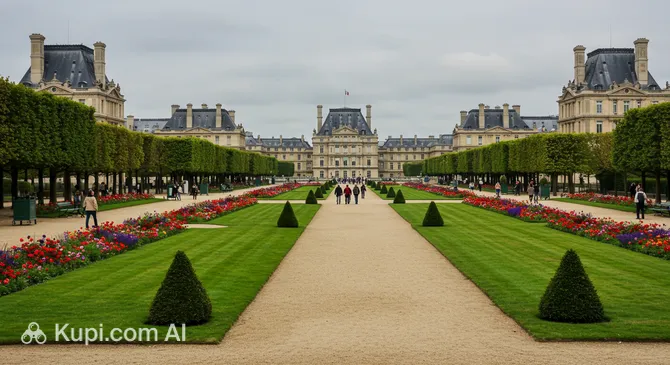
Tuileries Garden. Illustration.
Source: Kupi.com AI

Traveler photos:

The park was established in 1564 by order of Queen Catherine de' Medici. It owes its name to the tile workshops (from the French "tuile" — tile) that were formerly located on the site. Initially created in the Italian style, the garden was radically redesigned in the 17th century by the famous landscape architect André Le Nôtre, who gave it its elegant and formal French appearance. Today, the Tuileries is a model of landscape art with its flawless geometry, straight alleys, neatly trimmed trees, and numerous sculptures.

The park covers more than 25 hectares and is a favorite spot for strolls for both Parisians and tourists. Here, you can relax by one of the picturesque ponds, admire the fountains and classical statues, or simply sit on the famous green chairs while enjoying the atmosphere. In the western part of the garden are two renowned museums: the Musée de l'Orangerie, which houses Claude Monet's "Water Lilies," and the Jeu de Paume gallery, dedicated to contemporary art and photography.

Contacts

As the Tuileries Garden is a public park, it does not have specific visitor contacts such as a phone number or email address. For the most up-to-date information on opening hours and events, it is best to check the official tourism portals of Paris or the website of the Louvre Museum, which manages the garden. Reaching the park is very easy via public transport.

The most convenient way is the Paris Metro. The closest stations to the garden are Tuileries (Line 1) and Concorde (Lines 1, 8, and 12), which provide access to different parts of this large park. The garden's address is Rue de Rivoli (75001), but it is easiest to navigate using the Louvre on one side and Place de la Concorde on the other.

How to contactContact
Address75001 Paris, France
Websiteparisjetaime.com

What to Do

Visitors to the Tuileries Garden can fully enjoy its unique atmosphere, which combines historical grandeur with natural tranquility in the center of Paris. The main activity here is taking a leisurely stroll along the wide, well-kept paths that allow you to appreciate the full beauty of the French formal garden style. You can admire the geometric lawns, exquisite flowerbeds, and enjoy views of the city's iconic landmarks visible from various points in the park. It is the perfect place to take a break from the city bustle, sitting on one of the famous green chairs by the fountain and people-watching.

The Tuileries Garden is a true open-air museum, and exploring its artistic heritage is an essential part of any visit. The park is adorned with numerous sculptures created by famous masters from different eras, from classical to contemporary. Guests can spend time examining these works of art, relaxing by the large ponds, or simply inhaling the fragrance of the flowers. There is also entertainment for children: for instance, at the Grand Bassin Octogonal, you can rent and sail small model sailboats, a traditional Parisian pastime.

The garden's historical atmosphere, closely linked to the French monarchy, is felt at every turn. Although nothing remains of the former Tuileries Palace, menagerie, or theater, the spirit of the past lives on in the park's formal layout and its majestic views. In the summer, a fair with rides is sometimes held here, adding a lively touch to the garden. Thus, a visit to the Tuileries is an opportunity not only to relax in nature but also to touch the rich culture and history of France.

Getting There

The Tuileries Garden boasts a prime location in the very heart of Paris, making it easily accessible for travelers. It is situated between the Louvre and Place de la Concorde on the right bank of the Seine. You can reach the garden in several ways: by public transport, taxi, or even on foot during a stroll through the city.

The most convenient and fastest way to reach the garden is the Paris Metro. Several stations are located in the immediate vicinity: Tuileries (Line 1), which brings you right to the central part of the park; Concorde (Lines 1, 8, 12) at the western entrance; and Palais Royal - Musée du Louvre (Lines 1, 7) at the eastern entrance near the Louvre. From any of these stations, the garden entrance is just a few minutes' walk. Additionally, the park can be reached by one of the city's many bus lines.

Thanks to its central position, the Tuileries Garden fits perfectly into a walking route of Paris's main attractions. You can easily walk here from the Louvre Museum, stroll to Place de la Concorde and the Champs-Élysées, or cross the bridge to the other side of the Seine to visit the Musée d'Orsay. This makes the park more than just a spot on the map; it is a vital link between the iconic landmarks of the capital of France.

Nearest city: Paris

History & Facts

The history of the Tuileries Garden is inextricably linked with Queen Catherine de' Medici. In 1564, longing for the lush gardens of her native Florence, she ordered the creation of a new park and the construction of a palace on the outskirts of Paris. The name "Tuileries" comes from the French word tuile (tile), as tile workshops where clay was extracted once occupied the site. Originally, the garden was designed by Bernard Palissy in the Italian style favored by the Queen, featuring grottoes, fountains, and a clear layout of paths.

A century later, in the 1660s, the park's appearance was transformed by the genius of André Le Nôtre—the famous landscape architect who created the magnificent gardens of Versailles. He completely redesigned the Tuileries, turning it into a masterpiece of the French formal style (jardin à la française) with its perfect symmetry, wide perspectives, and strict geometric forms. An interesting fact: André Le Nôtre had a deep personal connection to this place from childhood, as his father, Jean Le Nôtre, served as the head gardener at the Tuileries under King Louis XIII.

Despite its beauty, the Kings of France rarely visited the Tuileries for a long time. Everything changed during the French Revolution when, in 1789, Louis XVI and his family were forced to leave Versailles and move to the Tuileries Palace. The palace itself did not survive to the present day—it was burned down in 1871 during the events of the Paris Commune and was never rebuilt. However, the garden survived all historical storms, and today it remains one of the most popular parks in Paris, connecting the Louvre with Place de la Concorde.

Time Needed

To get to know the Tuileries Garden, it is recommended to set aside one to two hours. This is enough time for a leisurely stroll along the main paths, to enjoy the beauty of the fountains, admire the numerous sculptures, and simply soak up the atmosphere of this historic park. In an hour or two, you can walk the garden from end to end, relax in one of the famous green chairs by the pond, and take beautiful photos against the backdrop of manicured lawns and flowerbeds.

However, if you plan a more in-depth visit, your time may increase. For example, visiting the museums located within the garden—the Musée de l'Orangerie with Monet's famous "Water Lilies" and the Jeu de Paume gallery—will require an additional few hours. It is also worth noting that the Tuileries Garden serves as a link between the Louvre and Place de la Concorde, so many tourists combine their walk here with these iconic landmarks, turning the visit into a half-day excursion.

Working Hours

The Tuileries Garden is open to visitors year-round, but its opening hours change depending on the season. Generally, during the summer months (June to August), the park is open the longest, typically from 7:00 to 23:00. In April, May, and September, the hours are slightly shorter—from 7:00 to 21:00. During the autumn-winter period, from October to March, the garden is accessible from 7:30 to 19:30. These timeframes may vary slightly, so it is recommended to check current information before your visit.

Visiting the Tuileries Garden is completely free of charge, and no advance booking or ticket purchase is required for entry. As it is a public park, you are free to come at any time during opening hours to walk, relax, or have a picnic. Fees only apply for entry to the museums located within the garden, such as the Musée de l'Orangerie and the Jeu de Paume gallery, as well as for seasonal fairs and attractions.

7:00 – 21:00

Nearby

The Tuileries Garden's location in the heart of Paris makes it an ideal starting point for exploring some of the most famous landmarks in the capital of France. A walk through the park seamlessly flows into a fascinating route through its surroundings, where history, art, and architecture are literally within walking distance. Exploring these sites will allow you to dive deeper into the city's atmosphere and enrich your experience.

Many iconic sites are located so close that they can be reached on foot in just a few minutes. This is a unique opportunity to create a rich and interesting itinerary for the day without spending much time on travel. Below is a list of nearby attractions worth visiting after a stroll through the garden.

NameDistance
Musée d'Orsay0.4 km
Hôtel de Crillon0.6 km
Louvre Museum0.8 km
Galerie Vivienne0.9 km
Petit Palais1 km
Les Invalides1.3 km
Napoleon's Tomb1.4 km

Have you reached the end of the page?

So the route has been studied inside and out