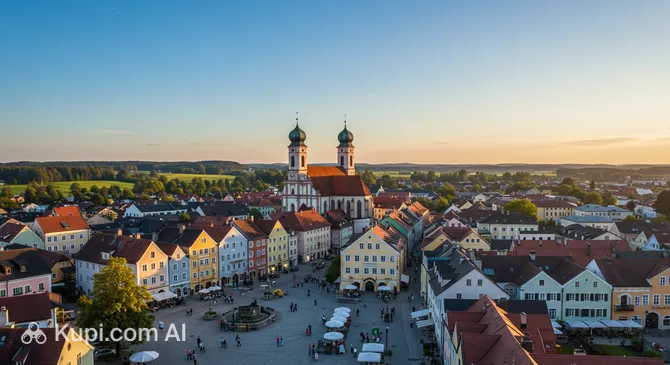
Traunstein is the epitome of a cozy Bavarian province, located in the heart of Upper Bavaria, near the picturesque Alps. This town in Germany harmoniously combines the charm of ancient architecture, a rich cultural heritage, and an atmosphere of true Alpine hospitality. Occupying an area of about 48 square kilometers, it is an important cultural and economic center of the region with a population of just over 20,000 people.
Traunstein. Illustration.
Source: Kupi.com AI
The town gained fame as far back as the 13th century as a key point on the famous Salt Road, and its city status was officially established in the 14th century. The rich history of Traunstein can still be read today in the appearance of its central squares and old streets, which once served as checkpoints for traders of "white gold." From an altitude of 591 meters above sea level, breathtaking views of mountain peaks open up, making the town an ideal place for those seeking peace surrounded by nature.
Today, Traunstein attracts travelers with its scenic views, traditional breweries, and beautifully preserved historic center. It is a place where you can take a leisurely stroll along cobbled streets, enjoying the silence and authentic Bavarian flavor. If you are looking for the real Germany, free from the bustle of metropolises, we invite you to discover the hospitality of this wonderful Alpine corner.
Weather Overview
The climate in Traunstein is of a temperate continental character with a distinct Alpine influence. This means that travelers should be prepared for changeable weather: sunny hours here are often replaced by refreshing rains, especially in the summer. The warmest months are July and August, with an average maximum of about +23°C... +24°C, creating excellent conditions for walking and outdoor activities.
Winters in the town are mild but snowy, which gives the historic streets a special fairytale look. In January and December, temperatures hover around zero, often dropping to light frosts at night (averaging -3°C). Expect a warm summer with occasional thunderstorms and cold, moderately humid winters. Spring and autumn in the region are quite long, with frequent fogs in the valleys and crystal-clear skies in the mountains.
When planning a trip, it is important to consider that precipitation is distributed fairly evenly throughout the year, with peak humidity occurring in May and June. Regardless of the season, it is recommended to have light waterproof clothing with you, as the proximity of the mountains can bring a sudden chill even in the middle of a sunny day.
Average monthly temperature
Average monthly precipitation
Interesting Facts
For centuries, Traunstein served as a vital checkpoint on the famous Salt Road, through which the main trade flows of "white gold" passed into Europe.
The town is home to a unique private observatory, which makes it an attractive destination for lovers of astronomy and the starry sky.
One of the most unusual local sights is an ancient well covered with glass, inside which, against all odds, lush green grass continues to grow.
Although Traunstein seems like a quiet town, it officially received city status as early as the beginning of the 14th century, and by 1493 it was already considered one of the most significant settlements in Bavaria.
The town is famous for its special "Bavarian spirit"—traditions of handcrafts are still preserved here, and local breweries follow recipes that are over several hundred years old.
How to Get There
Traunstein boasts excellent transport accessibility, making it a convenient base for traveling around the foothills of the Alps. The town is located in close proximity to major transport arteries connecting key cities in the region. To plan your route, you can use the detailed information on how to get to the city by various modes of transport.
The nearest major air hubs are Munich International Airport (MUC) and Salzburg Airport (SZG). From both airports, the town is easily reached by train or rental car. A car trip from Munich or Salzburg via the A8 autobahn takes about an hour, offering magnificent views of the Bavarian landscapes along the way.
Railway communication is one of the most comfortable ways to travel. The main station, Traunstein, is located in the very center of the town. Regular trains run from Munich (travel time about 1.5 hours) and Salzburg (only about 1 hour). Regional expresses provide reliable connections to neighboring resorts and Lake Chiemsee.
One of the most recognizable landmarks is the Traunstein City Square (Stadtplatz). This is the heart of the old town, surrounded by elegant historic buildings. Life is always bustling here: cozy cafes are open, and the architectural ensemble allows you to feel the spirit of old Bavaria. In the center of the square is the Lindlbrunnen—the famous decorative fountain that has become one of the symbols of the town.
An important architectural landmark is the St. Oswald's City Church (Stadtkirche Sankt Oswald). This majestic building impresses with its interior decoration and rich history. The church is closely linked to the cultural life of the town and is a place of pilgrimage for lovers of sacred art and tranquility.
Nature lovers should definitely visit Salinenpark. This park is a tribute to the town's salt-producing past. Cultural objects and installations dedicated to salt mining are located here, and well-kept alleys create ideal conditions for a peaceful break. Completing the historical picture are the Salinenkapelle and the impressive Viadukt Eisenbahnbrücke railway viaduct, which rises spectacularly over the landscape, serving as a reminder of the engineering skills of past centuries.
Local Cuisine
The town's gastronomic scene is steeped in the traditions of Upper Bavaria, where hearty dishes and quality beer take center stage. In local establishments, such as the historic hall of the Hofbräuhaus Traunstein, you should definitely try the classic schnitzel, homemade Bavarian sausages with mustard, and braised sauerkraut. The town's main drink remains the local beer, which has been brewed here for centuries, following strict purity laws.
Despite its loyalty to tradition, Traunstein also offers interesting international flavors. If you want a change of scenery, stop by Zhang Ramen, which serves excellent Asian noodles, or visit the Odysseas restaurant, offering Mediterranean specialties in a cozy atmosphere. Italian pasterias and Indian restaurants are also popular, making the town's gastro scene quite diverse.
Dining culture in Traunstein is centered around market squares and cozy beer gardens. Locals value leisurely lunches, and on weekends, street food stalls can often be found in the squares—from fresh pretzels to farm cheeses. The atmosphere of warmth and hospitality makes every meal in this town feel like a small celebration.
Travel Tips
Traunstein always welcomes travelers with its Alpine tranquility. To make your trip as comfortable and fulfilling as possible, use these practical tips.
Clothing and Gear: Even in summer, bring a windbreaker and comfortable shoes for walking. The proximity to the mountains makes the weather changeable. For visiting churches, follow a modest dress code.
Transport: The best way to get around the center is on foot. For regional travel, use the Bayern-Ticket; it is significantly cheaper than regular train tickets.
Finance: The official currency is the Euro. While cards are accepted almost everywhere, small shops and beer gardens (biergartens) may ask for cash. It is customary to leave a tip of 5-10% of the bill.
Communication: Wi-Fi is available in most cafes and hotels. If you need a local SIM card, you can buy one at supermarkets or mobile shops by presenting your passport.
Language and Communication: The main language is German (with a Bavarian dialect), but hotel staff and young people speak English well. Learn "Grüß Gott!" (the greeting in Bavaria)—it will immediately win over the locals.
Safety: Traunstein is very safe. Pharmacies operate on a standard schedule, and there is always one on duty (Notdienst) on weekends, information about which can be found on the door of any pharmacy.
What to Avoid: Do not plan shopping for Sunday—almost all shops will be closed. Also, do not make noise in residential areas after 22:00, as Bavarians value their peace and quiet.
Specific Tip: Visit the town during the Christmas Markets or local festivals, but book accommodation well in advance—the town is transformed on these dates, but hotel rooms are almost non-existent.
Traunstein is a place where time flows a little slower. Enjoy every moment in this cozy corner of Bavaria!
Entertainment & Nightlife
Entertainment in Traunstein is inextricably linked to its brewing traditions. Evening life here is calm and measured, focused on cozy gatherings with friends. The main points of attraction are historic breweries and pubs, such as the Hofbräuhaus Traunstein Bräustüberl or the famous Wochinger Brauhaus, where you can not only taste freshly brewed beer but also listen to live music in a traditional Bavarian setting.
For those who prefer a more modern style of relaxation, Parkcafé Traunstein is an excellent option. This establishment is famous for its relaxed atmosphere and is a popular meeting place for both locals and tourists. In the evening, the town's streets and squares are beautifully illuminated, creating a romantic setting for walks, and in the warmer months, life moves to the open-air beer gardens (biergartens).
Safety in the town is high, so night walks through the center cause no concern. Prices in bars and pubs remain quite affordable, and the main crowd consists of locals and travelers who appreciate authenticity. Despite the lack of large nightclubs, the town offers quality evening leisure in a classic Bavarian style.
Parks & Museums
The main place for outdoor relaxation and discovering history under the open sky is Salinenpark. This park is unique because it houses exhibitions dedicated to the salt industry, which was once the basis of the region's prosperity. Here you can combine a walk through shady alleys with the study of interesting historical mechanisms and cultural installations, making it an excellent place for family vacations and picnics.
Another important cultural space is Maxplatz and its adjacent green areas. From here, magnificent panoramic views of the mountains open up, and the square itself often becomes a venue for city festivals. Fans of science and the starry sky will be interested in the private observatory, where astronomical observations are held (by prior arrangement), which is a rare and notable feature for a small town.
Spiritual and cultural heritage is concentrated within the walls of ancient temples, such as St. Oswald's Church. Although there are few traditional museums in the classic sense in the town, the historic center itself, including attractions such as Traunstein City Square, can be considered an open-air museum. Here, every building facade and every ancient fountain tells its own chapter from the town's centuries-old history.
Getting Around
Traunstein is a compact city that is best explored on foot. Its historical part is designed so that most attractions can be reached in a matter of minutes. However, an effective suburban bus system operates for trips to remote areas and neighboring communes. Bus schedules are clearly synchronized, and tickets can be purchased from the driver or at special machines.
Railway transport plays a key role in the life of the town. Traunstein station is an important hub from which regional trains depart towards Munich, Salzburg, and the picturesque lakes of the region. For tourists, the Bayern-Ticket (Bavarian Ticket) is particularly advantageous, as it allows a group to save significantly on travel for a day on all regional trains and city transport.
Bicycles are popular as an alternative to public transport. The town and its surroundings are permeated by a network of well-maintained bike paths that lead to the most scenic corners of the Alpine foothills. For those who prefer a car, several convenient parking zones are provided in the town, although in the very center, traffic may be restricted in favor of pedestrians. Taxis are available by call or at the station stand.
Accommodation
The choice of accommodation in Traunstein allows you to find a suitable option for almost any budget. The most popular hotels are concentrated in the historic center, near Traunstein City Square. Staying here puts you within walking distance of the main attractions and the town's best restaurants. You can choose from traditional Bavarian guest houses with wooden furniture and home comfort, as well as modern comfortable hotels.
For those looking for a more secluded holiday, there are many apartments and private villas with panoramic mountain views in the vicinity of the town and its suburbs. The areas around the main square are considered the most prestigious and convenient in terms of transport logistics, especially if you plan to use the railway for trips to neighboring cities.
Accommodation prices in the town remain moderate compared to Munich or Salzburg, but it is worth remembering the seasonality. During major festivals or Christmas markets, accommodation should be booked several months in advance. For searching and booking, it is best to use trusted international platforms that offer a wide range of options from budget hostels to luxury rooms.
Nearby Cities
Traunstein serves as an ideal starting point for exploring the picturesque surroundings of Upper Bavaria and neighboring Austria. Thanks to its convenient location, you can easily plan several exciting day trips from here to complement your journey with new impressions.
Just 12 kilometers away is the town of Traunreut, which is perfect for a peaceful walk and getting to know the modern life of the region. It is also worth paying attention to the cozy Teisendorf and the ancient Trostberg, which have preserved their unique provincial charm. Water lovers will definitely enjoy a trip to Prien am Chiemsee, located on the shores of the famous "Bavarian Sea"—Lake Chiemsee, where you can visit a majestic royal palace.
In addition, you can reach the Austrian city of Salzburg, Mozart's birthplace, in just an hour, or slightly longer to the Bavarian capital, Munich. Proximity to such major cultural centers makes a holiday in Traunstein even more rewarding and varied. Don't miss the opportunity to explore this amazing Alpine region!
Shopping & Souvenirs
Shopping in Traunstein is primarily a stroll through the cozy shops and specialized stores of the historic center. The main shopping opportunities are concentrated on Traunstein City Square and its adjacent streets. There are no huge, noisy malls here, but you can find unique goods that you won't encounter in large chains.
The most common souvenirs brought from the town are items related to its salt-producing past, as well as traditional Bavarian crafts: from handmade wooden products to leather accessories. Special attention should be paid to local gourmet shops where you can buy signature beer from the Wochinger Brauhaus or sets of traditional spices and sweets.
Shops usually operate from 9:00 to 18:00 or 19:00 on weekdays, and close earlier on Saturdays. Sunday is a day off. International bank cards are accepted almost everywhere, but in small private shops or at farmers' markets, it is worth having some cash in euros. Tourists from non-EU countries can use the Tax Free system at major retail outlets marked with the appropriate logo.