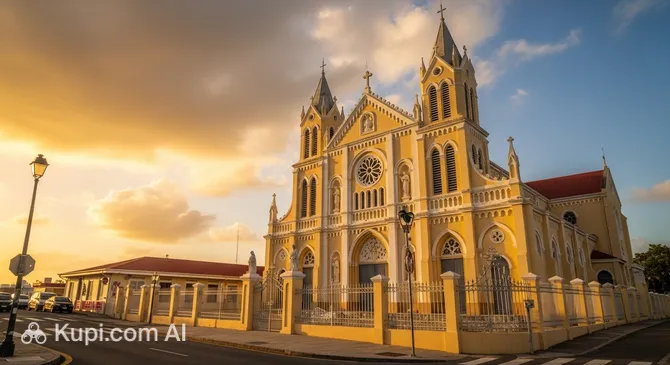
In the heart of Pointe-à-Pitre stands the majestic Catholic Church of Saints Peter and Paul—the largest religious building in Guadeloupe. Locals often refer to it as the "cathedral," although it does not officially hold that status. Capable of accommodating up to 3,000 people, this temple is a true symbol of the resilience and engineering ingenuity of the Caribbean region.
Saint Peter and Saint Paul Catholic Church, Pointe-à-Pitre. Illustration.
Source: Kupi.com AI
Traveler photos:
The church's main feature is hidden inside: its load-bearing structure is made entirely of cast iron and steel. This unusual solution was adopted in the 19th century to protect the building from frequent earthquakes and hurricanes. On the outside, the temple charms with a classical Italian Renaissance style facade featuring ornate columns and elegant arches, creating a striking contrast between its traditional appearance and industrial interior.
In 2021, the church was recognized as a particularly significant architectural monument, emphasizing its role in the island's cultural code. This is a place where colonial-era history meets "Iron Age" innovation, creating a unique atmosphere that should not be missed when visiting Guadeloupe.
Contacts
To find out more about the mass schedule or special events, you can use the following contact details:
When visiting the temple, your first look should be directed at the ceiling and columns. Inside, you will discover an impressive industrial interior with cast-iron columns and open roof trusses, reminiscent of Gustave Eiffel's workshop. Be sure to approach the high altar: this masterpiece made of white Carrara marble with Corinthian columns is an officially recognized historical monument.
The exterior of the church is equally interesting to explore. Take a look at the neoclassical facade, decorated with statues of the temple's patrons—Peter and Paul—as well as images of the four evangelists. On the north side of the building stands a slender 35-meter-high metal bell tower, which is a work of wrought-iron art in its own right.
If you're lucky, you might hear the sound of the local organ, installed in the 1980s, or attend a solemn mass when the temple is filled with singing and the special light passing through the tall windows. It is an ideal place for those seeking peace in the center of a busy city and wishing to take aesthetic shots of "iron" architecture.
Getting There
Finding this architectural masterpiece is easy, as it is located in the very heart of Pointe-à-Pitre on Place Gourbeyre. If you have arrived in Guadeloupe on a cruise ship, the walk from the port to the church will take only about 10 minutes. The popular Saint-Antoine Market and the Schoelcher Memorial are also within walking distance.
For those traveling from Pointe-à-Pitre International Airport (PTP), it is most convenient to take a taxi (a 15–20 minute trip) or the A1 bus line. Within the city, the Karu'Lis bus network (lines A and B) also operates, with stops near the main shopping streets.
If you are traveling by rental car, keep in mind that parking in the historical center is limited. It is recommended to leave your car in one of the designated parking lots on the outskirts of the central area and continue on foot, soaking in the colonial atmosphere of the streets.
Nearest city: Pointe-à-Pitre
History & Facts
The history of the temple began in the early 19th century, when the first stone of a new building was laid in 1807 on the site of a church destroyed during revolutionary upheavals. However, construction was repeatedly interrupted, partly due to the British occupation, and was only fully completed by 1817. But this building was not destined to stand long: the devastating earthquake of 1843 turned most of the structure into ruins.
The church acquired its modern appearance during a large-scale reconstruction in the second half of the 19th century. To protect the sanctuary from future natural disasters, architect Charles Trouillé proposed an innovative solution for the time—using an iron frame. The metal structures were manufactured in France by the famous Joly firm from Argenteuil, which also created structures for Paris markets. This "industrial armor" has allowed the building to successfully withstand numerous hurricanes and tremors.
In 1877, the ensemble was completed by a majestic 35-meter bell tower and a magnificent marble altar. Today, this building is recognized as an emblematic monument that carefully preserves the cultural heritage of Guadeloupe and stands as a living testament to the engineering progress of its era.
Time Needed
To leisurely explore the interiors and appreciate the church's exterior decor, **45–60 minutes** is sufficient for most tourists. This time is enough to study the unique metal structures, examine the altar details, and take memorable photos of the facade.
If you plan to attend a mass or want to catch an organ concert, you should set aside about 1.5 hours for your visit. On weekdays, a peaceful silence usually reigns in the temple, making it ideal for a longer stay and reflection away from the city bustle.
Working Hours
The temple is active, so it is open to the public daily. Usually, the doors are open to parishioners and tourists from 8:00 AM to 6:00 PM; however, please note that sightseeing may be limited during mass.
As official schedules may change due to church holidays or restoration work, visitors are advised to check current opening hours locally or through the city's official tourism portals.
Nearby
Its location in the historical center makes visiting the church an excellent starting point for getting to know the culture of Pointe-à-Pitre. Exploring the surrounding streets in Guadeloupe will allow you to see the contrast between the old architecture and the modern life of the island.