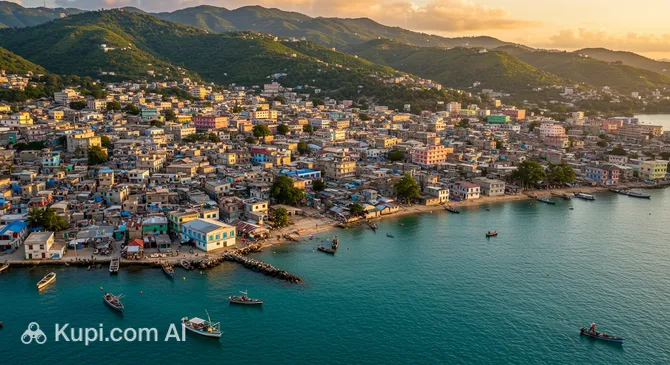
Carrefour is a dynamic and densely populated city in Haiti, located in the southwestern part of the capital's metropolitan area. As the country's second most populous center, it serves as an important residential and transit hub for the Ouest department. The city attracts those who want to see the authentic, unvarnished life of the Caribbean region, feel the rhythm of everyday life, and immerse themselves in the atmosphere of a real Haitian suburb.
Carrefour. Illustration.
Source: Kupi.com AI
Geographically, Carrefour stretches across a lowland plain near the coast, with a population exceeding 511,000 people. Despite the absence of classic tourist traps, the city is interesting for its chaotic charm: narrow streets filled with colorful "tap-tap" minibuses, bustling markets, and dense residential buildings create a unique urban landscape. The history of this place reflects the stages of rapid urbanization that transformed it from a quiet outskirt into a key residential district of the capital.
Visiting this city is an opportunity to get to know the local culture through interaction with residents and visits to central squares, which serve as the main meeting points. We recommend Carrefour to travelers who value authenticity and want to understand how life works in one of the most densely populated corners of the Caribbean.
Weather Overview
Carrefour is dominated by a tropical climate characterized by consistently high temperatures and significant humidity. Year-round, the thermometer fluctuates between 25°C and 32°C. The hottest months are July and August, when average highs reach 30°C. More detailed information can be found on the page about the weather in Carrefour.
Precipitation is unevenly distributed: the city has a rainy season that lasts from May to November. During this time, heavy downpours are possible, often followed by bright sunshine. The period from December to March is considered dry and the most comfortable for visiting, as air humidity decreases and rain becomes rare. Expect warmth year-round, but be sure to bring light clothing and be prepared for tropical thunderstorms in the summer-autumn period.
Average monthly temperature
Average monthly precipitation
Interesting Facts
Carrefour is a city of contrasts and amazing energy, holding many interesting facts for the curious traveler.
The city firmly holds second place in population in Haiti, second only to the capital, making it one of the country's largest urban centers.
Despite its reputation as a residential district, Carrefour ranks a respectable fourth place in the country for the number of available higher education institutions, serving as an important educational hub for youth.
The city's name translates from French as "crossroads," which perfectly reflects its role as a key transport hub connecting the capital with the southern regions of the country.
In recent decades, the city's population has grown several times over: from modest estimates of 129,000 people in past censuses to half a million residents today.
How to Get There
Transport accessibility to Carrefour is closely linked to its proximity to the nation's capital. The main flow of travelers arrives here via national roads heading southwest from the center of Port-au-Prince. The journey is only about 10–15 kilometers, but due to heavy traffic and narrow streets, travel time can vary from 20 minutes to 2 hours. More detailed information on logistics can be found on the page about ways to get to this region.
For international travelers, the nearest and most convenient hub is Toussaint Louverture International Airport (IATA: PAP), located approximately 20 kilometers from the city. From the airport, it is best to reach the destination by taxi or a pre-booked transfer, which will ensure comfort and safety in intense urban traffic conditions.
Railway service in the region is currently not developed, so the main burden falls on road transport. If you are planning a trip from other parts of Haiti, you can use intercity buses or the famous "tap-taps" that depart from the capital's central terminals. This is a budget-friendly, albeit less comfortable, way to travel that allows you to fully immerse yourself in the local atmosphere.
Main Attractions
In Carrefour, there are no classic architectural monuments of world significance; however, the main "attraction" here is the urban environment itself. The main centers of attraction for visitors are the lively central squares and spontaneous markets, where the life of the local population pulses. These areas lack tourist polish, but it is here that you can see the real life of Haiti's residents, watch the trade, and try street food.
Special attention should be paid to the public transport system — the famous tap-taps. These brightly painted trucks and buses are themselves a cultural phenomenon and an important visual element of the city. For photographers and fans of urban ethnogenesis, a walk along the main transport arteries will be a real adventure, opening up endless subjects for creativity.
As the city is focused on functionality, transit points on the way from the capital to the south of the country are also of interest. Here you can make a stop to feel the contrast between the modern rhythms of the metropolis and the traditional way of suburban life. Carrefour invites you not just to look at objects, but to live moments together with its energetic residents.
Local Cuisine
A gastronomic journey to Carrefour is an introduction to the bright and spicy flavors of Haiti. The basis of the local menu consists of hearty dishes, led by Griot — succulent pieces of pork marinated in citrus juice with herbs and fried until golden brown. It is traditionally served with rice and black mushrooms (diri ak djon djon), creating a unique palette of flavors.
Street food lovers should definitely try Pâté kode — fried pastries with various fillings sold on every corner. Fried plantains and thick soups are equally popular. To wash down all this Haitian variety, it is best to choose freshly squeezed mango and papaya juices or strong local coffee, famous for its deep aroma.
The food culture here is centered around markets and small local eateries. There are few specialized tourist restaurants in the city, so be prepared to dine where the residents themselves eat. For "adult" drinks, pay attention to the local rum Clairin, which has a specific character and high strength. The gastronomy of Carrefour is honest and simple food reflecting the soul of the island.
Travel Tips
Welcome to Carrefour! This energetic city will give you unforgettable impressions if you follow a few simple tips from experienced travelers.
Clothing and belongings: Choose light clothing made from natural fabrics, as it is hot and humid in Carrefour year-round. Don't forget comfortable closed-toed shoes for city walks and sun protection accessories. If you plan to visit churches, bring items that cover your shoulders and knees.
Transport: For getting around the city, it is best to use reliable taxi services. The famous "tap-taps" are interesting, but they can be very cramped and noisy. Avoid traveling on your own during rush hours.
Finances: The main currency is the Haitian gourde. Cards are accepted extremely rarely, only in large hotels or banks, so always have a supply of cash with you. Tipping in local cafes is welcome but remains at your discretion.
Health and safety: Always drink only bottled water and use insect repellent. Try not to visit remote residential areas alone or at night. Stay vigilant in crowded places, such as markets.
Communication: The main languages are Haitian Creole and French. English is not understood everywhere, so learn a couple of basic phrases in Creole — it really wins over the locals.
Local etiquette: Haitians are polite people. A greeting like "Bonjour" or "Bonsoir" is mandatory when entering a shop or starting a conversation. Be friendly but maintain a reasonable distance.
What to avoid: Do not take photos of people without their explicit consent — this can cause a negative reaction. Also, refrain from discussing political topics or criticizing local living conditions in conversations with strangers.
Connectivity: Buy a local SIM card at an official operator's office (e.g., Digicel) right upon arrival — Wi-Fi is not available everywhere in the city.
May your introduction to Carrefour be filled with only positive emotions and interesting discoveries!
Entertainment & Nightlife
Nightlife in Carrefour is predominantly local in character and does not feature an abundance of large clubs or fancy bars. The main evening entertainment for residents is concentrated in small neighborhood cafes and eateries where people gather to socialize after the workday. If you are looking for large-scale parties and modern discos, locals most often recommend heading to neighboring Port-au-Prince, which takes 30 to 60 minutes to reach.
Daytime entertainment in the city is linked to visiting street markets and participating in local festivals. There are no major cinemas or theaters in Carrefour, so cultural life revolves around religious gatherings and spontaneous musical performances on the streets. The atmosphere here is simple and soulful, and the absence of strict dress codes makes relaxation as informal as possible.
For tourists, the safest option for evening relaxation is visiting establishments at hotels or guest houses accompanied by local guides. Prices for drinks and food in local bars remain affordable, allowing you to get acquainted with local leisure traditions without significant expense. The main thing is to remember safety rules and plan your return to the hotel in advance using reliable taxi services.
Parks & Museums
When it comes to classic parks and museums, Carrefour remains a place where nature and culture are woven into the very fabric of residential development, rather than separated into distinct institutions. There are no specialized museums within the city; however, history buffs can find interesting stories by studying old buildings and talking with local elders. For classic museum exhibits and galleries, residents and visitors usually head to Port-au-Prince.
Green zones in Carrefour are represented by small squares and central plazas that serve as places for rest and socializing. Due to dense urban development, there aren't many spacious parks here, but the proximity to the coast provides opportunities to enjoy seascapes. Locals often choose natural areas on the outskirts or go to the coastline to trade the noise of the metropolis for the tranquility of the ocean breeze.
For a full cultural experience, we recommend combining a visit to the city with visits to the capital's parks and national museums, which are within transport reach. Carrefour itself is interesting for its "living open-air museum" — its markets and streets tell the history and culture of Haiti no less eloquently than exhibits behind glass cases.
Getting Around
The public transport system in Carrefour is colorful and chaotic at the same time. The main way to get around for most is tap-taps, brightly decorated pickups or minibuses that work as shared taxis. They run along main routes and are the cheapest means of transport. Moto-taxis are also extremely popular, allowing you to quickly overcome traffic jams and reach narrow residential quarters where a car cannot pass.
Payment in transport is made in cash to the driver or conductor. There are no unified passes or electronic ticket systems in the city, and the fare is fixed for certain routes. Travelers are recommended to have small bills in local currency with them. It is important to consider that during rush hours (from 7 to 9 AM and from 5 to 7 PM), transport can be overcrowded, and travel time can increase several times due to serious congestion.
Pedestrian accessibility in Carrefour is limited due to the lack of sidewalks on many sections of the roads and high traffic density. For safety and to save time, it is better for travelers to use official taxi services or rent a car with a local driver. This will ensure predictability for trips and allow you to explore this dynamic suburb of the capital in comfort.
Accommodation
The hotel sector in Carrefour is modestly developed, as the city is primarily focused on permanent residents rather than mass tourism. Most available accommodation options are small guesthouses and apartments, which are most often rented by expats or employees of international organizations for long periods. Living conditions here are usually basic, but this is offset by affordable prices and the opportunity to live among the local population.
For those looking for a higher level of comfort, chain hotels, and developed infrastructure, it is recommended to consider accommodation options in neighboring Port-au-Prince or the upscale district of Pétion-Ville. There, the choice of housing is significantly wider, ranging from boutique hotels to luxury complexes. By staying in the capital, you can visit Carrefour on day trips, avoiding the difficulties of finding quality overnight accommodation.
If you still decide to stay directly in the city, book your accommodation in advance through international platforms or by recommendation. Pay attention to the availability of security and proximity to main transport arteries. Despite the limited choice, you can find cozy corners here that will allow you to feel the hospitality of a Haitian home.
Nearby Cities
Carrefour occupies a strategically advantageous position, making it an excellent starting point for exploring the central part of Haiti. Proximity to major cities allows for easy planning of day trips, discovering different facets of island life — from business hustle to cultural centers.
Just 13 kilometers away is Port-au-Prince, the country's capital, where the main museums, galleries, and historical monuments are concentrated. If you are looking for a calmer and more refined atmosphere, it is worth heading to Pétion-Ville, known for its restaurants, art galleries, and green hills. Also of interest is the neighboring suburb of Delmas, which together with Carrefour forms a single economic rhythm for the capital region.
We recommend not limiting yourself to city walks but exploring the surrounding areas to fully appreciate the scale and diversity of the Ouest department. Short trips to neighboring communes will help you better understand the development logic of this dynamic region.
Shopping & Souvenirs
Shopping in Carrefour is primarily an immersion into the atmosphere of traditional street markets. Here you won't find huge shopping malls with international brands, but you will be able to purchase authentic Haitian goods. The main shopping areas are concentrated along the main roads and in the center, where large-scale trade of everything necessary unfolds daily: from fresh tropical fruits to clothing and household items.
As souvenirs from the city, it is worth bringing back works by local artisans. Pay attention to naive art paintings — bright canvases for which the entire island is famous. Handcrafted metal and wood souvenirs are also popular. It's best to look for these things in markets, where you can and should haggle with sellers, turning the buying process into a small performance.
Shops in the city usually operate from early morning until sunset, adjusting to daylight hours. Most outlets accept cash (Haitian gourdes), so it's worth taking care of change in advance. Remember that Carrefour's markets can be very crowded, especially during morning rush hours, so plan your purchases in advance to enjoy the process.