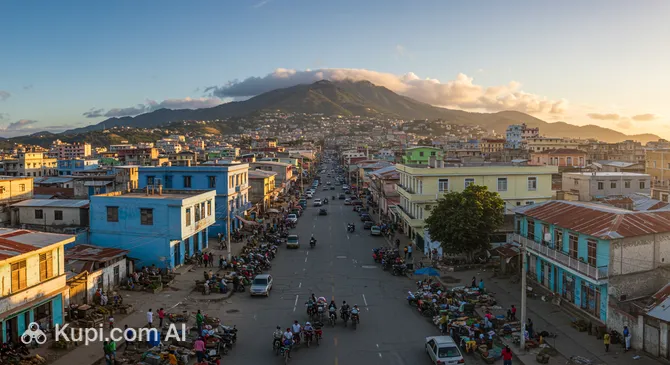
Delmas is a dynamic and densely populated city located in the heart of Haiti's capital region. As the country's third-largest city, it serves as a continuous urban extension of Port-au-Prince. You won't find provincial quiet here; Delmas lives to the rhythm of a major industrial and commercial hub, where residential neighborhoods are closely interwoven with shopping zones and enterprises.
Geographically, the city occupies a flat territory in the Ouest department. The population is impressive: according to recent data, more than 421,000 people live in the commune. This is a place where you can experience the authentic, unvarnished life of a Haitian metropolis, seeing its daily hustle and bustle and hardworking rhythm.
Delmas. Illustration.
Source: Kupi.com AI
While Delmas is not a classic tourist center with an abundance of historical monuments, its rich past and development are inextricably linked to the history of the entire country. The city attracts those who want to study Haiti's modern economy, visit local markets, or use it as a convenient base for exploring the capital.
We invite you to discover Delmas—a city that doesn't try to be anything other than the living, working, and constantly growing heart of Haiti. It is an excellent entry point for understanding the modern way of life in the Caribbean.
Weather Overview
In Delmas, a typical tropical climate prevails, characteristic of Haiti's coastal zone. It is hot and humid throughout the year, so travelers should be prepared for consistently high temperatures, which usually range from 25°C to 30°C. The weather in the city is largely determined by the alternation of the dry and rainy seasons.
The rainy season usually starts in May and lasts until November, with rainfall peaks often occurring in May and August-September. During this time, showers can be intense, but they are most often short-lived. The dry period lasts from December to April, when the number of wet days is minimal and the sky is clear. Due to dense construction and heavy traffic, the city can feel muggy, so having air conditioning at your accommodation will be a significant advantage.
Average monthly temperature
Average monthly precipitation
Interesting Facts
Delmas is full of interesting details that help to better understand this industrial center of Haiti. Here are some notable facts:
Third largest: Delmas officially ranks third in population among all Haitian cities, surpassed only by the capital and Carrefour.
Commercial giant: The city is considered one of the most important hubs for business and industry, concentrating a significant portion of the capital region's commercial capacity.
Rapid growth: The city's population has grown to 421,000 in recent years, making it one of the fastest-developing suburbs in the country.
Urban unity: The borders between Delmas and Port-au-Prince are virtually erased—they form a single, dense urban fabric where one building might be in one city and the neighbor in another.
How to Get There
The transport accessibility of Delmas is due to its strategic location right next to the capital of Haiti. It is worth finding out in advance how to get to the city, as road traffic in this region can be very heavy.
The main air gateway for travelers is Toussaint Louverture International Airport (IATA: PAP). It is located just 10–15 kilometers north of Delmas. A taxi or local minibus ride from the airport usually takes 30 to 60 minutes, but travel time depends heavily on traffic, which can be very dense during peak hours.
From the center of Port-au-Prince, Delmas can be reached by traditional public transport—colorful minibuses called "tap-taps." The city is also connected by a network of national roads to other regions of the country, making it an important land transport hub. Railway service in this part of Haiti is currently not developed.
Main Attractions
Delmas is primarily a functional suburb, so there are few prominent world-class attractions here. Nevertheless, the city is interesting for its urban atmosphere and its role as the region's main commercial hub. Tourists visiting Delmas often notice its vibrant shopping areas, which reflect the daily lives of local residents.
The city's central squares and large markets serve as the main landmarks. Walking through them, you can observe how local trade is organized and feel the energy of this densely populated district. The main architectural objects here are modern commercial centers and administrative buildings, which contrast with the residential areas.
For those looking for cultural sites and historical monuments, Delmas serves as a convenient transit point on the way to Port-au-Prince. Most travelers combine their stay in the city with visits to the capital's museums and cathedrals, returning to Delmas for its convenient infrastructure and business contacts.
Local Cuisine
The gastronomy of Delmas is a vibrant palette of traditional Haitian flavors. The star of the local table is griot—succulent pieces of pork marinated in citrus juice with spices and fried until golden brown. It is traditionally served with diri ak pwa (rice and beans) and the spicy vegetable slaw pikliz.
Be sure to try fried plantains and thick soups based on cassava or pumpkin, which are prepared here with special skill. The city's culinary scene is mainly represented by affordable cafes and street food stalls, where you can try authentic dishes eaten by Haitians themselves.
Among drinks, the famous Haitian coffee remains a favorite, possessing a rich aroma and deep flavor. If you're looking for something stronger, pay attention to the local rum or clairin—a traditional strong sugarcane spirit that is an important part of the local drinking culture.
Travel Tips
A trip to Delmas requires some preparation and an understanding of local specifics. These practical tips will help make your stay in the city more comfortable and safe.
Clothing and gear: Choose light clothing made of natural fabrics, as it is almost always hot and humid in the city. Don't forget comfortable closed-toe shoes for walking on dusty streets and sunglasses. For visiting official institutions or churches, it's better to stick to a restrained style.
Transport: The best way to get around is a licensed taxi or a car with a driver hired through a hotel. Public transport (tap-taps) is colorful but can be uncomfortable due to overcrowding and heat.
Finance: The primary currency is the Haitian gourde, but US dollars are also widely accepted. It is recommended to always carry cash in small denominations, as credit cards are only accepted in major hotels and supermarkets.
Health and safety: Drink only bottled water and avoid ice in drinks from street cafes. In Delmas, you should follow basic safety rules: do not display expensive electronics and avoid walking in unfamiliar residential areas after dark.
Communication: The main languages are Haitian Creole and French. English is not understood everywhere, so knowing a few basic phrases in French will be a huge plus.
Local etiquette: Haitians are polite and sociable people. A greeting of "Bonjour" (during the day) or "Bonsoir" (in the evening) is mandatory when entering any establishment or starting a conversation.
What to avoid: Do not photograph local residents, government buildings, or police officers without prior permission—this can cause a negative reaction or legal problems.
Additional tip: Plan all your important errands and trips for the first half of the day to avoid peak traffic jams, which in Delmas can paralyze traffic for several hours.
May your introduction to this lively and energetic city be rewarding and bring only positive impressions!
Entertainment & Nightlife
The entertainment scene in Delmas is predominantly local in character. You won't find huge concert halls or noisy world-famous nightclubs here, as the city is focused on work and commerce. However, evening life is centered in cozy street cafes and small bars where locals gather after a day's work.
If you are looking for a full nightlife experience with discos and themed parties, most travelers and expats prefer to head to central Port-au-Prince or neighboring Pétion-Ville, which can be quickly reached by taxi. In Delmas itself, the atmosphere is more relaxed and down-to-earth, perfect for a leisurely dinner at one of the local Creole restaurants.
Daytime entertainment in the city includes visiting sports grounds in residential neighborhoods or walking through the lively markets. This is a great way to get to know the real Haiti, away from typical tourist routes, and see how the residents of one of the capital's most populous suburbs spend their free time.
Parks & Museums
Delmas is a densely built urban area, so there are few extensive park zones or large state museums here. The urban environment is governed by functionality, and green islands are most often represented by small squares within residential blocks or the adjacent areas of commercial centers.
While there are no world-famous galleries in Delmas itself, art lovers can find small private studios where vibrant Haitian paintings and sculptures are created. Local culture here manifests not in museum halls, but directly on the streets, in the architecture of buildings, and the design of public spaces.
To visit large-scale cultural sites, such as the National Pantheon or art museums, residents and guests usually head to neighboring Port-au-Prince. Nonetheless, Delmas remains an important place for those who want to study modern urban life in Haiti and its daily dynamics.
Getting Around
The public transport system in Delmas is typical of a large Haitian metropolis. The main means of transport are "tap-taps"—brightly painted pickups or minibuses that run along specific routes. This is the most affordable and popular way to get to different parts of the city or reach the city center.
In addition to tap-taps, motorcycle taxis are very popular in Delmas. They are ideal for quickly bypassing the traffic jams that often occur on the main roads. However, it is worth remembering that this type of transport requires a certain degree of courage and caution from the passenger. Traditional taxis are also available and recommended for more comfortable and safer trips, especially in the evening.
Fares in public transport are paid in cash to the driver or conductor. There are no fixed tariffs in the form of travel cards, so it is useful for tourists to check the cost of the trip in advance and have small change with them. Keep in mind that during peak hours, transport can be very crowded, so plan your movements with extra time.
Accommodation
The housing stock in Delmas is primarily oriented toward business travelers, expats, and those coming to the city for work. Here you will find about 40 different accommodation options, dominated by practical apartments and mid-range hotels. There are virtually no luxury resort complexes in the city itself, as it functions as a commercial and industrial center.
The most convenient housing options are located near the main commercial zones and transport arteries. This allows guests to minimize travel time in heavy urban traffic. Many properties offer a basic set of services necessary for a comfortable short-term stay.
When planning a trip, it is recommended to book accommodation in advance, especially if you are looking for options in safe and well-lit areas. When choosing a hotel, pay attention to the presence of private security and backup power sources, which is an important standard for quality accommodation in this region of Haiti.
Nearby Cities
Thanks to its central position in the capital region, Delmas serves as an excellent starting point for exploring the surroundings of the Ouest department. Just a few kilometers away are key cities in the country, each with its own character.
The main destination for a trip is Port-au-Prince, located just 6 km away. Here, major government buildings, cathedrals, and historic markets are concentrated. Another interesting place is Pétion-Ville—a more prestigious and elevated suburb known for its restaurants, galleries, and hotels. If you are interested in local culture and crafts, it is worth looking into the city of Croix-des-Bouquets, famous for its metalwork artisans.
Exploring neighboring communes will allow you to see Haiti from different perspectives: from busy capital avenues to quiet craft quarters. All these cities are within a short drive or public transport ride.
Shopping & Souvenirs
Shopping in Delmas is primarily an immersion into the atmosphere of energetic street trade and lively markets. The city is the commercial heart of the capital metropolitan area, so you can find almost everything here: from daily necessities to unique items made by local artisans.
Main shopping activities are concentrated along the major transport arteries and in the market areas. There are no huge malls in the Western sense, but there are modern shopping centers and specialized stores. Tourists often come here for authentic souvenirs: Haitian coffee beans, spices, and colorful textiles.
Most shops operate from morning until early evening. Payment is most often made in cash in local currency, although cards may be accepted at larger outlets. Visiting the local markets is not just about shopping, but also about the unique experience of interacting with the people of Haiti.