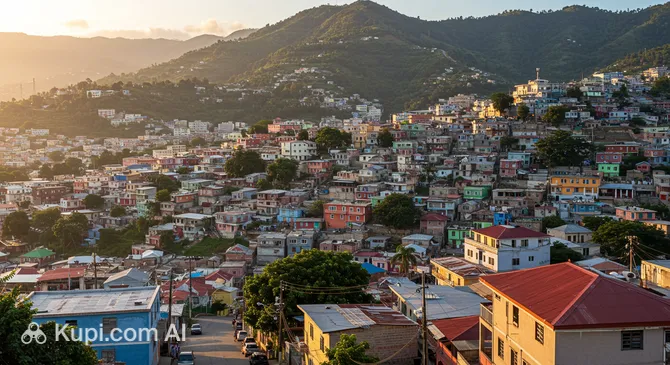
Pétion-Ville is a vibrant and contrasting suburb of the capital of Haiti, which is rightfully considered one of the most prestigious areas in the country. Founded in 1831, the city was named after Alexandre Pétion, a prominent leader in the struggle for independence. Today, it is a modern hub with a population of about 360,000 people, where fashionable boutiques and art galleries harmoniously coexist with lively local markets.
Situated at an altitude of about 1,000 meters above sea level, Pétion-Ville offers its guests a cooler and more pleasant climate than low-lying Port-au-Prince. This place attracts those seeking comfortable relaxation, quality gastronomy, and the opportunity to experience the island's modern culture. You can learn more about the historical development of the city while strolling through its central streets, where every building facade tells its own part of the story.
Petionville. Illustration.
Source: Kupi.com AI
The city is famous for its unique atmosphere: the hilly terrain opens up breathtaking panoramas of the bay, while the developed infrastructure makes it convenient for long stays. Pétion-Ville invites travelers to immerse themselves in the world of Haitian art and enjoy the hospitality of this "green oasis" above the hustle and bustle of the capital.
Weather Overview
A tropical climate prevails in Pétion-Ville, which, thanks to its altitude of about 1,000 meters above sea level, is noticeably milder and more pleasant than in neighboring coastal areas. The air temperature remains consistently warm throughout the year, usually ranging from +20°C at night to +30°C during the day. The mountain relief promotes good air circulation, making even the hottest months more comfortable for walking.
Precipitation is uneven: the wettest periods are considered to be spring (April-May) and autumn (September-October), when tropical downpours can be intense but short-lived. The driest and most favorable time to visit lasts from November to March. During this period, the climate of Pétion-Ville becomes particularly mild, humidity decreases, and the sky offers clear sunny days.
Travelers should take into account that the summer months can be muggy due to increased humidity, although the average temperature in July and August rarely exceeds +30°C. If you plan evening outings to restaurants with open terraces, it is recommended to bring light, long-sleeved clothing, as it can get cool in the mountains after sunset.
Average monthly temperature
Average monthly precipitation
Interesting Facts
Pétion-Ville is located 1,000 meters above sea level, making the air temperature here always several degrees lower than in the neighboring capital.
The city was officially founded in 1831 during the reign of President Jean-Pierre Boyer and has been considered an elite enclave of the region ever since.
Despite being perceived by many as part of the capital, administratively Pétion-Ville is the country's fourth-largest city.
This place is the gastronomic capital of Haiti: it has the highest concentration of international restaurants per square kilometer.
The city is named after Alexandre Pétion, who was the republic's second president and one of the nation's "founding fathers."
How to Get There
The most convenient way to reach Pétion-Ville is through the country's international air gateway. The main transport hub is Toussaint Louverture International Airport, located in neighboring Port-au-Prince. The journey from the airport to the central quarters of Pétion-Ville takes between 20 and 40 minutes by taxi; however, during peak hours, this time can increase significantly due to heavy traffic on the hilly roads.
For a more comfortable trip, travelers are recommended to pre-book a transfer through their hotel or use trusted taxi services. There is also the option of renting a car with a driver, which is particularly relevant given the winding and steep terrain. If you are looking for detailed information about routes, explore the section on how to get to the city.
There is currently no rail service in the region, so land transport consists exclusively of cars and buses. Colorful "tap-tap" minibuses regularly run between Pétion-Ville and other areas, though they may not always be convenient for foreign tourists due to overcrowding. For trips within the city and the surrounding areas, it is best to rely on private transport.
Main Attractions
Although Pétion-Ville is not a classic tourist center with an abundance of historical ruins, it charms visitors with its lively energy and modern style. One of the city's main "attractions" is its unique hillside location, offering stunning panoramic views of Port-au-Prince and the Caribbean Sea. A walk through the highlands during the sunset hours is a must for every visitor.
The heart of local life is found in the central squares and shopping districts, where the best art galleries are concentrated. Haitian art is world-renowned for its brightness and originality, and it is in Pétion-Ville that you can find rare works by local masters, ranging from naive painting to complex metal sculptures. These galleries serve as cultural hubs, bringing together the country's creative elite.
For those seeking local flavor, the open-air markets are a must-visit. These are the places where the city's true life pulses: here you can see mountains of tropical fruits, spices, and folk crafts. Unlike the formal shopping centers, the markets of Pétion-Ville allow you to feel the true spirit of Haiti, hear the melody of the Creole language, and observe the daily life of the city's residents.
Local Cuisine
The gastronomy of Pétion-Ville is an amazing mix of Caribbean traditions and global culinary influences. The city is considered the country's culinary heart, where you can find an exquisite French restaurant, a cozy Lebanese café, or a Japanese sushi bar all in the same block. Local haute cuisine is based on the freshest seafood, exotic fruits, and grilled meats prepared with aromatic spices.
Be sure to try the traditional Haitian dish Griot (fried pork marinated in citrus sauce) and refreshing seafood salads. Establishments like Quartier Latin or Magdoos offer visitors not only delicious food but also the chance to soak in the city's cosmopolitan atmosphere. For a light snack, local bakeries such as Patisserie Marie Beliard are ideal, serving magnificent Haitian coffee and fresh pastries.
The beverage culture in Pétion-Ville centers around the famous local rum, which serves as the base for an endless variety of tropical cocktails. Don't forget non-alcoholic drinks: natural juices made from mango, papaya, and passion fruit are served in almost every café. Dinner on the open terrace of the Observatoire restaurant, overlooking the lights of the night city, will be one of the most memorable impressions of your trip.
Travel Tips
Pétion-Ville is the most welcoming and comfortable place in Haiti for international guests. To ensure your trip goes as smoothly as possible, take advantage of our practical recommendations.
Clothing and Accessories: Due to the high altitude, evenings in the city can be cool, so bring a light jacket or sweater. During the day, clothes made of natural fabrics and comfortable shoes for walking on hilly streets will come in handy.
Transport: The best choice for getting around is a taxi or renting a car with a driver. Avoid walking alone at night into remote areas further down the slope.
Finances: The official currency is the gourde (HTG), but US dollars are accepted in many hotels and large restaurants. Always carry cash with you, as cards only work in prestigious establishments.
Safety: Pétion-Ville is considered a safe neighborhood, but standard precautions are necessary. Do not display expensive jewelry or electronics in crowded markets.
Language and Connectivity: The main languages are Haitian Creole and French. English is understood in hotels. A SIM card from the local operator Digicel can be purchased in the city center for 4G access.
Etiquette: Locals are very polite. Greet people with "Bonjour" (daytime) or "Bonsoir" (evening). Tips in restaurants are welcomed and usually amount to 10-15%.
What to Avoid: Do not take photos of people without their explicit consent, especially in markets. It is also not recommended to drink tap water—use only bottled water.
Health: Be sure to use sunscreen and insect repellent, even if you are staying in an air-conditioned hotel.
By following these simple rules, you will be able to fully enjoy the atmosphere of this amazing city and feel the true spirit of the Caribbean.
Entertainment & Nightlife
The nightlife in Pétion-Ville is considered the most vibrant and diverse on the entire island. Most activity is concentrated around restaurants with open terraces and bars that transform into centers of fun after sunset. Establishments here cater to a discerning crowd, offering a high level of service, live music, and signature cocktails made with the famous local rum.
Places like Quartier Latin, where you can enjoy Latin American and Caribbean rhythms under the open sky, or FUBAR, known for its parties and energetic atmosphere, are particularly popular. Local bands often perform in these venues, playing both traditional "kompa" music and modern global hits. Nighttime Pétion-Ville is a safe and stylish alternative to the capital's center, attracting both expats and affluent locals.
Daytime entertainment in the city is more relaxed and culturally oriented. In addition to visiting galleries, tourists can spend time in elite fitness centers, spas, or simply relax on the terrace of a café with a mountain view. The evening dress code in most popular venues leans towards an elegant style, emphasizing the city's status as the most fashionable district in Haiti.
Parks & Museums
Unlike cultural capitals with massive state museums, Pétion-Ville focuses on private art galleries and natural spaces. The city, sprawling across the hillsides, is a viewpoint in itself. Green zones here are primarily represented by private gardens and small local squares that create a sense of coolness amidst the dense urban development.
Art lovers should pay attention to the galleries located in the central part of the city. Here you can find both works by recognized masters of Haitian "naive" art and installations by contemporary artists addressing relevant social themes. These galleries often function as small museums where you can learn about the evolution of local culture and traditions of metal and textile processing.
While there are no large-scale amusement parks in Pétion-Ville itself, the natural landscape around the city offers excellent walking opportunities. The hills surrounding residential neighborhoods are popular with locals as a spot for morning jogs and observing the bay's panorama. This is an ideal place for those who value natural landscape beauty over strictly ordered city gardens.
Getting Around
The public transport system in Pétion-Ville has its own characteristic features dictated by the complex mountainous terrain. The main form of mass transit is the "tap-tap"—brightly painted pickups or minibuses that run on fixed routes. This is the cheapest way to get around, but it requires some skill and knowledge of local directions, as stops are often not officially marked.
For tourists, taxis are the most convenient and safest way to travel. In Pétion-Ville, both official services and private carriers operate. It is always wise to agree on the fare in advance, as meters in cars are rare. In the evening and at night, taxis are the only recommended way to travel between restaurants and hotels.
Walking in Pétion-Ville can be tiring due to the steep climbs and narrow streets, but the central shopping districts are quite suitable for exploring on foot. Renting a car is a good choice for those who feel confident on winding roads and are prepared for heavy traffic during peak hours. Bike rentals and scooters are not common here due to the terrain and traffic intensity.
Accommodation
The hotel sector in Pétion-Ville offers the highest quality accommodation options in the entire country. Mid-range and high-end hotels predominate, providing international levels of service and security. Most popular hotels are located on the hills, ensuring guests fresh mountain air and panoramic views of the city.
Among the most famous establishments, hotels such as NH Haiti El Rancho and the legendary Hotel Montana stand out. These properties cater to business travelers and tourists, offering comfortable rooms, swimming pools, and conference halls. Apartment rentals in gated residential complexes are also available in the city, which is convenient for those planning a long-term stay.
Accommodation prices in Pétion-Ville are higher than the national average, reflecting the prestige of the area and the level of services provided. It is recommended to book accommodation in advance, especially if your trip coincides with major cultural festivals or business forums. Most hotels support booking via international online platforms.
Nearby Cities
Pétion-Ville serves as an ideal base for exploring the central region of Haiti due to its proximity to key settlements. Although the city is surrounded by mountains, a developed road network allows for quick access to the republic's main economic and cultural centers.
Just a few kilometers away is Port-au-Prince, the country's capital, where major museums, government buildings, and historical monuments are concentrated. Also of interest are the neighboring cities of Delmas and Tabarre, which have effectively merged with Pétion-Ville into a single urban area, offering additional shopping and business opportunities. A bit further away is Croix-des-Bouquets, famous for its metalwork craft workshops.
Exploring the surroundings of Pétion-Ville provides an opportunity to see the country's life from different perspectives: from the bustling avenues of the capital to the quiet villages of artisans. We recommend planning trips to nearby cities in the first half of the day to avoid evening traffic jams and fully enjoy the region's character.
Shopping & Souvenirs
Shopping in Pétion-Ville is, above all, a search for unique art pieces and quality local products. The city is considered the best place on the island for purchasing paintings, wooden sculptures, and metal panels for which Haiti is so famous. The central streets are lined with boutiques where you can find not only souvenirs but also clothing from local designers that blends Caribbean motifs with modern trends.
For a more familiar shopping format, head to the small shopping centers and specialty stores. Here you will find an excellent selection of famous Haitian coffee, which makes a wonderful gift. Pétion-Ville is also known for its jewelry shops and cosmetic boutiques offering products based on natural tropical oils and ingredients.
The city's traditional markets offer a completely different experience: a lively atmosphere of bargaining prevails here, and the stalls are overflowing with fresh fruits and spices. Most shops are open from 9:00 AM to 6:00 PM, and major retail outlets accept bank cards, though it is essential to have cash gourdes for visiting the markets. Pétion-Ville provides shopping opportunities for every taste—from high fashion to authentic crafts.