Support

Ashoka Pillar

About

The Ashoka Pillar in Nashik, India, is an outstanding historical monument consisting of an ancient monumental stone column. It is part of the legacy of the great Emperor Ashoka, who ruled the mighty Mauryan Empire in the 3rd century BCE. Such columns were erected throughout his vast empire, serving not only as symbols of power but also as a means of spreading Buddhist teachings.
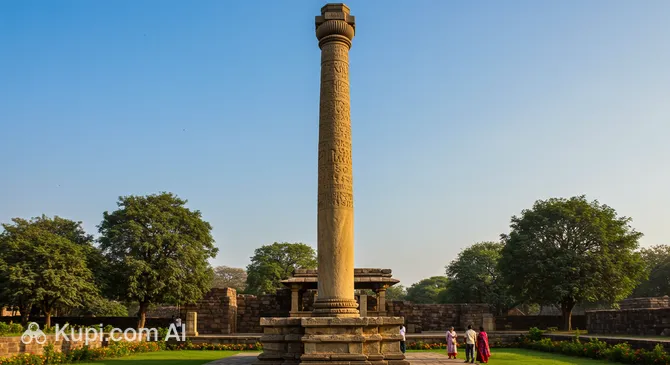
Ashoka Pillar. Illustration.
Source: Kupi.com AI

Traveler photos:

This pillar in Nashik is one of the valuable surviving examples of these historical monuments. It stands as a silent witness to an era when Buddhist ideas were actively spreading and the Mauryan Empire exerted a significant influence on the cultural and political development of the region. For lovers of history and ancient civilizations, visiting this site will be a true discovery, allowing them to touch the past.

The city of Nashik itself, located in the state of Maharashtra, has a rich history closely intertwined with the ancient Indian epic, the Ramayana, and is an important religious and cultural center of India. The Ashoka Pillar fits harmoniously into the city's historical landscape, representing a significant artifact that emphasizes the deep historical roots and cultural diversity of this ancient land.

Contacts

The Ashoka Pillar is a significant historical site and, as such, may not have a dedicated visitor contact service. To find its exact location, operating hours (if applicable), and the best ways to reach the Ashoka Pillar in Nashik, we recommend contacting local tourist information centers or checking the official tourism resources of India. Information about such landmarks can often be found on city maps and in local travel guides.

How to contactContact
AddressAshok Stambh, Old Agra Rd, Ashok Stambh, Raviwar Karanja, Panchavati, Nashik, Maharashtra 422001, India

What to Do

A visit to the Ashoka Pillar in Nashik provides a unique opportunity to touch the ancient history of India and see firsthand a material testament to the era of the great Emperor Ashoka. The primary object of study is, of course, the pillar itself. Visitors can closely examine the inscriptions carved into it. These inscriptions, often in Pali or other ancient languages, are the Edicts of Ashoka, reflecting the Buddhist principles of non-violence, tolerance, and righteous governance that the Emperor sought to spread across his vast empire.

Studying these ancient texts allows for a deeper understanding of the philosophical and ethical foundations of Ashoka's rule and his contribution to the spread of Buddhism. It is more than just viewing a historical artifact; it is a dialogue with the past, an opportunity to reflect on the ideas that shaped the culture and worldview of an entire civilization. For many tourists, this becomes a moment of quiet contemplation and reflection on eternal values.

In addition to examining the pillar itself, your trip can be enriched by exploring the rich historical and cultural heritage of Nashik. The city is known for being divided into two main zones: the northern part, where Shaivite temples predominate, and the southeastern part, famous for its Vaishnavite shrines. This makes Nashik an attractive destination for those interested in India's religious history and architecture. It is also worth taking the time to learn about local legends, many of which are linked to the great epic \"Ramayana\" and explain the origin of the city's name, adding another layer to your cultural experience.

Getting There

To reach the Ashoka Pillar in Nashik, you first need to travel to the city itself. Nashik is located approximately 200 kilometers from Mumbai, and can be reached from there in several ways: by train, bus, or taxi. The most convenient and often budget-friendly option is the railway, as Nashik has had a functional railway station since 1862.

Trains depart regularly from Mumbai to Nashik, and the journey usually takes between 3 and 4 hours. This is a popular way to travel for both locals and tourists. There is also an extensive bus network connecting Nashik with other major cities in the region. If you prefer a more comfortable and private journey, you might consider hiring a taxi to take you directly to the site.

Upon arrival in Nashik, you can reach the historical area where the Ashoka Pillar is located via local public transport. The city offers local buses, as well as more maneuverable auto-rickshaws and taxis. Your choice of transport will depend on your budget and comfort preferences.

Nearest city: Nashik

History & Facts

Ashoka Pillars are unique monuments of ancient India, erected by order of the powerful Emperor Ashoka. He ruled the Mauryan Empire in the 3rd century BCE, from 268 to 232. These majestic columns became a symbol of his reign and the profound changes that occurred in his worldview.

After the bloody Kalinga War, Emperor Ashoka, shocked by the scale of the violence, converted to Buddhism. He decided to dedicate his reign to spreading the principles of peace, tolerance, and righteousness. Pillars like the one in Nashik served not only as religious monuments but also as the \"notice boards\" of antiquity. The Emperor's edicts and decrees were carved onto their smooth surfaces, carrying his will to the most remote corners of his vast empire.

The city of Nashik, home to one of these pillars, has a rich history of its own. It is believed that a permanent settlement existed here as far back as the Stone Age. Over the centuries, the city has seen many rulers: from the Mughal Empire sultan Nizam Shah, who captured it in 1615, to the Maratha Empire in 1673, and finally British India starting in 1818. Thus, the Ashoka Pillar in Nashik stands as a witness not only to the Mauryan era but also to subsequent turbulent historical events.

Interestingly, not all Ashoka Pillars have remained in their original locations. Historical chronicles indicate that some were moved. For instance, one of the famous columns was brought to Delhi by order of Sultan Firoz Shah. This highlights the immense value and significance of these monuments to rulers of later eras, who sought to associate themselves with the glory and wisdom of the great Ashoka. The pillar in Nashik is thus an important link in the chain of these historical artifacts.

Time Needed

To view the Ashoka Pillar in Nashik, 1-2 hours is usually sufficient. This time allows you to carefully examine the monument, soak in its historical atmosphere, and learn about its origins and significance. You can take a leisurely walk around the pillar, study its details, and take commemorative photos.

If you plan a deeper immersion into the history and culture of Nashik and wish to visit other historical and religious landmarks in the city, you should plan for significantly more time. In that case, a full day may be required to explore the city properly. However, for a focused visit to the Ashoka Pillar itself, the aforementioned 1-2 hours will be quite enough.

Working Hours

Unfortunately, exact information regarding the opening hours of the "Ashoka Pillar" in Nashik is not always available in general sources. To plan your visit as effectively as possible, it is recommended to check for current schedules on the official website of the site, if one exists, or to inquire at local tourist information centers upon arrival in Nashik. You can also find out there if advance booking or tour registration is required.

As a rule, open-air historical monuments are accessible for visiting year-round; however, operating hours may change depending on the season, weather conditions, or special events. Therefore, it is always best to verify the details in advance to ensure your experience at the "Ashoka Pillar" is comfortable and pleasant.

Nearby

Visiting a site as significant as the Ashoka Pillar is a highlight in itself. However, to truly immerse yourself in the atmosphere of Nashik and its rich history, it is worth taking the time to explore the surroundings. Often, it is the nearby sites that help complete the picture and provide a deeper impression of your journey through India.

Exploring the attractions located near the Ashoka Pillar will allow you to discover new facets of this amazing region. Below is a list of several interesting places in Nashik that are easily accessible.

NameDistance
Sundarnarayan Temple0.5 km
Triveni Sangam0.7 km
Ramkund, Panchavati0.8 km
Shree Kapaleshwar Mahadev Temple0.9 km
Naroshankar Temple0.9 km
Kalaram Temple1.1 km
Bhaktidham1.1 km

Have you reached the end of the page?

So the route has been studied inside and out