Support

Masjid Jamik Kota Bengkulu

About

Imagine a unique architectural masterpiece where Javanese and Sumatran traditions intertwine. Jamik Mosque is one of the oldest and most significant religious sites preserved by Indonesia. This place draws the eye with its unusual three-tiered roof, where each level symbolizes important spiritual stages: faith (iman), Islam, and perfection (ihsan).
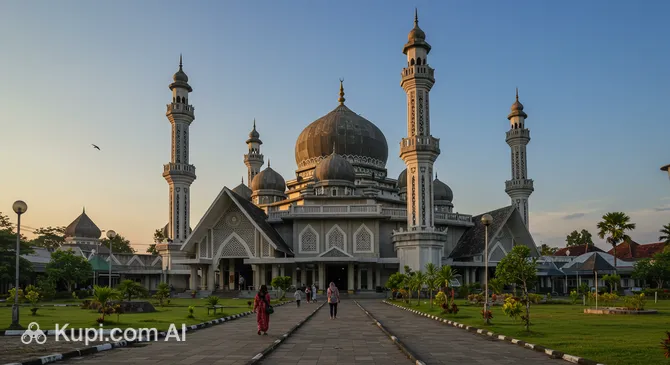
Jamik Mosque of Bengkulu
Jamik Mosque of Bengkulu. Иллюстрация. Источник: Kupi.com AI

This historical monument in the city of Bengkulu is often called the "Bung Karno Mosque" in honor of the country's first president, who participated in its design during his exile. Inside the central prayer hall, you will see magnificent carvings with verses from the Quran and an elegant Istanbul-style minbar with aluminum domes.

Today, the mosque is an official cultural heritage site. It impresses not only with its grandeur but also with the harmony of its yellow ornaments and structured forms. It is more than just a place for prayer; it is a living testament to the rich cultural exchange and the skill of Indonesian architects.

Contacts

For your convenience, we have compiled the main contact details of the attraction in the table below. This will help you find your way on-site more quickly.

How to contactContact
Address6756+3X2, Jl. Letjend Suprapto, Tengah Padang, Kec. Ratu Samban, Kota Bengkulu, Bengkulu 38222, Indonesia

What to Do

The main reason to visit the Jamik Mosque is to examine its unusual architecture in detail. Be sure to notice the high ceilings and calligraphic inscriptions on the doorways. Every interior detail, from the carved pillars to the stone minbar, carries the spirit of bygone eras and the skill of local artisans.

For photographers, there is an excellent view of the Ottoman-style minaret and the characteristic curves of the roof. Inside, an atmosphere of tranquility and meditation prevails, allowing you to briefly escape the city noise and immerse yourself in the local culture. Even if you are not Muslim, you can still tour the building, provided you maintain silence and follow a respectful dress code.

A visit to the mosque is often combined with a tour of the historical quarter. After your visit, you can walk to the nearby Sukarno's exile house to complete your knowledge of Indonesian history and the mosque's role in the life of the city.

Getting There

Reaching this landmark is easy, as it is located in the heart of Bengkulu. If you arrive by plane at Fatmawati Soekarno Airport, a ride by taxi or online ride-hailing services (such as Grab or GoJek) will take about 20–30 minutes, covering a distance of approximately 15–20 km.

For getting around the city, you can use local public transport—the colorful angkot minibuses, whose routes pass through the busy Jl. Letjend Suprapto. The mosque building is clearly visible from a distance, making it almost impossible to miss.

Many tourists prefer to get here on rented motorbikes, which allows them to avoid traffic and easily find a parking spot. A visit to the mosque can also be conveniently combined with a walk to other historical sites, such as Fort Marlborough, which is only a couple of kilometers away.

Ближайший город: Bengkulu

History & Facts

The history of this site dates back to the early 18th century when it was known as Surau Lamo. Initially, the building was entirely wooden with a palm-leaf roof and was located in a different area. Due to the threat of flooding, the mosque was moved to its current location, where it eventually became a true symbol of the region.

The most interesting chapter in the mosque's history is linked to the period of 1938–1942. During this time, the future first president of Indonesia—engineer Sukarno—was in exile in Bengkulu. He personally had a hand in designing the reconstruction of the old prayer house. Sukarno managed to find a compromise with the conservative elders, preserving the foundation of the building while adding modern elements: solid walls, a new floor, and a majestic minbar.

Since then, the building has undergone several renovations but has retained its unique appearance. In 2004, the Ministry of Education and Culture officially recognized the mosque as a cultural heritage site. Since 2010, the law strictly prohibits any significant changes to the architecture to preserve the authentic heritage created by the great politician and architect.

Time Needed

To take a leisurely look at the mosque's architecture and feel its peaceful atmosphere, 30 to 60 minutes is usually enough. This time is sufficient for an external viewing of the multi-tiered roof, examining the carved columns inside, and taking a few memorable photos.

If you are interested in historical details or plan to offer a prayer, set aside a little over an hour for your visit. The mosque is centrally located, making it convenient to fit into a short break between walks to nearby historical sites in the city.

Working Hours

The doors of the Jamik Mosque in Bengkulu are open to believers and visitors 24 hours a day, seven days a week. You can visit at any time that suits you, whether it's early morning or late evening.

Please note that as a place of worship, the mosque follows a daily prayer schedule. During these times, tourists are encouraged to maintain silence and refrain from using flash photography so as not to disturb the worshipers.

Круглосуточно

Nearby

The mosque is situated in a historically rich area, so a visit here can easily be turned into a full sightseeing route. Walking around the neighborhood will allow you to dive deeper into the atmosphere of Bengkulu and see the city from different perspectives—from monuments to heroes to quiet park areas.

Many interesting places are within walking distance or a few minutes' drive. The table below lists the nearest attractions worth visiting:

NameDistance
Mega Mall Bengkulu0.5 km
House of Fatmawati Soekarno0.7 km
Soekarno's Exile House0.8 km
Berkas Beach Park1.1 km
Fort Marlborough1.3 km
Tapak Paderi Beach1.3 km
View Tower1.3 km

Reached the end of the page?

That means the route is fully explored