Support

Pagoda Pulo Kemaro

About

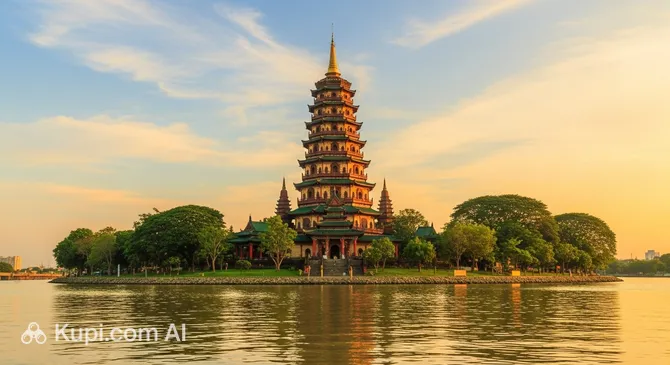
The Kemaro Island Pagoda is an impressive nine-story structure built in the classic Chinese architectural style. Located in the middle of the wide Musi River in the city of Palembang, this bright red tower serves as a spiritual and cultural symbol of the region. It is part of the Hok Tjing Rio temple complex, which harmoniously blends the traditions of Buddhism, Taoism, and Confucianism.
\n\n

Kemaro Island Pagoda
Kemaro Island Pagoda. Иллюстрация. Источник: Kupi.com AI

\n\n

This architectural gem, which enriches Indonesia, was finalized in 2006, becoming the dominant feature of the small island. Surrounded by lush tropical greenery, the pagoda stands in sharp contrast to the river landscapes, creating a strikingly picturesque view, especially when seen from the water. The island's name itself comes from a local word meaning "dry", as even during river swells, this piece of land remains above the water's surface.

\n\n

Today, the Kemaro Island Pagoda is not only an active place of worship but also a popular destination for spiritual tourism. Visitors are drawn here by the harmonious combination of vibrant Chinese gates, elegant statues, and an authentic atmosphere that offers a temporary escape from the bustle of the noisy metropolis.

Contacts

To clarify trip details or organize a group visit, you can use the following contact information:

\n\n
How to contactContact
Address1 Ilir, Ilir Timur II, Palembang City, South Sumatra 30119, Индонезия
Phone+62 812-1830-8938
Websitewa.me

What to Do

The highlight of your visit will be climbing the nine-story pagoda. From its upper tiers, you can enjoy magnificent panoramic views of the Musi River, passing boats, and the distant silhouette of the Ampera Bridge. It is an ideal spot for those wanting to see the city's industrial and natural landscapes from a bird's-eye view.

\n\n

Photography enthusiasts should definitely take a stroll through the grounds of the Hok Tjing Rio temple. Here, you can capture stunning shots against the backdrop of massive carved Chinese gates and find charming panda statues scattered throughout the garden. Inside the temple buildings, you can observe traditional rituals, take in the scent of burning incense, and examine the intricately crafted altars.

\n\n

If your trip coincides with the Cap Go Meh festival (marking the end of Chinese New Year celebrations), you will find yourself at the heart of the cultural action. The island transforms: thousands of red lanterns, festive processions, and food courts offering local delicacies create a unique atmosphere. On ordinary days, it is pleasant to simply relax, enjoy a fresh coconut by the riverbank, and soak in the calm rhythm of the island community.

Getting There

This unique location is accessible exclusively by water, which adds a special charm to the trip. The primary route is via the Musi River: you will need to rent a boat at one of the city's piers, such as the riverfront or the Pusri area. The motorboat ride takes between 10 and 20 minutes, during which you can enjoy the river panorama and the famous Ampera Bridge.

\n\n

For navigation to the nearest piers, use the address: 1 Ilir, Ilir Timur II, Palembang City, South Sumatra 30119. On regular days, boats operate on a charter basis, and it is advisable to agree on the price in advance. However, during the Cap Go Meh festival, free ferries run between the city and the island, organized for the convenience of numerous pilgrims and tourists.

\n\n

The island's landing points are well-equipped with concrete piers, making disembarkation comfortable. Once you arrive, the area is explored on foot. It is recommended to plan your trip for the morning hours, before the heat reaches its peak and while the lighting is perfect for taking vibrant photos.

Ближайший город: Palembang

History & Facts

Kemaro Island has a storied past. During the era of the Palembang Sultanate (from the 16th to the 19th century), it served as an important strategic outpost and fortress, protecting the city from maritime approaches. Historians note the island's role in major defensive efforts against Dutch colonial forces in 1659 and 1819.

\n\n

Following the era of the sultanate, the island remained largely uninhabited for a long period until spiritual life began to see a revival in the mid-20th century. The first wooden pagoda appeared in 1947, and the modern Hok Tjing Rio temple complex was established in 1962. The majestic nine-story pagoda seen today was completed in 2006, becoming the island's central architectural landmark.

\n\n

A special place in the island's history is held by the romantic legend of the tragic love between the Chinese prince Tan Bun An and the local princess Siti Fatimah. According to tradition, their fate is inextricably linked to the emergence of this land, the name of which comes from the word “kemarau” (dry), as the island is never flooded by the waters of the Musi River.

Time Needed

For a standard tour of the attraction, 1–2 hours is sufficient for most travelers. This allows enough time for the boat trip to the island, exploring the main pagoda, visiting the surrounding temples, and taking photos at the statues and gates.

\n\n

If your visit coincides with major festivals such as Cap Go Meh, it is worth setting aside 2–3 hours or even more. During holidays, the island fills with thousands of people, and there are ritual ceremonies and fairs, which require extra time for moving around and soaking in the atmosphere.

Working Hours

The attraction is open to visitors throughout the week, except for Sundays. Opening hours: Monday to Saturday — from 09:00 to 17:00. The complex is closed to tourists on Sundays.

\n\n

Please note that during major religious holidays, the operating schedule may change. It is recommended to check for updated information on official resources or with local boat operators at the pier before your trip.

DayWorking hours
понедельник09:00–17:00
вторник09:00–17:00
среда09:00–17:00
четверг09:00–17:00
пятница09:00–17:00
суббота09:00–17:00
воскресеньеЗакрыто

Nearby

A visit to Kemaro Island can be complemented by exploring other interesting locations nearby. The Musi River is the city's main transport artery, and along its banks are many sites that offer a deeper look into the life and culture of the local people.

\n\n
NameDistance
Pusri Deer Park1.8 km
Lawang Kidul Mosque4.2 km
Hadrami Village Al Munawar4.5 km
Jakabaring Sport City Lake for Water Skiing4.7 km
Jakabaring Fountain5.6 km
Sultan Mahmud Badaruddin II Museum5.9 km
Palembang Fountain Circle5.9 km

Reached the end of the page?

That means the route is fully explored