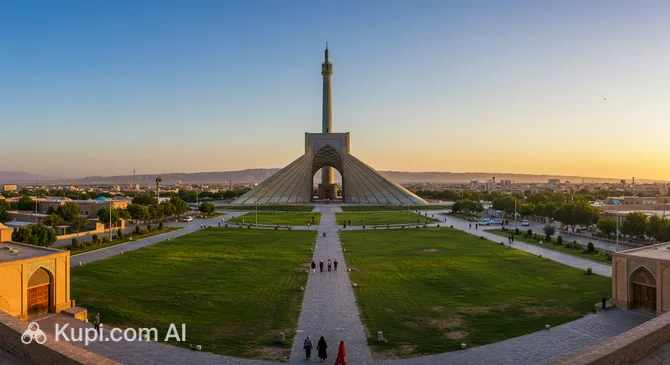
Gonbad-e Kavus is a fascinating cultural and historical center located in the northern part of Iran, in the Golestan province. The city lies at the foot of the Kopet Dag mountain range and is famous for its unique atmosphere, where Persian and Turkmen traditions harmoniously intertwine. With a population of about 152,000 people, it serves as an important link between the Caspian Sea and the central regions of the country.
The city's geographical position in a fertile valley makes its surroundings incredibly picturesque. Here, the pace of life is calmer than in major metropolises, and the hospitality of the locals allows you to experience true oriental comfort. One of the main reasons to visit this place is its rich historical heritage, symbolized by the famous brick tower, visible from almost any point in the city.
Gonbad-e Kavus. Illustration.
Source: Kupi.com AI
Gonbad-e Kavus attracts tourists not only with its monuments but also with its vibrant bazaars, where you can get acquainted with the lifestyle of ethnic Turkmens and taste the region's unique products. It is a city that invites leisurely exploration of architecture, walks through green parks, and immersion into the authentic culture of northern Iran.
Weather Overview
The climate in Gonbad-e Kavus is continental in nature with clearly defined seasonality. Summers here are usually hot and dry: in July and August, the average maximum reaches +35°C...36°C, and rain is very rare at this time. If you plan a visit during this period, be prepared for the scorching sun and low humidity.
Winters in the city are cool and dry. In January and February, daytime temperatures fluctuate around +13°C...15°C, but at night they can drop to +2°C and below. Precipitation occurs mainly in the winter and spring months, but the total amount is small, making walks comfortable provided you have warm clothing.
The most favorable time to visit is considered to be April, May, as well as October and November, when the air temperature stays at a pleasant +19°C...25°C. To plan your wardrobe more accurately, check the current weather forecast for the city before your flight, as spring rains can be sudden.
Average monthly temperature
Average monthly precipitation
Interesting Facts
The city's name translates as "The Dome of Qabus," in honor of the legendary ruler and poet Qabus ibn Vashmgir, who built the famous tower-mausoleum.
The Gonbad-e Qabus Tower was designed so precisely that for a thousand years it has remained virtually undamaged by earthquakes, despite the lack of a deep foundation in the modern sense.
The city is the unofficial capital of Iranian Turkmens, which is reflected in the architecture, language, and the world-famous art of Turkmen carpet weaving.
Gonbad-e Kavus is located in one of Iran's most fertile regions, famous for its cotton and cereal crops, which is why it is often called the "breadbasket" of the north.
The local hippodrome is considered one of the best in the country, as horse breeding and horse racing are an essential part of the local residents' cultural code.
How to Get There
Gonbad-e Kavus is an important transport hub in northern Iran, though getting here directly from abroad can be challenging. Most travelers prefer to use combined routes via Tehran or Gorgan. Detailed information on how to get to the city will help you plan your trip as efficiently as possible.
For air travelers, the nearest major aviation hub is Gorgan Airport, which receives regular flights from the capital. Gonbad-e Kavus itself has a small airfield, but it mainly serves domestic or special flights. From Gorgan to the city center, you can take a taxi or a regular bus, which takes about 1.5–2 hours.
Railway communication in this region is moderately developed. The nearest stations are in neighboring cities, from where fixed-route taxis (savari) and buses run to Gonbad-e Kavus. The road network here is in good condition, making bus trips from Mashhad or Tehran a popular and budget-friendly option for tourists.
Station
Passenger traffic
Distance
Gorgan Railway Station
3
80 km
Sari Railway Station
2
203 km
Gyzylarbat
—
215 km
Ashgabat railway station
8
295 km
Main Attractions
The main and absolute jewel of the city is the Gonbad-e Qabus Tower. This magnificent 12th-century structure is considered one of the tallest brick towers in the world and is included in the UNESCO World Heritage List. Built as a mausoleum for the ruler Qabus ibn Vashmgir, it impresses with its strict geometry and the engineering perfection of ancient masters.
In addition to the famous tower, tourists should visit the local central bazaar. It is not just a place for shopping, but a living ethnographic museum where you can see traditional costumes and handmade crafts. Also worthy of attention are the ruins of the ancient city of Jorjan, located nearby, which preserve traces of the region's former greatness during the pre-Mongol period.
Nature lovers will find the surroundings of the Kopet Dag mountains interesting. There are hiking trails here that offer views of the fertile plains and foothills. The combination of austere historical monuments and soft natural landscapes makes Gonbad-e Kavus a must-visit point on any itinerary through northern Iran.
Local Cuisine
The gastronomy of Gonbad-e Kavus is a vibrant mix of Iranian and Central Asian culinary traditions. The menu is based on dishes made of lamb, rice, and fresh vegetables. You should definitely try Chelow kebab—tender meat served with aromatic rice—and the local variation of pilaf, which features a special set of spices characteristic of the Golestan province.
A unique feature of the region is Turkmen dishes, such as Borek (pastries with meat or herbs) and thick soups based on homemade yogurt and legumes. For dessert, it is customary to serve sweets with honey and local nuts, which pair perfectly with strong black tea served in small glass cups called armudu.
Food culture in the city is centered around the markets and central squares. At the bazaar, you can find many street food stalls where fresh flatbreads are prepared right in a tandoor. Locals often eat in traditional restaurants where, instead of tables, they may offer takhts—low wooden platforms covered with carpets, creating the unique atmosphere of an oriental feast.
Travel Tips
Preparing for a trip to Gonbad-e Kavus requires considering several important nuances that will make your journey comfortable and pleasant. Use these practical tips for a better acquaintance with the city.
Clothing and dress code: Strict dress code rules apply in Iran: women must wear a headscarf and clothing that covers their arms and legs to the ankles; men are not recommended to wear shorts. Choose natural fabrics, as it can be very hot here in the summer.
Best time to visit: Plan your trip for spring (March–May) or autumn (September–November). During these periods, the weather is most favorable for walking, whereas summer can be exhaustively hot, and winter is quite dry and cold.
Finance: Be sure to bring cash currency (Euros or Dollars) and exchange it at official exchange offices (sarafi). International Visa and Mastercard cards do not work in Iran.
Connectivity: Buy a local SIM card (e.g., Irancell) immediately upon arrival at the airport or at specialized stores in the city. Wi-Fi is available in many hotels, but its speed can be unstable.
Transport: It is most convenient to get around the city by taxi. To call a car, you can use a local app (e.g., Snapp) if you have an Iranian SIM card.
Etiquette and communication: Local residents are very friendly. Learn a few phrases in Persian (for example, "Salam" — hello, "Merci" — thank you); this always evokes sympathy. Remember the concept of "Taarof" — a complex system of politeness where you might be offered something for free several times before you are actually expected to pay.
What to avoid: Do not take photos of government buildings and military facilities. Also, refrain from public displays of affection, as this is not customary in local society.
Drinking water: It is recommended to drink only bottled water, which is sold everywhere.
Gonbad-e Kavus will leave you with the warmest memories if you show respect for local traditions and remain open to new experiences.
Entertainment & Nightlife
Entertainment in Gonbad-e Kavus is predominantly calm and contemplative, oriented towards family vacations and cultural leisure. There are no noisy nightclubs or bars due to local traditions, but the city is famous for its chaikhanas (teahouses). These are ideal places to spend an evening in quiet conversation, trying traditional tea with sweets surrounded by local residents.
The center of daytime and evening activity is the park surrounding the Gonbad-e Qabus Tower. City festivals are often held here, and families arrange picnics. Along the main streets, there are cozy cafes and small restaurants where you can enjoy local cuisine in a pleasant setting.
For those seeking cultural enrichment, there are exhibition halls and small galleries in the city showcasing the work of local artisans. Night walks through the illuminated city center are considered safe, and for traveling late at night, it is best to use the services of an official taxi, which can be easily called through a hotel receptionist or by phone.
Parks & Museums
The green heart of the city is Qabus Park, which surrounds the majestic Gonbad-e Qabus Tower. This well-maintained space with shady alleys and relaxation areas is a favorite walking spot for citizens. The park grounds offer the best angles for viewing the brick monument, which looks especially impressive in the rays of the setting sun.
For those interested in history, the local archaeological museum is a must-visit. Despite its modest size, it houses unique artifacts found during excavations of the ancient city of Jorjan. Among the exhibits, you can see exquisite ceramics, ancient coins, and household items that are centuries old.
There are also several nature parks in the city's vicinity offering panoramic views of the Kopet Dag foothills. These recreational areas are popular for family picnics, which are a true national hobby in Iran. The combination of historical significance and natural beauty makes walking through the parks of Gonbad-e Kavus a pleasant and educational pastime.
Getting Around
The public transport system in Gonbad-e Kavus is primarily represented by an extensive network of buses and minibuses. Buses connect the main residential areas with the city center and the market square. The fare is very inexpensive, and payment is usually made in cash to the driver or through special terminals at some stops.
The most popular way to get around for both tourists and locals is by taxi. Both traditional city services and "savari"—shared taxis that follow specific routes—operate here. This is a convenient and fast way to reach any point in the city or nearby settlements for a fixed and very affordable fee.
For those who prefer active recreation, the center of Gonbad-e Kavus is quite suitable for walking, as the main attractions are located compactly. Bicycle rental is poorly developed in the city, so it is better to rely on a car for long-distance travel. If you plan to take a taxi, it is always useful to have your hotel address written in Persian to facilitate communication with the driver.
Accommodation
Accommodation options in Gonbad-e Kavus consist mainly of mid-range hotels and traditional guesthouses. Most hotels are concentrated in the central part of the city, within walking distance of the Gonbad-e Qabus Tower, which is extremely convenient for tourists wishing to see the main attraction at different times of day.
For those who want to dive deeper into the local flavor, we recommend looking at ethno-hotels or small family-run pensions. They often offer homemade breakfasts and room decor in a traditional Turkmen or Persian style. Accommodation prices here are quite affordable, especially compared to Iran's major tourist centers.
During peak tourist seasons—spring and early autumn—it is recommended to book rooms in advance, as the city is also popular among Iranians themselves. Most local hotels are not listed on global Western booking services, so it is worth using regional platforms or booking accommodation through specialized agencies.
Nearby Cities
Gonbad-e Kavus serves as an excellent starting point for exploring the picturesque Golestan province, offering travelers many interesting destinations within an hour's drive. Proximity to mountains and protected forests makes this region ideal for one-day nature trips or visits to neighboring authentic towns.
Just 18 kilometers away is Minudasht—a city surrounded by dense forests and hills, often called the gateway to the northern woodlands. It is also worth visiting Azadshahr, known for its gardens and mild microclimate. These small towns allow you to see Iranian provincial life without the hustle and bustle, while enjoying the silence and fresh mountain air.
City
Population
Distance
Minudasht
30 085
18 km
Azadshahr
43 760
18 km
Galikesh
23 394
23 km
Khan Bebin
10 878
31 km
Kalaleh
36 176
32 km
Traveling around the surroundings is convenient by rented car or by using the services of local taxi drivers. Each of these directions will complement your idea of Iran, revealing the country from a new, greener, and cooler side.
Shopping & Souvenirs
Shopping in Gonbad-e Kavus is, above all, a journey into the world of traditional crafts. The main shopping destination is the Central Bazaar, where the atmosphere of the old East prevails. Here you can find the famous Turkmen carpets with their characteristic dark red patterns, which are considered among the best in quality and durability in Iran.
In addition to carpets, you should bring home local ceramics, hand-embroidered fabrics, and traditional Turkmen headwear from the city. In the food rows of the bazaar, tourists are drawn to stalls with spices, dried fruits, and mountains of select pistachios and walnuts, for which the Golestan region is famous.
Shops in the city usually operate from morning until late evening with a lunch break during the hottest hours. Payment is made in cash in Iranian Rials, as international bank cards are rarely accepted. Don't forget that polite bargaining is appropriate at the bazaar—it is not only a way to save money but also an important part of the local culture of communication.