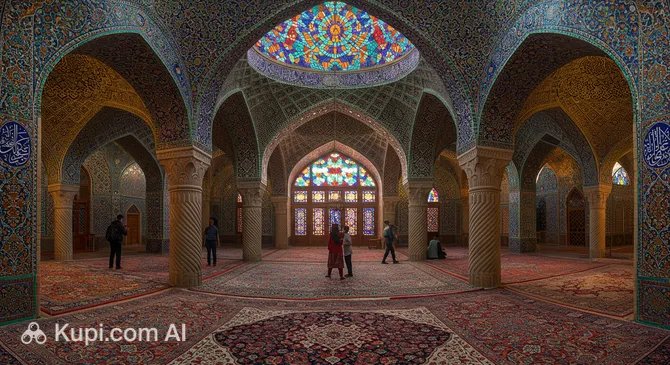
Imagine a building that turns into a giant kaleidoscope at dawn. Nasir al-Mulk Mosque is one of the most photogenic and recognizable shrines hidden within ancient Shiraz. This architectural masterpiece is a unique blend of traditional Persian canons and an incredible color palette, earning it the nickname the "Pink Mosque."
Nasir al-Mulk Mosque. Illustration.
Source: Kupi.com AI
Traveler photos:
Located in the historical center of Iran, the mosque captures the imagination both inside and out. It is famous for its stained-glass windows, which flood the hall with rainbow light in the morning hours, creating an atmosphere of magic and serenity. Intricate mosaics, elegant stone carvings, and an abundance of floral patterns make it a must-see for every tourist.
It is more than just a religious building; it is a true monument of the Qajar era, where every brick and piece of glass tells the story of refined Persian art. The mosque is situated close to other significant city sites, serving as the heart of the old quarter's cultural life.
Contacts
For your convenience, the main contact details for Nasir al-Mulk Mosque are provided below. Its location in the historical quarter makes it easy to find while walking through the city center.
The main experience people come to Nasir al-Mulk for is the morning light show. Try to arrive as early as possible to catch the moment when the first rays of sun pass through the multi-colored stained glass, "painting" the Persian carpets and carved columns in fantastic colors.
Inside the mosque, it's worth taking time to examine the traditional "panj kase" (five colors) tiles, dominated by pink and yellow hues. By looking at the detailed mosaics and floral ornaments on the walls, you can connect with the history of Shiraz. For photographers, there is endless creative space here: the play of light and shadow creates unique shots that cannot be replicated at any other time of day.
Also, be sure to visit the courtyard with its rectangular pool, which reflects the building's facade. It is the perfect spot to pause for a moment and enjoy the silence and harmony of classical Persian architecture.
Getting There
Nasir al-Mulk Mosque is located on Lotf Ali Khan Zand Street, in the heart of the historical district, making it easily accessible for travelers. If your hotel is in the central part of the city, walking to the mosque will be a pleasant addition to your itinerary.
For those who prefer comfort, the most convenient way to get there is by taxi—which is relatively inexpensive in Shiraz. You can also use the metro: the nearest station is "Zandiyeh," from which it is about a 15–20 minute walk to the attraction through colorful neighborhoods.
Thanks to its prime location, a visit to the "Pink Mosque" is often combined with a visit to the Shah Cheragh Mausoleum and a walk through the famous Vakil Bazaar, both of which are within walking distance.
Nearest city: Shiraz
History & Facts
Construction of this masterpiece of Persian architecture began in 1877 and lasted over ten years, finishing in 1888. It was commissioned by Mirza Hasan Ali Nasir ol-Molk, who served as Minister of Finance and belonged to the influential Qajar dynasty.
Building the mosque held a deeply personal meaning for the patron: he decided to immortalize the memory of his father, Ali Akbar Qavam al-Molk. The project was led by the prominent masters of the time—architects Mirza Mohammad Hossein-Memar and Mohammad Reza Kashi-Paz-e-Shirazi, whose skill is evident in every decorative detail.
Interestingly, Nasir al-Mulk is one of the few mosques where pink tiles were used extensively on the facades and interior walls, which is atypical for traditional Islamic architecture. In 1966, the site was officially recognized as a national treasure and included in the country's historical heritage list.
Time Needed
To leisurely explore all the halls and the courtyard of the mosque, you usually need 1 to 2 hours. Most visitors spend the bulk of their time admiring the incredible play of light in the winter prayer hall, where every corner looks like a work of art.
If you are interested in art photography, we recommend allowing a bit more time, as the lighting changes every minute, creating new whimsical patterns on the carpets and columns. In any case, this is a place that shouldn't be rushed.
Working Hours
The mosque welcomes visitors daily, seven days a week. The schedule is consistent throughout the week: from 8:00 to 17:00.
Keep in mind that the most impressive visual effect from the stained glass is observed during the morning hours (usually until 10:00–11:00), so it's worth planning your visit for the very opening to see the light's magic in all its glory.
8:00 – 17:00
Nearby
Exploring the area around the mosque allows you to dive deeper into the city's atmosphere and see not only historical monuments but also leisure spots for locals. The surrounding neighborhood is full of contrasts, where ancient streets lead to green zones and modern entertainment centers.
If you want a change of scenery and some time in a park after visiting the mosque, consider the following nearby spots: