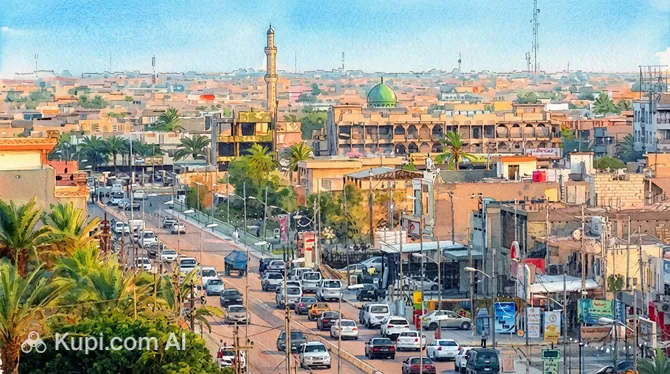
Located in the picturesque Euphrates River valley, Fallujah is one of the most significant settlements in the Anbar Province of Iraq. This city, situated approximately 57 kilometers west of Baghdad, is steeped in the atmosphere of the traditional Arab East. With a population of over 326,000, it serves as an important administrative and residential center for the region, where life flows to the rhythm of the ancient river.
The city's geographic location on the right bank of the Euphrates has largely defined its way of life. Fallujah is surrounded by fertile lands, making it a vital hub for agricultural activity. Travelers who come here can discover the rich history of the region, which dates back to antiquity when these lands were part of the great Mesopotamian civilizations.
Fallujah. Illustration.
Source: Kupi.com AI
One of the city's unique features is its dense, low-rise architecture and an abundance of mosques, which is why it is sometimes referred to as the "City of Mosques." While Fallujah is not a classic tourist destination with a developed entertainment infrastructure, it attracts those who want to see the authentic, unvarnished life of modern Iraq, stroll through vibrant oriental markets, and experience the hospitality of local communities.
Visiting this city is an opportunity to connect with the authentic culture of the country's Sunni region. We recommend Fallujah as an interesting stop while exploring the Euphrates Valley, where you can enjoy views of the great river and immerse yourself in the daily life of provincial Iraq.
Weather Overview
Fallujah features a typical desert climate (BWh according to the Köppen classification), which means sharp seasonal temperature fluctuations and minimal rainfall. Summers here are long and extremely hot: in July and August, the mercury often rises to +45°C and even +50°C. During this period, the air becomes very dry, and the sky remains piercingly clear.
In contrast, winter in the city is very mild and comfortable. In January, the average daytime temperature is about +16°C...+17°C, dropping to +7°C at night. Most of the annual precipitation falls during the winter months, although rain is rare—averaging no more than 4–5 wet days per month. Spring and autumn are transitional periods when the city's climate becomes most favorable for visiting.
An important feature of the region is the dust and sandstorms, which most often occur in late spring and early summer. They can temporarily reduce visibility and air quality. Travelers are recommended to plan their visit during the cool season—from November to March—when the weather is conducive to walking along the Euphrates and exploring local markets without the grueling heat.
Average monthly temperature
Average monthly precipitation
Interesting Facts
Fallujah is located on the right bank of the Euphrates River, which has served as the cradle of Mesopotamian civilizations for millennia.
In 1941, an important historical event took place in the vicinity of the city—a battle between British forces and the forces of Rashid Ali al-Gaylani's government.
The city is known for its unique architectural appearance, earning it the unofficial nickname "City of Mosques" due to the vast number of religious structures within the city limits and its surroundings.
The name of the city in the local dialect is pronounced as [el.fɐl.ˈluː.dʒɐ], which is important to keep in mind when communicating with residents for better understanding.
Fallujah is considered one of the largest and most significant settlements in the Anbar Province, serving as a vital trade hub between Baghdad and the country's western borders.
How to Get There
Fallujah is an important transport hub in the western part of the country; however, there is no direct air or rail service. Road transport remains the primary way to reach the city. The city is conveniently located just 57 kilometers from the capital, and you can find more details about the transport accessibility of the city in the region's official logistics guides.
A journey from Baghdad by car typically takes between 1 and 1.5 hours. The main route follows the highway leading toward the Anbar Province. It is worth noting that travel time can increase significantly due to traffic at checkpoints and heavy truck traffic. For international visitors, the most reliable option is to use a private transfer or a licensed taxi.
The nearest international aviation hub is Baghdad International Airport (IATA: BGW), which hosts flights from many international airlines. Upon arrival at the airport, tourists will need to take a taxi or an intercity bus to reach Fallujah. There are currently no direct trains to the city, as the rail infrastructure in this area requires restoration.
Public transport consists mainly of shared taxis and small buses that run regularly between Fallujah, Baghdad, and Ramadi. Bus stations are located in the central part of the city, making it easy to reach the main markets and residential areas by local taxi.
Station
Passenger traffic
Distance
Baghdad railway station
10
56 km
Main Attractions
In Fallujah, you won't find the amusement parks or massive museums typical for Western tourists; however, the city itself serves as a living monument to local culture and traditions. The primary natural and visual landmark is the majestic Euphrates River. A stroll along its banks offers a unique perspective of the city, allowing you to watch local fishermen and enjoy the cool breeze that the water brings on hot days.
The local markets (souks), located in the heart of the city, are a magnet for any visitor. Here, among the narrow streets, authentic life thrives: vendors offer fresh produce, fabrics, and handicrafts. This is the best place to feel the spirit of the city, hear the local dialect, and witness the daily life of Anbar Province residents. The central squares near the markets often serve as gathering spots for socializing.
The architectural character of Fallujah is shaped by its numerous mosques, with their distinctive minarets and domes. Although most of them are active religious sites oriented towards the local community, they lend the urban landscape a unique charm. Administrative buildings and bridges across the Euphrates complete the picture of this important regional center, turning an ordinary walk into a fascinating exploration of the Iraqi urban environment.
Local Cuisine
The gastronomic scene in Fallujah is a celebration of traditional Mesopotamian flavors. The local cuisine is based on fresh products from the Euphrates Valley and is characterized by hearty, aromatic dishes. The main favorite here is Kabsa—an exquisite rice dish with tender lamb or chicken, generously seasoned with a blend of oriental spices, raisins, and nuts.
While walking along the central streets, it is impossible to pass by the numerous grill cafes preparing the famous Iraqi kebabs and kofta over an open fire. Be sure to try Samoon—traditional Iraqi diamond-shaped bread baked in stone ovens and served hot with almost any meal. Also popular are dishes like Mansaf (meat in a dry yogurt sauce) and fresh hummus with olive oil.
The beverage culture in Fallujah centers on strong black tea, which is served here with plenty of sugar in small glass cups (istikan). Arabic coffee, with its characteristic aroma of cardamom, also holds an important place in local etiquette. Alcohol is not served in public establishments, in accordance with local traditions and norms. The best places to explore the food are small family restaurants and eateries in local markets, where you can always find fresh products and authentic tastes.
Travel Tips
Visiting Fallujah is a unique experience of immersion into authentic Iraq, and to make your trip comfortable and safe, we have prepared some practical tips.
Clothing and Dress Code: Choose modest and covered clothing that respects local traditions. For women, it is advisable to carry a headscarf when visiting religious quarters. Clothing made of natural fabrics (linen, cotton) will help you tolerate the heat more easily.
City Transport: Taxis are the optimal choice. Always agree on the fare with the driver in advance. Keep in mind that traffic jams and road checks may increase travel time.
Finances: The main currency is the Iraqi Dinar. Cards are rarely accepted, so always carry a sufficient supply of cash. It is better to exchange money at major banks in Baghdad before traveling to the province.
Health: Drink only bottled water and avoid ice in drinks. During the summer, be sure to use sunscreen and wear a hat to avoid heatstroke.
Communication: For navigation and communication, it is best to buy a local SIM card (Asiacell or Zain) immediately upon arrival in the country. Wi-Fi is available in some cafes in the center, but mobile internet is more reliable.
Local Etiquette: Greet people with the phrase "Salam Alaikum." Using the right hand for eating and passing objects is considered a sign of politeness.
What to Avoid: Do not take photographs of military objects, checkpoints, or administrative buildings without official permission. It is also advisable to refrain from walking on the outskirts after dark.
Best Time to Visit: Plan your trip for the period from October to April, when the extreme heat subsides and pleasant warm weather sets in.
May your journey to Fallujah be filled with interesting discoveries and warm encounters in this hospitable corner of Iraq!
Entertainment & Nightlife
The entertainment scene in Fallujah is conservative and tranquil, reflecting the traditional way of life of the local society. You won't find noisy nightclubs or bars here, as evening leisure for the townspeople is centered around family and socializing with friends. The main spots for evening relaxation are the numerous tea houses and small cafes located on the central streets and squares.
A leisurely atmosphere prevails in these establishments: men gather over a cup of strong tea or Arabic coffee to discuss news and play board games. For a tourist, visiting such a tea house is an excellent chance to observe the social rituals of the locals. During the day, a popular activity is walking along the banks of the Euphrates, where families often have picnics while enjoying the river views.
If you are looking for more active entertainment, cinemas, or major cultural centers, locals usually head to Baghdad, which is just over an hour's drive away. In Fallujah itself, it's best to focus on the gastronomic pleasures of local restaurants and exploring the colorful markets, which remain lively until sunset.
Parks & Museums
Green spaces in Fallujah are primarily concentrated along the Euphrates shoreline. Although there is a shortage of classic parks with paved paths and benches, the riverbanks serve as a natural recreation area. Locals often come here to enjoy the view of the water, which is especially beautiful during sunset hours. These improvised riverside parks are the heart of the city's outdoor social life.
As for museum exhibitions, there are currently no major historical or art museums in Fallujah itself. The city is more focused on living history and everyday culture. However, history buffs can appreciate the architecture of local mosques, which are themselves reflections of the region's spiritual heritage and the craftsmanship of local builders.
For those wishing to visit classic museums, we recommend day trips to the capital, where the rich collections of the National Museum of Iraq are located. In Fallujah itself, the role of an "open-air museum" is played by the old market quarters, where trade and craft traditions have remained unchanged for many decades. This place is ideal for those seeking authentic experiences rather than museum display cases.
Getting Around
The public transport system in Fallujah is mainly represented by a network of private and state-run buses, as well as shared taxis. These modes of transport connect central districts with the outskirts and neighboring cities in Anbar Province. Traffic is most intense during daylight hours, especially in the morning and evening when residents commute to work and school.
The main and most convenient means of transportation for a tourist is the taxi. Taxis are easy to spot in the general flow and can be hailed with a simple wave of the hand on any busy street. Fares are usually low, but it is worth agreeing on the price beforehand, as meters are rarely used. Within the city, taxis allow you to reach markets or the riverbank quickly, avoiding the wait for public transport.
There are currently no special travel cards or mobile apps for bus payments in the city; payment is made in cash to the driver. It is important to remember that during peak hours, transport can be overcrowded, and delays on the roads are possible due to security checkpoints. Walking through the central part of the city is also a great option, allowing you to observe the architecture and feel the rhythm of life in Fallujah at a relaxed pace.
Accommodation
The hospitality market in Fallujah is primarily geared towards business travelers, transit passengers, and specialists working in the region. You will hardly find any international hotel chains here; instead, there are many small private hotels and guesthouses. Most accommodation options offer basic amenities, ensuring a comfortable stay after your journey.
The central neighborhoods located near the banks of the Euphrates are considered the most convenient areas for staying. This is where the main urban activity, markets, and administrative buildings are concentrated, which helps save time on travel. In these areas, you can find both budget-friendly rooms and apartments for longer stays.
Accommodation prices in Fallujah remain affordable compared to the capital. Nevertheless, tourists are advised to book their stay in advance, especially if visiting during local events. To find and book accommodation, it is best to use specialized local services or contact the properties directly, as international booking systems may not display all available options.
Nearby Cities
Thanks to its location in the central part of the country, Fallujah can serve as an interesting starting point for exploring the surrounding towns and settlements of the Euphrates Valley. The region around the city is rich with small communities, each possessing its own unique provincial charm and traditional way of life.
Just a few kilometers away is Saqlawiyah, a small settlement surrounded by agricultural land. It is also worth visiting the town of Habbaniyah, located 19 kilometers away. It is famous for Lake Habbaniyah, which has historically been a popular vacation spot for residents of the region, offering opportunities for boating and relaxation on the shore.
City
Population
Distance
As Saqlawiyah
25 000
9 km
Al Jubayish
36 100
16 km
Habbaniyah
32 300
19 km
Al Karmah
95 000
20 km
Abu Ghraib
189 000
28 km
For more extensive trips, Ramadi (the administrative center of Anbar Province) and Baghdad are ideal, both located within an hour's drive. These cities offer more developed infrastructure, museums, and large shopping centers, complementing the impressions left by the quiet atmosphere of Fallujah. Exploring the surroundings will allow you to better understand the diversity of the Iraqi province and enjoy the views of Mesopotamian landscapes.
Shopping & Souvenirs
Shopping in Fallujah is primarily an immersion into the atmosphere of a traditional oriental bazaar. The city has no giant glittering malls; instead, it preserves a culture of market trade where every shopping trip becomes a social event. The main shopping areas are concentrated in the city center near the river, where rows of stalls stretch along busy streets.
At the local markets, it is worth paying attention to textiles and fabrics—Iraqi fabrics are famous for their quality and traditional patterns. The city is also an excellent place to buy spices, nuts, and dried fruits brought from nearby farms. If you are looking for souvenirs, look for handmade copperware or traditional Arabic ceramics, which can often be found in artisans' shops.
Shops typically open early in the morning and close at dusk, with many owners taking a break during the hottest midday hours. Payments are mainly made in cash using the local currency (Iraqi Dinars). In small shops, bargaining is not only appropriate but encouraged—it is an integral part of the buying process, allowing you not only to save money but also to strike up a friendly conversation with the seller.