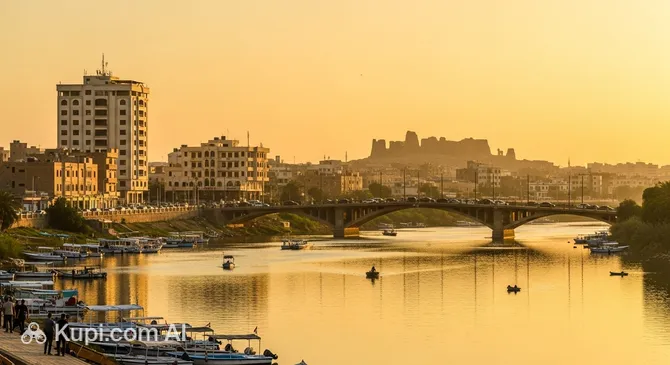
Al-Hillah is the bustling administrative center of the Babil Governorate, located in the heart of Iraq. The city spans the scenic banks of the Euphrates River, approximately 100 kilometers south of Baghdad. With a population of over 540,000, it serves as an important regional hub where the daily life of the modern East intertwines with echoes of a grand past.
Founded in 1101, the city has deep roots, and the history of Al-Hillah is inextricably linked with regional governance and trade. While today it is primarily a residential and administrative center, its atmosphere is steeped in authenticity: dense urban development, traditional markets, and proximity to the river create the unique character of the Iraqi province.
Al Hillah. Illustration.
Source: Kupi.com AI
The main draw for travelers is not the city's architecture itself, but its unique location. Al-Hillah is the closest major settlement to the legendary ruins of ancient Babylon and Borsippa. This makes the city a strategically important point for anyone wishing to touch the origins of human civilization while enjoying the hospitality of the local residents.
We recommend visiting Al-Hillah for those seeking the real, unvarnished life of central Iraq and planning a detailed exploration of the archaeological sites of the Euphrates valley.
Weather Overview
The climate in Al-Hillah is typical for the central plains of Iraq and is characterized as a desert climate. This means travelers should prepare for extremely hot and dry summers, with temperatures in July and August reaching 45–50°C. During this period, precipitation is virtually non-existent, and low humidity is often accompanied by dust storms.
In contrast, winter in the city is quite mild and pleasant. In January, the average temperature is around 13°C, and during the day, the air often warms up to a comfortable 18–20°C. The bulk of the annual precipitation occurs during the winter months and November, although rain remains a relatively rare phenomenon. If you want the weather in Al-Hillah to be as favorable as possible for walking, it is better to plan your visit for the period from November to March.
Spring and autumn here are short but also suitable for tourism. However, one should consider the "urban heat island" effect—the dense buildings and lack of extensive green zones in the city center make the summer heat even more palpable. Expect scorching sun for most of the year and do not forget UV protection.
Average monthly temperature
Average monthly precipitation
Interesting Facts
Al-Hillah is a city with a rich past and a dynamic present, hiding many surprises behind its facades.
Ancient Foundation: The city was founded in 1101 as a fortified outpost on the Euphrates River, making it the historical successor to the region's great civilizations.
Neighbor to a Legend: Al-Hillah is located just 15 miles (about 24 km) north of the ruins of ancient Babylon, one of the most significant cities in human history.
Rapid Growth: The city's population has increased by more than 180% in recent decades, transforming it from a small center into a large metropolis with over half a million residents.
Administrative Heart: The city is the center of the Babil Governorate, with about 78% of its residents living in the urbanized city zone, emphasizing its status as a key regional hub.
How to Get There
Transport accessibility to Al-Hillah is largely tied to its proximity to the capital. The main way to get to Al-Hillah for foreign tourists is by car from Baghdad, which is about 100 kilometers away. The journey usually takes between 1.5 to 3 hours, depending on traffic and road checks.
The city does not have its own airport. Travelers should head for Baghdad International Airport (IATA: BGW), which is the nearest major air hub. From there, Al-Hillah can be reached by taxi or rental car. Driving by private car on the Baghdad–Hillah highway is considered the fastest option, although one should account for possible dust storms during the summer season.
Railway connections in the region are underdeveloped. Although tracks pass through the city, regular passenger trains from Baghdad to Hillah are rare, and the journey itself can take up to 4 hours. Most locals and tourists prefer intercity buses and minibuses, which depart regularly from the capital's stations.
Station
Passenger traffic
Distance
Baghdad railway station
10
94 km
Main Attractions
Although Al-Hillah is a modern administrative center, its main value lies in its unique location. Within a radius of 10–15 kilometers from the city are monuments of global importance, such as the ruins of Babylon, ancient Borsippa, and the remains of the city of Kish. These sites allow tourists to take a journey through time, exploring the foundations of temples and legendary walls that are thousands of years old.
Within the city itself, life is centered around the main squares and the Euphrates embankments. Traditional bazaars are labyrinths of shops where one can feel the rhythm of the local population's life. While there are no large museums here, the architecture of administrative buildings and mosques reflects the functional style of a modern Iraqi city.
For those looking to take a break from walking through historical sites, modern venues are open in the city. For example, you can visit the BDC Mall, which is one of the key points of the city's modern infrastructure. Another popular spot for both locals and visitors to relax is the Chocolate Sarayi Babylon cafe, where you can enjoy sweets in a cozy atmosphere.
Local Cuisine
The gastronomic scene in Al-Hillah offers guests the classic flavors of central Iraq, where spices, fresh meat, and river fish play the leading roles. The basis of the local diet consists of lamb and rice dishes, such as the aromatic kabsa. A special place is held by masgouf — grilled fish caught from the Euphrates, prepared over an open fire in the traditional way.
You can experience regional culinary traditions at establishments like the Sanaa Yemeni Mandi Restaurant, which serves tender meat with spiced rice. The food culture here is closely tied to family traditions and strict adherence to halal standards. Alcohol is completely absent from public establishments in the city, and the main drinks remain strong tea with sugar, Arabic coffee, and refreshing juices.
For those with a sweet tooth or a craving for modern desserts, Chocolate Sarayi Babylon is an excellent spot where European confectionery traditions meet local hospitality. Street food is also popular: at the central markets, be sure to try fresh Iraqi samoon bread, which perfectly complements any local dish.
Travel Tips
A trip to Al-Hillah promises to be rich and authentic, but it requires some preparation. These practical tips will help you feel confident and comfortable during your visit to this Iraqi region.
Clothing and Dress Code: Choose modest clothing made from natural, breathable fabrics. Iraq is a conservative country, so a modest dress code (shoulders and knees covered) is essential for both men and women, especially when visiting mosques or markets. In summer, don't forget sunglasses and a head covering.
Getting Around Town: The best way to move around is by official taxi. Avoid overcrowded minibuses during peak hours. If you plan a trip to Babylon, arrange a waiting period or return trip with the taxi driver in advance.
Finances: The main currency is the Iraqi dinar. Cards are rarely accepted (only in large malls), so always carry a sufficient supply of cash. It is best to exchange money at official exchange offices in the city center.
Health: Drink exclusively bottled water and avoid ice in drinks at street cafes. During the summer months (June–August), temperatures can exceed +45°C, so plan your activities for the early morning or evening.
Communication: The primary language is Arabic. English is not widely spoken, so it is helpful to learn basic phrases or have an offline translator. A local SIM card can be purchased in the city center to ensure stable mobile internet.
Local Etiquette: Greetings are very important—a simple "Salam Alaykum" is enough to start a friendly conversation. Always ask for permission before taking photos of local residents.
What to Avoid: Do not discuss political topics and avoid photographing sensitive government or security installations, as this can cause serious suspicion with security services.
Safety: Try not to visit remote outskirts of the city at night and always have your documents (or copies of them) with you.
Following these simple rules will help you fully enjoy the hospitality of Al-Hillah and make your trip safe and pleasant.
Entertainment & Nightlife
The entertainment industry in Al-Hillah is of a quiet, family-oriented nature, typical of the Iraqi provinces. You won't find noisy nightclubs or bars here, as the city's social life is oriented toward traditional values and early nights. Locals prefer to spend their evenings in numerous tea houses along the banks of the Euphrates or in family cafes.
One popular spot for evening leisure is Chocolate Sarayi Babylon, which serves desserts and drinks in a modern setting. For those who prefer a more substantial dinner, the Sanaa Yemeni Mandi Restaurant is an excellent option. Most activity in the city winds down fairly early, and for larger-scale cultural events, concerts, or cinema screenings, residents often travel to Baghdad.
Daytime entertainment in the city is limited to strolling through markets and visiting shopping complexes like the BDC Mall. In terms of safety, evening walks in the city center are considered quite acceptable, but tourists are advised to stick to well-lit streets and use taxis for travel late at night.
Parks & Museums
The park infrastructure of Al-Hillah is currently under development. In the hot desert climate and dense urban setting, green zones are a true sanctuary for citizens. These are mainly small squares and alleys along the Euphrates River, which serve as the primary spots for relaxation and evening walks for locals.
There are no large museums within the city limits, but this lack is more than compensated for by the proximity to archaeological zones. Museum exhibits dedicated to the region's history are concentrated directly on the territory of ancient Babylon, just a few minutes' drive from Al-Hillah. There, you can see artifacts that are thousands of years old.
For modern leisure and walks in comfortable conditions, residents often choose the grounds of large facilities like the BDC Mall, where air-conditioned spaces replace outdoor parks during the hottest hours. Nevertheless, the banks of the Euphrates remain the most atmospheric place to enjoy the cool air by the water at the end of a long day.
Getting Around
The public transport system in Al-Hillah consists mainly of buses and numerous shared taxis, which locals call "bobils." This is the most affordable way to get around, connecting the center with the outskirts. However, it should be noted that during peak hours (7 to 9 AM and 5 to 7 PM), transport can be very crowded, and congestion often occurs on the city's narrow streets.
For tourists, the most convenient and reliable option for moving around is the taxi. There is no metro or tram in the city, so private carriers replace all forms of high-speed transport. It is better to agree on the fare in advance, as meters are rarely used. A trip within the city usually takes between 10 to 30 minutes.
The central part of the city is quite compact, making it possible to explore the main shopping streets and the Euphrates embankment on foot. This is a great way to feel the rhythm of Al-Hillah's life, though one should be prepared for dust and heavy traffic. Bike rental or car-sharing services are currently unavailable in the city, so taxis remains the primary alternative to walking.
Accommodation
The hotel infrastructure in Al-Hillah is oriented more toward business travelers and pilgrims rather than mass Western tourism. You won't find luxury five-star international chains here, but the choice of accommodation allows for decent options in the mid-range and budget segments.
The most convenient area to stay is the city center, located near the Euphrates River embankment. Most guesthouses and apartments are concentrated here. Staying in this area provides walking access to markets and administrative institutions. The cost of a standard room typically ranges from 20 to 50 USD per night.
For those planning a long stay, renting an apartment is a popular option. It is recommended to book accommodation in advance, especially if your trip coincides with major religious holidays in neighboring Karbala, as the demand for lodging in Al-Hillah increases significantly during these times.
Nearby Cities
Due to its central location, Al-Hillah serves as an excellent starting point for exploring the iconic sites of the region. Its proximity to important religious and historical centers allows for planning interesting day trips and returning to the city by evening.
Just 40 kilometers to the southwest is Karbala — one of the greatest holy cities, attracting millions of pilgrims with the magnificent architecture of its mosques. It is also worth visiting the town of Al-Hindiya, located just 20 kilometers away, to see typical life in the Iraqi countryside on the banks of the Euphrates. For those missing the rhythm of the capital, Baghdad is just a couple of hours' drive to the north.
Exploring the surroundings of Al-Hillah reveals a palette of Iraqi history and culture to the traveler, from the ruins of ancient empires to modern centers of spiritual life. Take the opportunity to visit nearby small towns to fully experience the hospitality of this region.
Shopping & Souvenirs
Shopping in Al-Hillah is primarily an immersion into the atmosphere of traditional Oriental bazaars. The main trading activity is concentrated in the central markets located near the Euphrates. Here you can find everything from aromatic spices and bags of premium rice to vibrant fabrics and household items. This is the best place to feel the city's flavor and practice the art of haggling.
If you prefer a more modern shopping format, you should visit the BDC Mall. It is one of the few venues in the city offering a wide selection of modern clothing and electronics in a comfortable, air-conditioned environment. Shops here usually operate from morning until late evening, with a lunch break during the hottest hours.
As souvenirs from Al-Hillah, it is worth bringing back items made by local artisans, such as handmade carpets or traditional ceramics. Note that small stalls in the markets only accept cash (Iraqi dinars), while shopping malls are gradually beginning to accept international cards, though cash remains the most reliable method of payment.